Department of Molecular, Cellular, and Developmental Biology, University of Colorado, Boulder, Colorado 80309, USA.
Genes Dev. 2019 Jan 1;33(1-2):4-5. doi: 10.1101/gad.322651.118.
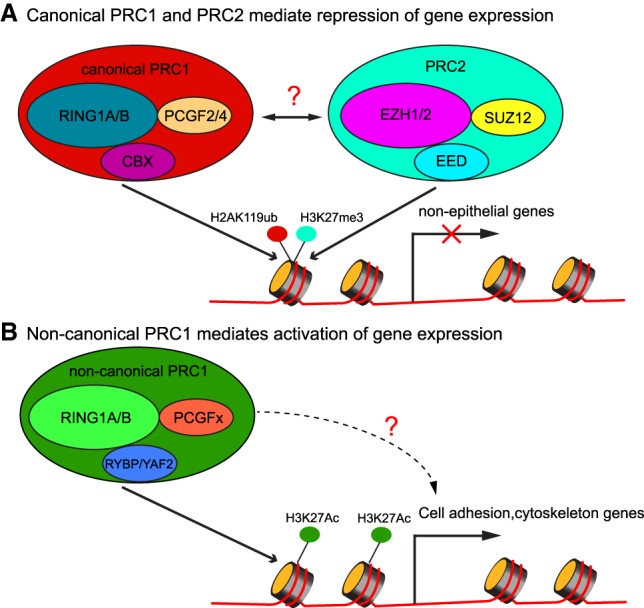
All of the cells in our body share largely identical DNA, yet functionally distinct cells are generated to give rise to different tissues and organs. A fundamental question in biology is how different cell fates are specified and maintained. Epigenetic mechanisms hold a key answer to the question. Without changing the sequence of DNA but through modifying DNA, histones, or RNA, epigenetic mechanisms can decide which genes to express and which to suppress. Polycomb group (PcG) proteins are a group of evolutionarily conserved proteins that can regulate gene expression through histone modification. Although PcG proteins have been traditionally described as epigenetic repressors, emerging evidence suggests a more complex scenario in which PcG proteins can have a dynamic effect on gene expression. In this issue of , Cohen and colleagues (pp. 55-60) studied the function of Polycomb-repressive complex 1 (PRC1) in mouse skin development and identified PRC1's unique function independent of PRC2. Notably, the total loss of PRC1 but not canonical PRC1 in the skin leads to widespread down-regulation of genes involved in cell adhesion and cytoskeleton organization, resulting in skin fragility. This new study lays a foundation to examine the role of PRC1 in activating gene expression.
我们体内所有的细胞都共享着大量基本相同的 DNA,但为了产生不同的组织和器官,功能不同的细胞被生成。生物学中的一个基本问题是如何指定和维持不同的细胞命运。表观遗传机制提供了一个关键的答案。通过修饰 DNA、组蛋白或 RNA,而不改变 DNA 序列,表观遗传机制可以决定哪些基因表达,哪些基因抑制。多梳组(PcG)蛋白是一组进化上保守的蛋白质,它们可以通过组蛋白修饰来调节基因表达。尽管 PcG 蛋白传统上被描述为表观遗传抑制剂,但新出现的证据表明,在这种情况下,PcG 蛋白可以对基因表达产生动态影响。在本期 杂志中,Cohen 及其同事(第 55-60 页)研究了多梳抑制复合物 1(PRC1)在小鼠皮肤发育中的功能,并确定了 PRC1 独立于 PRC2 的独特功能。值得注意的是,皮肤中 PRC1 的完全缺失而不是经典 PRC1 的缺失导致参与细胞黏附和细胞骨架组织的基因广泛下调,导致皮肤脆弱。这项新研究为研究 PRC1 在激活基因表达中的作用奠定了基础。