Alistar Mirela
Atlas Institute and Department of Computer Science, University of Colorado Boulder, Boulder, CO 80309-0320, USA.
Bioengineering (Basel). 2019 Jan 3;6(1):5. doi: 10.3390/bioengineering6010005.
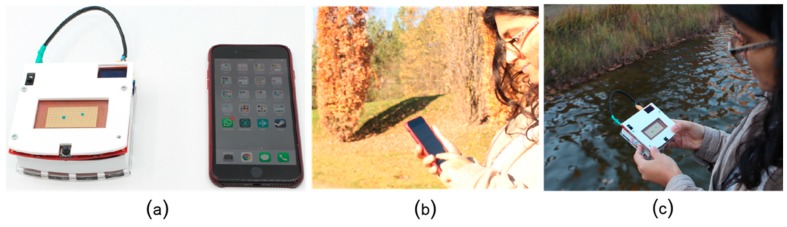
Microfluidics platforms can program small amounts of fluids to execute a bio-protocol, and thus, can automate the work of a technician and also integrate a large part of laboratory equipment. Although most microfluidic systems have considerably reduced the size of a laboratory, they are still benchtop units, of a size comparable to a desktop computer. In this paper, we argue that achieving true mobility in microfluidics would revolutionize the domain by making laboratory services accessible during traveling or even in daily situations, such as sport and outdoor activities. We review the existing efforts to achieve mobility in microfluidics, and we discuss the conditions mobile biochips need to satisfy. In particular, we show how we adapted an existing biochip for mobile use, and we present the results when using it during a train ride. Based on these results and our systematic discussion, we identify the challenges that need to be overcome at technical, usability and social levels. In analogy to the history of computing, we make some predictions on the future of mobile biochips. In our vision, mobile biochips will disrupt how people interact with a wide range of healthcare processes, including medical testing and synthesis of on-demand medicine.
微流控平台可以对少量流体进行编程以执行生物协议,因此,能够使技术人员的工作自动化,还能整合大部分实验室设备。尽管大多数微流控系统已大幅缩小了实验室的规模,但它们仍是台式设备,其尺寸与台式计算机相当。在本文中,我们认为在微流控领域实现真正的移动性将给该领域带来变革,因为这能让人们在旅行期间甚至在日常活动(如运动和户外活动)中都能获得实验室服务。我们回顾了在微流控领域实现移动性的现有努力,并讨论了移动生物芯片需要满足的条件。特别是,我们展示了如何将现有的生物芯片改造为可移动使用的形式,并呈现了在火车上使用它时的结果。基于这些结果和我们的系统讨论,我们确定了在技术、可用性和社会层面需要克服的挑战。类比计算技术的发展历程,我们对移动生物芯片的未来做了一些预测。在我们看来,移动生物芯片将改变人们与广泛的医疗保健流程(包括医学检测和按需药物合成)的交互方式。