Schäffer Andreas, Kästner Matthias, Trapp Stefan
1Institute for Environmental Research, RWTH Aachen University, Worringerweg 1, 52074 Aachen, Germany.
2Department Environmental Biotechnology, Helmholtz Centre for Environmental Research, UFZ, Permoserstraße15, 04318 Leipzig, Germany.
Environ Sci Eur. 2018;30(1):51. doi: 10.1186/s12302-018-0181-x. Epub 2018 Dec 17.
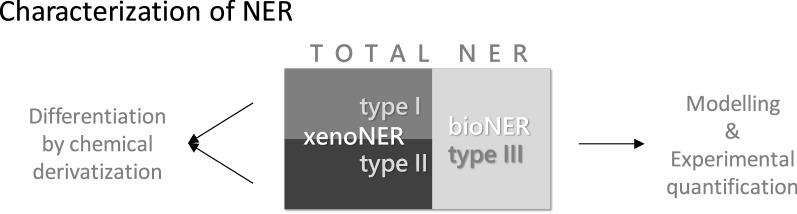
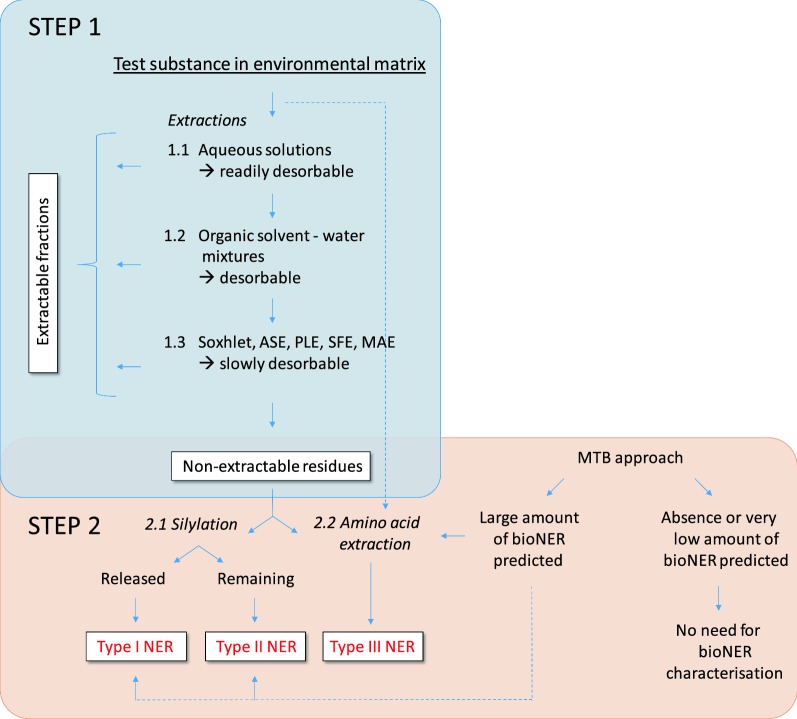
All chemicals form non-extractable residues (NER) to various extents in environmental media like soil, sediment, plants and animals. NER can be quantified in environmental fate studies using isotope-labeled (such as C or C) tracer compounds. Previous NER definitions have led to a mismatch of legislation and state of knowledge in research: the residues are assumed to be either irreversibly bound degradation products or at least parts of these residues can be released. In the latter assumption, soils and sediments are a long-term source of slowly released residues. We here present a conceptual experimental and modeling approach to characterize non-extractable residues and provide guidance how they should be considered in the persistence assessment of chemicals and pesticides. Three types of NER can be experimentally discriminated: sequestered and entrapped residues (type I), containing either the parent substance or xenobiotic transformation products or both and having the potential to be released, which has indeed been observed. Type II NER are residues that are covalently bound to organic matter in soils or sediments or to biological tissue in organisms and that are considered being strongly bound with very low remobilization rates like that of humic matter degradation rates. Type III NER comprises biogenic NER (bioNER) after degradation of the xenobiotic chemical and anabolic formation of natural biomolecules like amino acids and phospholipids, and other biomass compounds. We developed the microbial turnover to biomass (MTB) model to predict the formation of bioNER based on the structural properties of chemicals. Further, we proposed an extraction sequence to obtain a matrix containing only NER. Finally, we summarized experimental methods to distinguish the three NER types. Type I NER and type II NER should be considered as potentially remobilizable residues in persistence assessment but the probability of type II release is much lower than that of type I NER, i.e., type II NER in soil are "operationally spoken" irreversibly bound and can be released only in minute amounts and at very slow rates, if at all. The potential of remobilization can be evaluated by chemical, physical and biological methods. BioNER are of no environmental concern and, therefore, can be assessed as such in persistence assessment. The general concept presented is to consider the total amount of NER minus potential bioNER as the amount of xenoNER, type I + II. If a clear differentiation of type I and type II is possible, for the calculation of half-life type I NER are considered as not degraded parent substance or transformation product(s). On the contrary, type II NER may generally be considered as (at least temporarily) removed. Providing proof for type II NER is the most critical issue in NER assessment and requires additional research. If no characterization and additional information on NER are available, it is recommended to assess the total amount as potentially remobilizable. We propose our unified approach of NER characterization and evaluation to be implemented into the persistence and environmental hazard assessment strategies for REACH chemicals and biocides, human and veterinary pharmaceuticals, and pesticides, irrespective of the different regulatory frameworks.
所有化学物质在土壤、沉积物、植物和动物等环境介质中都会不同程度地形成不可提取残留物(NER)。在环境归宿研究中,可以使用同位素标记(如碳-14或碳-13)的示踪化合物对NER进行定量。以往对NER的定义导致了法规与研究知识状态的不匹配:这些残留物被假定为要么是不可逆结合的降解产物,要么至少这些残留物的一部分可以释放出来。在后一种假设中,土壤和沉积物是缓慢释放残留物的长期来源。我们在此提出一种概念性的实验和建模方法,以表征不可提取残留物,并提供在化学品和农药持久性评估中应如何考虑它们的指导。通过实验可以区分三种类型的NER:隔离和截留残留物(I型),其包含母体物质或异源生物转化产物或两者兼有,并且有可能被释放出来,这一点已得到证实。II型NER是与土壤或沉积物中的有机物或生物体中的生物组织共价结合的残留物,被认为结合牢固,迁移率极低,类似于腐殖质的降解速率。III型NER包括异源生物化学物质降解后以及氨基酸和磷脂等天然生物分子和其他生物质化合物合成代谢形成的生物源NER(bioNER)。我们开发了微生物转化为生物量(MTB)模型,以根据化学品的结构特性预测bioNER的形成。此外,我们提出了一种提取顺序,以获得仅包含NER的基质。最后,我们总结了区分三种NER类型的实验方法。在持久性评估中,I型NER和II型NER应被视为潜在可迁移的残留物,但II型NER释放的可能性远低于I型NER,即土壤中的II型NER在“实际意义上”是不可逆结合的,即使有可能释放,也只会以极微量且极慢的速率进行。迁移潜力可以通过化学、物理和生物学方法进行评估。BioNER对环境没有影响,因此,在持久性评估中可以如此评估。所提出的总体概念是将NER的总量减去潜在的bioNER视为异源NER(I型+II型)的量。如果能够明确区分I型和II型,在计算半衰期时,I型NER被视为未降解的母体物质或转化产物。相反,II型NER通常可以被视为(至少暂时)已去除。证明II型NER的存在是NER评估中最关键的问题,需要进一步研究。如果没有关于NER的表征和其他信息,建议将总量评估为潜在可迁移的。我们建议将我们统一的NER表征和评估方法应用于REACH化学品和生物杀灭剂、人用和兽用药品以及农药的持久性和环境危害评估策略中,而不考虑不同的监管框架。