Department of Pathology, Peking University First Hospital, Beijing 100034, China.
Institute of Systems Biomedicine, School of Basic Medical Sciences, Peking University Health Science Center, Beijing 100191, China.
Chin Med J (Engl). 2019 Jan 20;132(2):161-170. doi: 10.1097/CM9.0000000000000054.
DNA methylation is involved in numerous biologic events and associates with transcriptional gene silencing, playing an important role in the pathogenesis of endometrial cancer. ESR1/PGR frequently undergoes de novo methylation and loss expression in a wide variety of tumors, including breast, colon, lung, and brain tumors. However, the mechanisms underlying estrogen and progesterone receptors (ER/PR) loss in endometrial cancer have not been studied extensively. The aims of this study were to determine the expression of DNA (cytosine-5)-methyltransferase 3A/3B (DNMT3A/3B) in endometrial cancer to investigate whether the methylation catalyzed by DNMT3A/3B contributes to low ER/PR expression.
The clinicopathologic information and RNA-Seq expression data of DNMT3A/3B of 544 endometrial cancers were derived from The Cancer Genome Atlas (TCGA) uterine cancer cohort in May 2018. RNA-Seq level of DNMT3A/3B was compared between these clinicopathologic factors with t-test or one-way analysis of variance.
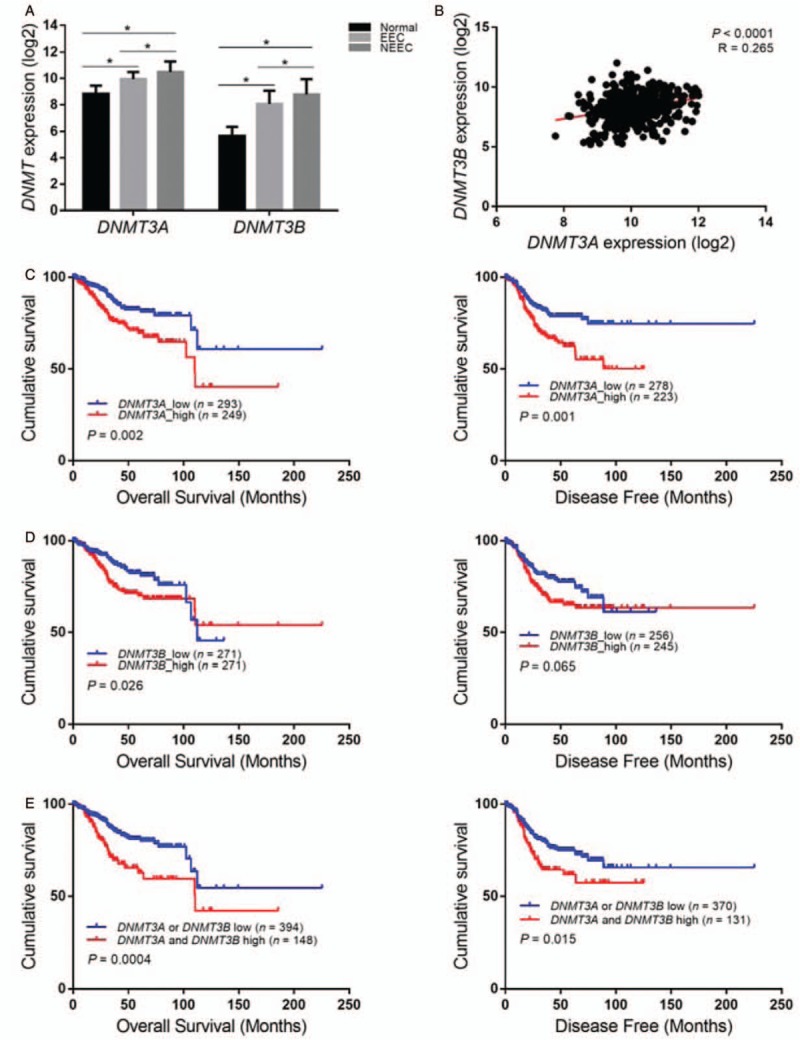
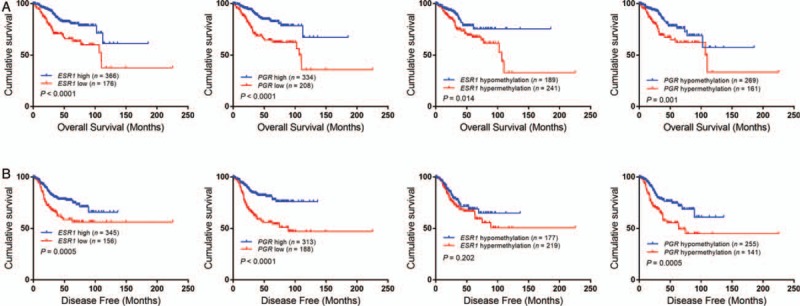
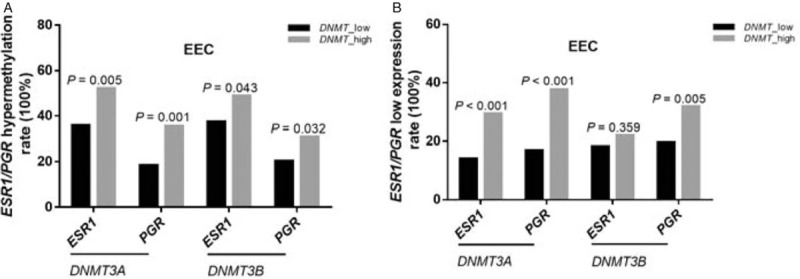
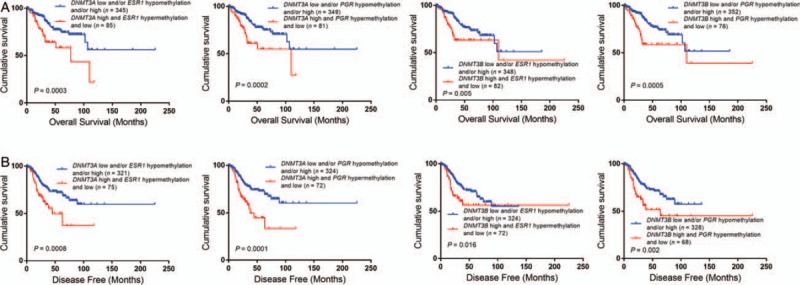
DNMT3A/3B was overexpressed in endometrioid carcinoma (EEC) and was even higher in non-endometrioid carcinoma (NEEC) (DNMT3A, EEC vs. NEEC: 37.6% vs. 69.9%, t = -7.440, P < 0.001; DNMT3B, EEC vs. NEEC: 42.4% vs. 72.8%, t = -6.897, P < 0.001). In EEC, DNMT3A overexpression was significantly correlated with the hypermethylation and low expression of the ESR1 and PGR (P < 0.05). The same trend was observed in the DNMT3B overexpression subgroup. In the ESR1/PGR low-expression subgroups, as much as 83.1% of ESR1 and 59.5% of PGR were hypermethylated, which was significantly greater than the ESR1/PGR high-expression subgroups (31.3% and 11.9%, respectively). However, the above phenomena were absent in NEEC, while DNMT3A/3B overexpression, ESR1/PGR hypermethylation, and low ER/PR expression occurred much more often. In univariate analysis, DNMT3A/3B overexpressions were significantly correlated with worse prognosis. In multivariate analysis, only DNMT3A was an independent predictor of disease-free survival (P < 0.05).
DNMT3A/3B expression increases progressively from EEC to NEEC and is correlated with poor survival. The mechanisms underlying low ER/PR expression might be distinct in EEC vs. NEEC. In EEC, methylation related to DNMT3A/3B overexpression might play a major role in ER/PR downregulation.
DNA 甲基化参与了许多生物学事件,并与转录基因沉默相关,在子宫内膜癌的发病机制中发挥着重要作用。ESR1/PGR 在广泛的肿瘤中经常经历从头甲基化和表达缺失,包括乳腺癌、结肠癌、肺癌和脑肿瘤。然而,子宫内膜癌中雌激素和孕激素受体(ER/PR)缺失的机制尚未得到广泛研究。本研究的目的是确定子宫内膜癌中 DNA(胞嘧啶-5)-甲基转移酶 3A/3B(DNMT3A/3B)的表达,以探讨 DNMT3A/3B 催化的甲基化是否有助于 ER/PR 表达降低。
从 2018 年 5 月的癌症基因组图谱(TCGA)子宫癌症队列中获得了 544 例子宫内膜癌的临床病理信息和 DNMT3A/3B 的 RNA-Seq 表达数据。使用 t 检验或单因素方差分析比较这些临床病理因素之间的 RNA-Seq 水平。
DNMT3A/3B 在子宫内膜样癌(EEC)中过表达,在非子宫内膜样癌(NEEC)中甚至更高(DNMT3A,EEC 与 NEEC:37.6%与 69.9%,t=7.440,P<0.001;DNMT3B,EEC 与 NEEC:42.4%与 72.8%,t=6.897,P<0.001)。在 EEC 中,DNMT3A 过表达与 ESR1 和 PGR 的高甲基化和低表达显著相关(P<0.05)。DNMT3B 过表达亚组也观察到了相同的趋势。在 ESR1/PGR 低表达亚组中,多达 83.1%的 ESR1 和 59.5%的 PGR 发生了高甲基化,明显高于 ESR1/PGR 高表达亚组(分别为 31.3%和 11.9%)。然而,在 NEEC 中没有出现上述现象,而 DNMT3A/3B 过表达、ESR1/PGR 高甲基化和低 ER/PR 表达则更为常见。在单因素分析中,DNMT3A/3B 过表达与预后不良显著相关。在多因素分析中,只有 DNMT3A 是疾病无进展生存的独立预测因子(P<0.05)。
DNMT3A/3B 的表达从 EEC 到 NEEC 逐渐增加,并与不良预后相关。ESR1/PGR 低表达的机制在 EEC 与 NEEC 之间可能不同。在 EEC 中,与 DNMT3A/3B 过表达相关的甲基化可能在 ER/PR 下调中起主要作用。