Boston University School of Medicine, Boston, Massachusetts, and University of Manchester, NIHR Manchester Musculoskeletal Biomedical Research Centre, Manchester University Hospitals NHS Foundation Trust, Manchester, UK.
University of Manchester, NIHR Manchester Musculoskeletal Biomedical Research Centre, Manchester University Hospitals NHS Foundation Trust, Manchester, UK.
Arthritis Rheumatol. 2019 Jun;71(6):908-915. doi: 10.1002/art.40808. Epub 2019 Apr 8.
Lateral wedge shoe insoles decrease medial knee loading, but trials have shown no effect on pain in medial knee osteoarthritis (OA). However, loading effects of insoles are inconsistent, and they can increase patellofemoral loading. We undertook this study to investigate the hypothesis that insoles would reduce pain in preselected patients.
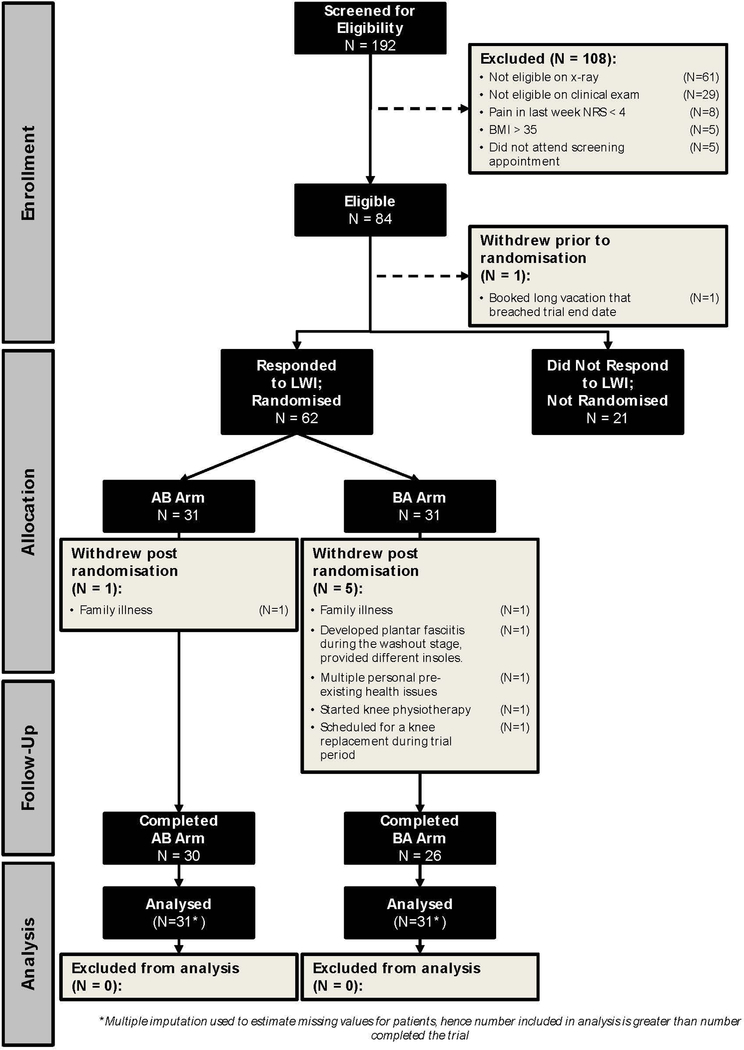
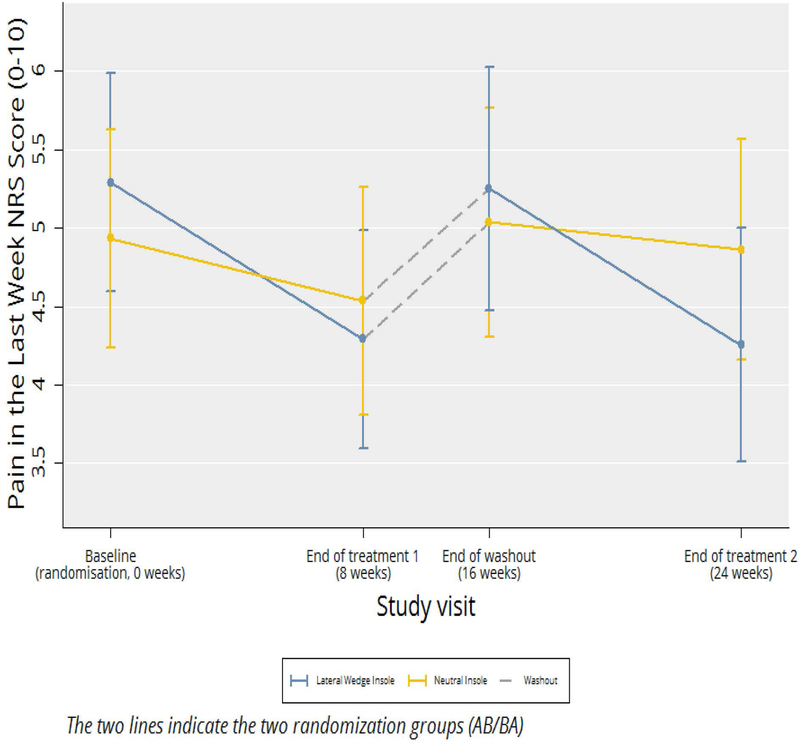
Among patients with painful medial knee OA, we excluded those with patellofemoral OA and those with a pain rating of <4 of a possible 10. We further excluded participants who, in a gait analysis using lateral wedges, did not show at least a 2% reduction in knee adduction moment (KAM), compared to wearing their shoes and a neutral insole. We then randomized subjects to lateral wedge versus neutral insole for 8-week periods, separated by an 8-week washout. The primary outcome measure was knee pain (0-10 scale) during the past week, and secondary outcome measures included activity pain and pain rated in the Knee Injury and Osteoarthritis Outcome Score questionnaire. We carried out mixed model analyses adjusted for baseline pain.
Of 83 participants, 21 (25.3%) were excluded from analysis because of insufficient reduction in KAM. In the 62 patients included in analysis, the mean ± SD age was 64.2 ± 9.1 years, and 37.1% were women. Lateral wedge insoles produced a greater reduction in knee pain than neutral insoles (mean difference of 0.7 on 0-10 scale [95% confidence interval 0.1, 1.2]) (P = 0.02). Findings for secondary outcome measures were mixed.
In participants prescreened to eliminate those with patellofemoral OA and biomechanical nonresponders, lateral wedge insoles reduced knee pain, but the effect of treatment was small and is likely of clinical significance in only a minority of patients. Targeting patients may identify those who respond to this treatment.
外侧楔形鞋垫可减少内侧膝关节的负荷,但试验表明其对内侧膝骨关节炎(OA)的疼痛没有影响。然而,鞋垫的负荷效应并不一致,它们可能会增加髌股关节的负荷。我们进行这项研究的目的是验证这样一个假设,即鞋垫会减轻预先选择的患者的疼痛。
在患有疼痛性内侧膝骨关节炎的患者中,我们排除了那些患有髌股关节 OA 和疼痛评分为 10 分中<4 分的患者。我们还排除了在使用外侧楔形物进行步态分析时,与穿着鞋子和中性鞋垫相比,膝关节内收力矩(KAM)没有至少降低 2%的参与者。然后,我们将受试者随机分为外侧楔形鞋垫组和中性鞋垫组,每组 8 周,中间间隔 8 周洗脱期。主要结局测量指标为过去一周的膝关节疼痛(0-10 分),次要结局测量指标包括活动疼痛和膝关节损伤和骨关节炎结果评分问卷中的疼痛评分。我们进行了混合模型分析,调整了基线疼痛。
在 83 名参与者中,有 21 名(25.3%)因 KAM 减少不足而被排除在分析之外。在纳入分析的 62 名患者中,平均年龄为 64.2±9.1 岁,37.1%为女性。外侧楔形鞋垫组的膝关节疼痛缓解程度大于中性鞋垫组(0-10 分量表上的平均差值为 0.7[95%置信区间 0.1,1.2])(P=0.02)。次要结局指标的结果不一致。
在预先筛选出髌股关节 OA 和生物力学无反应者的参与者中,外侧楔形鞋垫可减轻膝关节疼痛,但治疗效果较小,可能只有少数患者具有临床意义。针对患者可能会识别出对这种治疗有反应的患者。