Giubertoni Giulia, Meister Konrad, DeVries Arthur L, Bakker Huib J
AMOLF , Science Park 104 , 1098 XG Amsterdam , The Netherlands.
Max-Planck Institute for Polymer Research , D-55128 Mainz , Germany.
J Phys Chem Lett. 2019 Feb 7;10(3):352-357. doi: 10.1021/acs.jpclett.8b03468. Epub 2019 Jan 10.
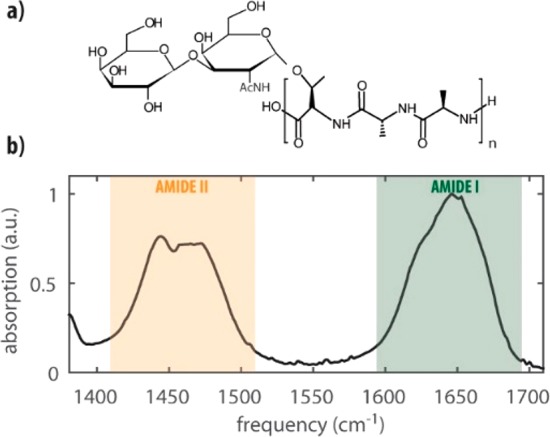
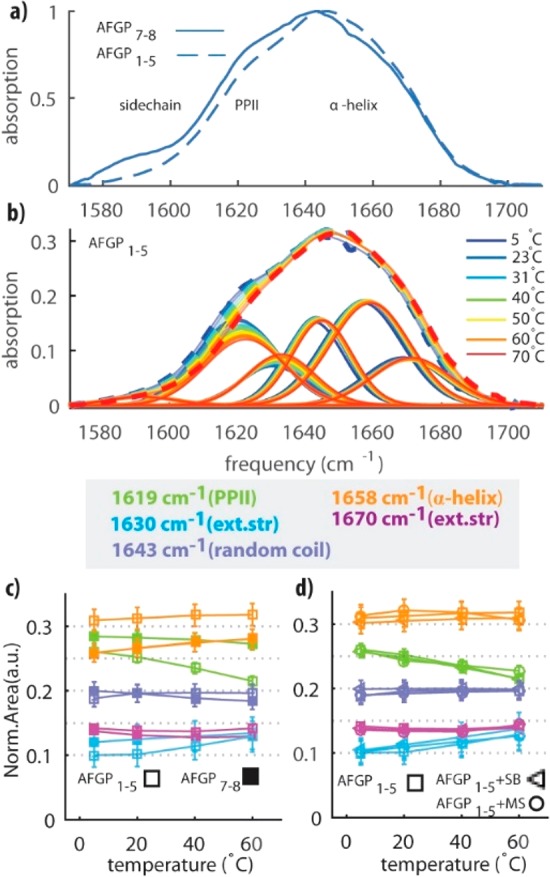
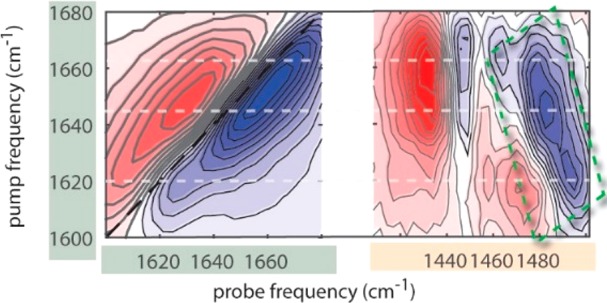
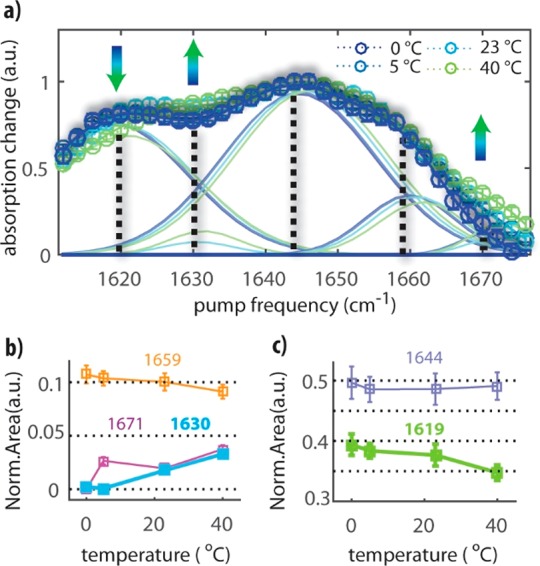
We study the solution structure of antifreeze glycoproteins (AFGPs) with linear and two-dimensional infrared spectroscopy (2D-IR). With 2D-IR, we study the coupling between the amide I and amide II vibrations of AFGPs. The measured nonlinear spectral response constitutes a much more clearly resolved amide I spectrum than the linear absorption spectrum of the amide I vibrations and allows us to identify the different structural elements of AFGPs in solution. We find clear evidence for the presence of polyproline II (PPII) helical structures already at room temperature, and we find that the fraction of PPII structures increases when the temperature is decreased to the biological working temperature of AFGP. We observe that inhibition of the antifreeze activity of AFGP using borate buffer or enhancing the antifreeze activity using sulfate buffer does not lead to significant changes in the protein conformation. This finding indicates that AFGPs bind to ice with their sugar side chains.
我们利用线性和二维红外光谱(2D-IR)研究了抗冻糖蛋白(AFGP)的溶液结构。通过2D-IR,我们研究了AFGP的酰胺I和酰胺II振动之间的耦合。所测量的非线性光谱响应构成了比酰胺I振动的线性吸收光谱分辨率更高的酰胺I光谱,使我们能够识别溶液中AFGP的不同结构元素。我们发现,即使在室温下也有明显证据表明存在多聚脯氨酸II(PPII)螺旋结构,并且我们发现当温度降至AFGP的生物学工作温度时,PPII结构的比例会增加。我们观察到,使用硼酸盐缓冲液抑制AFGP的抗冻活性或使用硫酸盐缓冲液增强抗冻活性不会导致蛋白质构象发生显著变化。这一发现表明,AFGP通过其糖侧链与冰结合。