• 文献检索
  • 文档翻译
  • 深度研究
  • 学术资讯
  • Suppr Zotero 插件Zotero 插件
  • 邀请有礼
  • 套餐&价格
  • 历史记录
应用&插件
Suppr Zotero 插件Zotero 插件浏览器插件Mac 客户端Windows 客户端微信小程序
定价
高级版会员购买积分包购买API积分包
服务
文献检索文档翻译深度研究API 文档MCP 服务
关于我们
关于 Suppr公司介绍联系我们用户协议隐私条款
关注我们

Suppr 超能文献

核心技术专利:CN118964589B侵权必究
粤ICP备2023148730 号-1Suppr @ 2026

文献检索

告别复杂PubMed语法,用中文像聊天一样搜索,搜遍4000万医学文献。AI智能推荐,让科研检索更轻松。

立即免费搜索

文件翻译

保留排版,准确专业,支持PDF/Word/PPT等文件格式,支持 12+语言互译。

免费翻译文档

深度研究

AI帮你快速写综述,25分钟生成高质量综述,智能提取关键信息,辅助科研写作。

立即免费体验

投票体验和对选票保密性的看法。

The voting experience and beliefs about ballot secrecy.

机构信息

Department of Political Science, University of Mississippi, Oxford, MS, United States of America.

Department of Political Science, Loyola University Chicago, Chicago, IL, United States of America.

出版信息

PLoS One. 2019 Jan 7;14(1):e0209765. doi: 10.1371/journal.pone.0209765. eCollection 2019.

DOI:10.1371/journal.pone.0209765
PMID:30615669
原文链接:https://pmc.ncbi.nlm.nih.gov/articles/PMC6322754/
Abstract

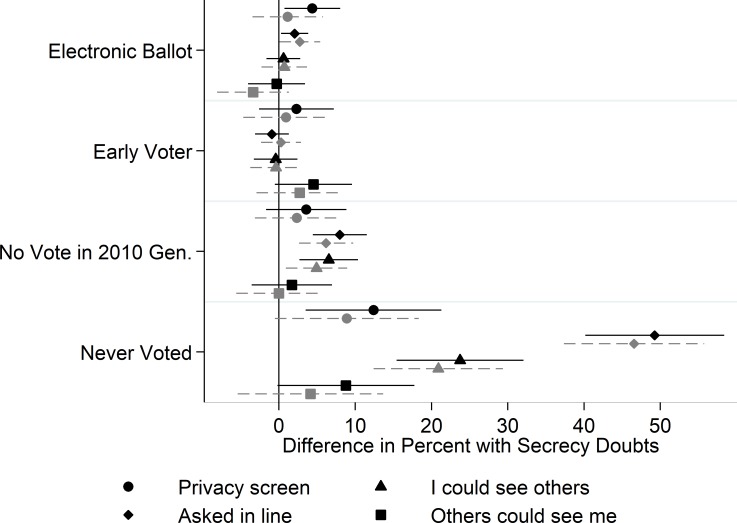
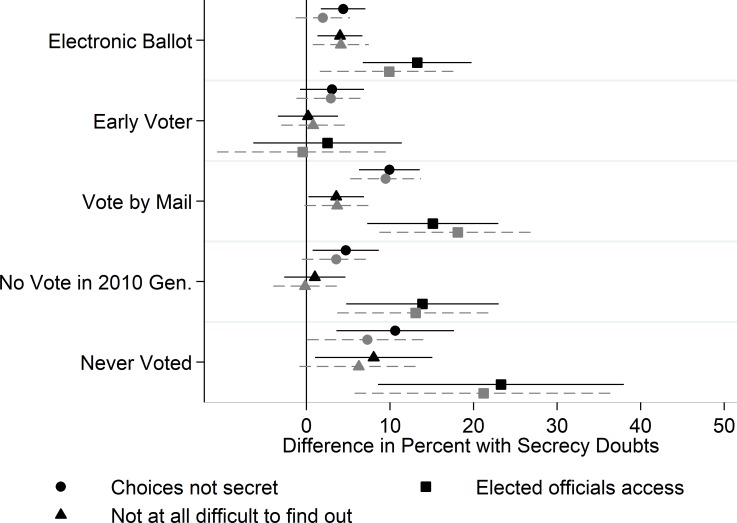
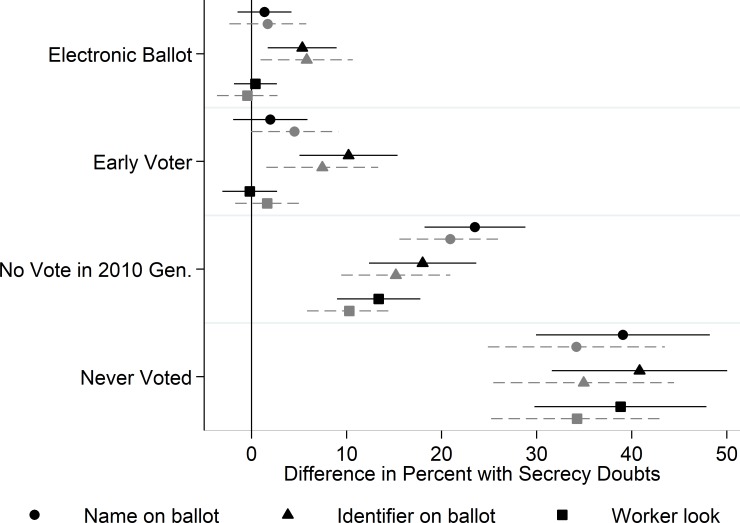
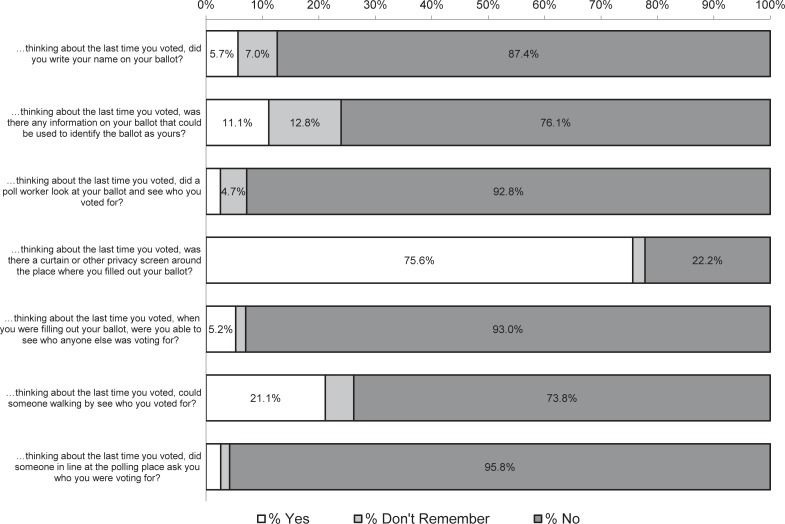
New democracies go to great lengths to implement institutional protections of the electoral process. However, in this paper we present evidence that shows that even in the United States-where the secret ballot has been in place for generations-doubts about the secrecy of the voting process are surprisingly prevalent. Many say that their cast ballot can be matched to their name or that others could observe their vote choices while they were voting. We find that people who have not previously voted are particularly likely to harbor doubts about the secrecy of voters' ballots. Those who vote by mail in the privacy of their own homes also feel that others are able to discover their vote choices. Taken together, these findings suggest an important divergence between public perceptions about and the institutional status of the secret ballot in the United States, a divergence that may affect patterns of voting behavior and political participation.

摘要

新兴民主国家不遗余力地实施选举过程的制度保护。然而,在本文中,我们提出的证据表明,即使在美国——秘密投票已经实行了几代人——对投票过程保密性的怀疑仍然非常普遍。许多人表示,他们的选票可以与他们的名字相对应,或者其他人在投票时可以观察他们的投票选择。我们发现,以前没有投票的人特别有可能对选民选票的保密性表示怀疑。那些通过邮件在自己家中投票的人也认为其他人能够发现他们的投票选择。总的来说,这些发现表明,在美国,公众对秘密投票的看法与制度地位之间存在重要分歧,这种分歧可能会影响投票行为和政治参与的模式。
https://cdn.ncbi.nlm.nih.gov/pmc/blobs/8a7b/6322754/2970cf3f0d80/pone.0209765.g004.jpg
https://cdn.ncbi.nlm.nih.gov/pmc/blobs/8a7b/6322754/b0a0cae59714/pone.0209765.g001.jpg
https://cdn.ncbi.nlm.nih.gov/pmc/blobs/8a7b/6322754/af7f2488227b/pone.0209765.g002.jpg
https://cdn.ncbi.nlm.nih.gov/pmc/blobs/8a7b/6322754/6387738bf3f0/pone.0209765.g003.jpg
https://cdn.ncbi.nlm.nih.gov/pmc/blobs/8a7b/6322754/2970cf3f0d80/pone.0209765.g004.jpg
https://cdn.ncbi.nlm.nih.gov/pmc/blobs/8a7b/6322754/b0a0cae59714/pone.0209765.g001.jpg
https://cdn.ncbi.nlm.nih.gov/pmc/blobs/8a7b/6322754/af7f2488227b/pone.0209765.g002.jpg
https://cdn.ncbi.nlm.nih.gov/pmc/blobs/8a7b/6322754/6387738bf3f0/pone.0209765.g003.jpg
https://cdn.ncbi.nlm.nih.gov/pmc/blobs/8a7b/6322754/2970cf3f0d80/pone.0209765.g004.jpg

相似文献

1
The voting experience and beliefs about ballot secrecy.投票体验和对选票保密性的看法。
PLoS One. 2019 Jan 7;14(1):e0209765. doi: 10.1371/journal.pone.0209765. eCollection 2019.
2
The effect on turnout of campaign mobilization messages addressing ballot secrecy concerns: A replication experiment.解决投票保密问题的竞选动员信息对投票率的影响:一项复制实验。
PLoS One. 2017 Aug 9;12(8):e0182199. doi: 10.1371/journal.pone.0182199. eCollection 2017.
3
Evaluating ballot initiative support for legalised marijuana: The case of Washington.评估支持大麻合法化的投票倡议:以华盛顿州为例。
Int J Drug Policy. 2018 Jun;56:6-20. doi: 10.1016/j.drugpo.2018.02.010. Epub 2018 Mar 11.
4
Eye Movements Predict Large-Scale Voting Decisions.眼球运动可预测大规模投票决策。
Psychol Sci. 2021 Jun;32(6):836-848. doi: 10.1177/0956797621991142. Epub 2021 May 25.
5
Voting Intention and Choices: Are Voters Always Rational and Deliberative?投票意向与选择:选民总是理性且经过深思熟虑的吗?
PLoS One. 2016 Feb 17;11(2):e0148643. doi: 10.1371/journal.pone.0148643. eCollection 2016.
6
Emergency Absentee Voting for Hospitalized Patients and Voting During COVID-19: A 50-State Study.紧急情况下为住院患者提供缺席投票和在 COVID-19 期间投票:一项 50 个州的研究。
West J Emerg Med. 2021 Jul 15;22(4):1000-1009. doi: 10.5811/westjem.2021.4.50884.
7
Results from a 2020 field experiment encouraging voting by mail.2020 年鼓励邮寄投票的实地试验结果。
Proc Natl Acad Sci U S A. 2021 Jan 26;118(4). doi: 10.1073/pnas.2021022118.
8
America's electorate is increasingly polarized along partisan lines about voting by mail during the COVID-19 crisis.在美国 COVID-19 危机期间,通过邮件投票的问题上,美国选民越来越两极分化,党派立场鲜明。
Proc Natl Acad Sci U S A. 2020 Oct 6;117(40):24640-24642. doi: 10.1073/pnas.2008023117. Epub 2020 Sep 22.
9
How Human Factors Can Help Preserve Democracy in the Age of Pandemics.人类因素如何帮助在大流行时代保护民主
Hum Factors. 2020 Nov;62(7):1077-1086. doi: 10.1177/0018720820946896. Epub 2020 Aug 3.
10
[Convenient, but Prone to Error: Invisible Uncounted Mail Ballots].[方便但容易出错:无形的未计票邮寄选票]
Polit Vierteljahresschr. 2021;62(4):597-619. doi: 10.1007/s11615-021-00358-3. Epub 2021 Nov 5.

引用本文的文献

1
The effect on turnout of campaign mobilization messages addressing ballot secrecy concerns: A replication experiment.解决投票保密问题的竞选动员信息对投票率的影响:一项复制实验。
PLoS One. 2017 Aug 9;12(8):e0182199. doi: 10.1371/journal.pone.0182199. eCollection 2017.