Allen Jessica L, Ting Lena H, Kesar Trisha M
Department of Chemical and Biomedical Engineering, West Virginia University, Morgantown, WV, United States.
Division of Physical Therapy, Department of Rehabilitation Medicine, Emory University School of Medicine, Atlanta, GA, United States.
Front Neurol. 2018 Dec 20;9:1127. doi: 10.3389/fneur.2018.01127. eCollection 2018.
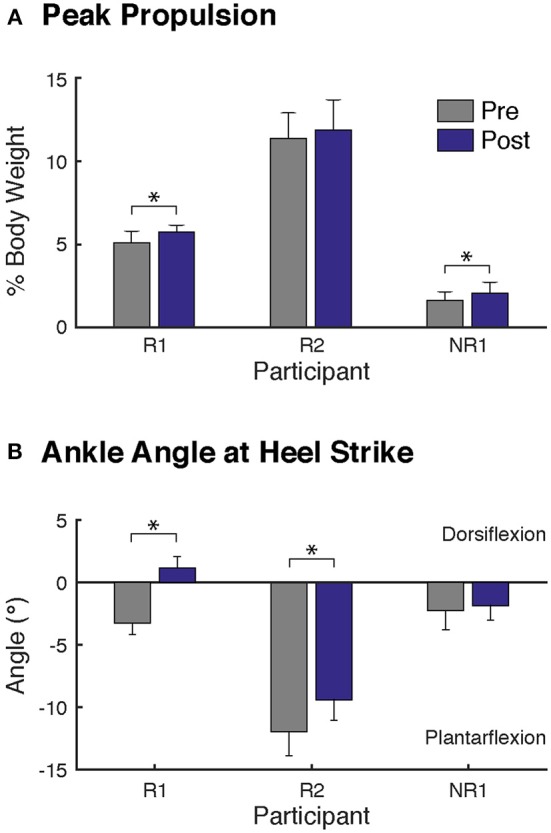
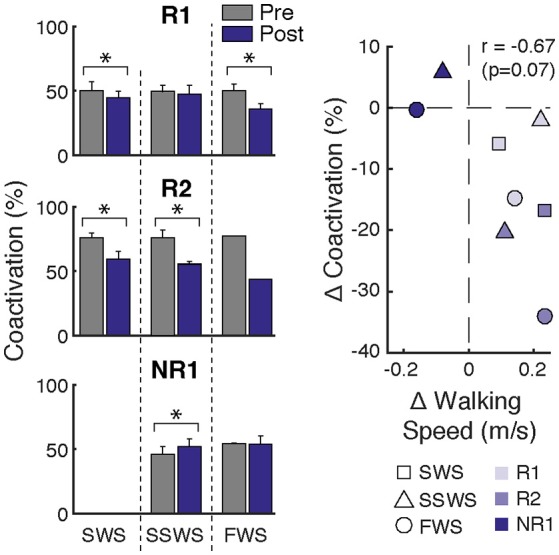
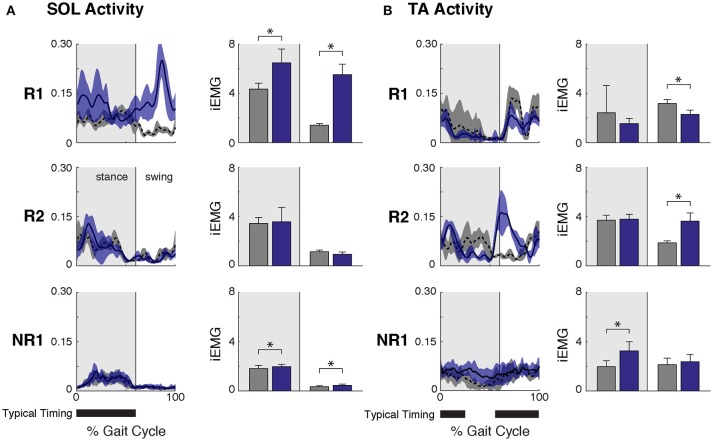
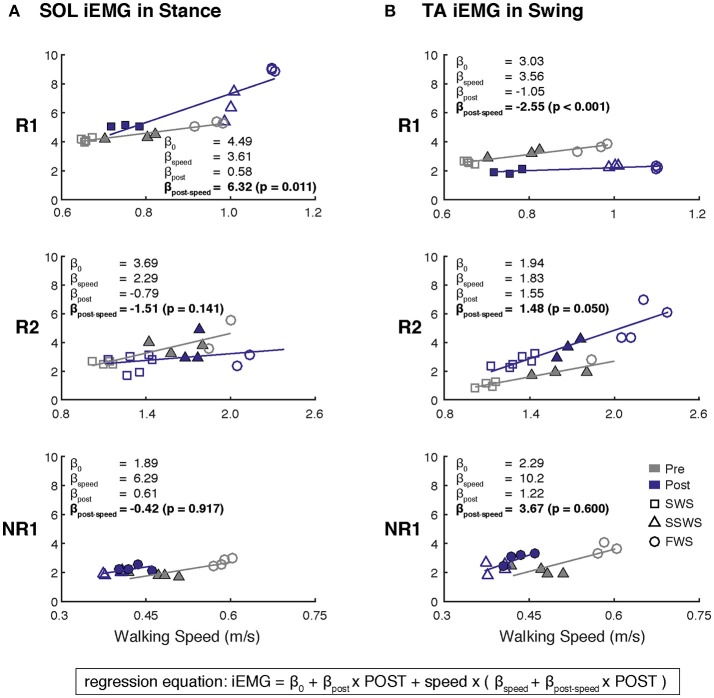
Previous studies have demonstrated that post-stroke gait rehabilitation combining functional electrical stimulation (FES) applied to the ankle muscles during fast treadmill walking (FastFES) improves gait biomechanics and clinical walking function. However, there is considerable inter-individual variability in response to FastFES. Although FastFES aims to sculpt ankle muscle coordination, whether changes in ankle muscle activity underlie observed gait improvements is unknown. The aim of this study was to investigate three cases illustrating how FastFES modulates ankle muscle recruitment during walking. We conducted a preliminary case series study on three individuals (53-70 y; 2 M; 35-60 months post-stroke; 19-22 lower extremity Fugl-Meyer) who participated in 18 sessions of FastFES (3 sessions/week; ClinicalTrials.gov: NCT01668602). Clinical walking function (speed, 6-min walk test, and Timed-Up-and-Go test), gait biomechanics (paretic propulsion and ankle angle at initial-contact), and plantarflexor (soleus)/dorsiflexor (tibialis anterior) muscle recruitment were assessed pre- and post-FastFES while walking without stimulation. Two participants (R1, R2) were categorized as responders based on improvements in clinical walking function. Consistent with heterogeneity of clinical and biomechanical changes commonly observed following gait rehabilitation, how muscle activity was altered with FastFES differed between responders. R1 exhibited improved plantarflexor recruitment during stance accompanied by increased paretic propulsion. R2 exhibited improved dorsiflexor recruitment during swing accompanied by improved paretic ankle angle at initial-contact. In contrast, the third participant (NR1), classified as a non-responder, demonstrated increased ankle muscle activity during inappropriate phases of the gait cycle. Across all participants, there was a positive relationship between increased walking speeds after FastFES and reduced SOL/TA muscle coactivation. Our preliminary case series study is the first to demonstrate that improvements in ankle plantarflexor and dorsiflexor muscle recruitment (muscles targeted by FastFES) accompanied improvements in gait biomechanics and walking function following FastFES in individuals post-stroke. Our results also suggest that inducing more appropriate (i.e., reduced) ankle plantar/dorsi-flexor muscle coactivation may be an important neuromuscular mechanism underlying improvements in gait function after FastFES training, suggesting that pre-treatment ankle muscle status could be used for inclusion into FastFES. The findings of this case-series study, albeit preliminary, provide the rationale and foundations for larger-sample studies using similar methodology.
先前的研究表明,中风后步态康复结合在快速跑步机行走期间对踝部肌肉施加功能性电刺激(FastFES)可改善步态生物力学和临床行走功能。然而,个体对FastFES的反应存在相当大的差异。尽管FastFES旨在塑造踝部肌肉协调性,但尚不清楚观察到的步态改善是否基于踝部肌肉活动的变化。本研究的目的是调查三个案例,以说明FastFES在行走过程中如何调节踝部肌肉募集。我们对三名个体(年龄53 - 70岁;男性2名;中风后35 - 60个月;下肢Fugl - Meyer评分为19 - 22分)进行了一项初步的病例系列研究,他们参加了18次FastFES治疗(每周3次;ClinicalTrials.gov:NCT01668602)。在无刺激行走时,对临床行走功能(速度、6分钟步行试验和计时起立行走试验)、步态生物力学(患侧推进力和初始接触时的踝角)以及跖屈肌(比目鱼肌)/背屈肌(胫骨前肌)的肌肉募集情况在FastFES治疗前后进行了评估。两名参与者(R1、R2)根据临床行走功能的改善被归类为反应者。与步态康复后常见的临床和生物力学变化的异质性一致,FastFES对肌肉活动的改变在反应者之间存在差异。R1在站立期表现出跖屈肌募集改善,同时患侧推进力增加。R2在摆动期表现出背屈肌募集改善,同时初始接触时患侧踝角改善。相比之下,第三名参与者(NR1)被归类为无反应者,在步态周期的不适当阶段表现出踝部肌肉活动增加。在所有参与者中,FastFES后步行速度增加与比目鱼肌/胫骨前肌共同激活减少之间存在正相关关系。我们的初步病例系列研究首次表明,中风后个体在FastFES治疗后,踝部跖屈肌和背屈肌募集(FastFES的目标肌肉)的改善伴随着步态生物力学和行走功能的改善。我们的结果还表明,诱导更适当(即减少)的踝部跖屈/背屈肌共同激活可能是FastFES训练后步态功能改善的重要神经肌肉机制,这表明治疗前的踝部肌肉状态可用于纳入FastFES治疗。尽管本病例系列研究的结果是初步的,但为使用类似方法的更大样本研究提供了理论依据和基础。