Alsved Malin, Holm Stine, Christiansen Sigurd, Smidt Mads, Rosati Bernadette, Ling Meilee, Boesen Thomas, Finster Kai, Bilde Merete, Löndahl Jakob, Šantl-Temkiv Tina
Ergonomics and Aerosol Technology, Department of Design Sciences, Lund University, Lund, Sweden.
NanoLund, Lund University, Lund, Sweden.
Front Microbiol. 2018 Dec 18;9:3086. doi: 10.3389/fmicb.2018.03086. eCollection 2018.
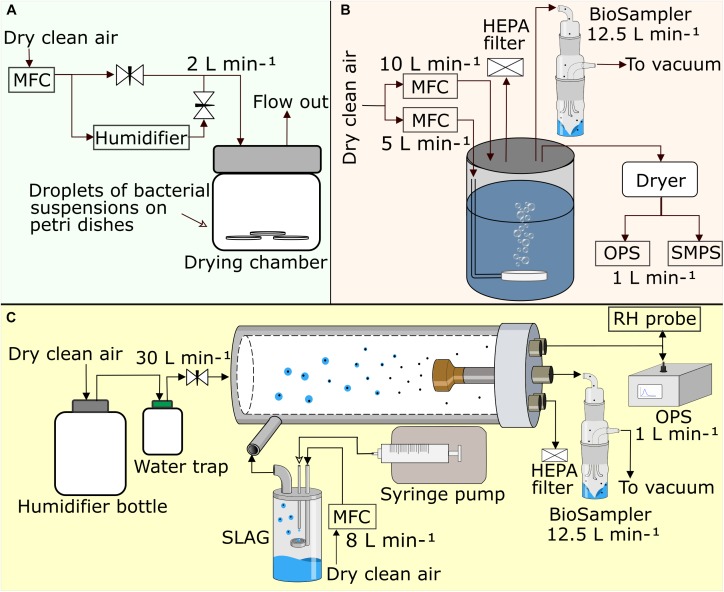
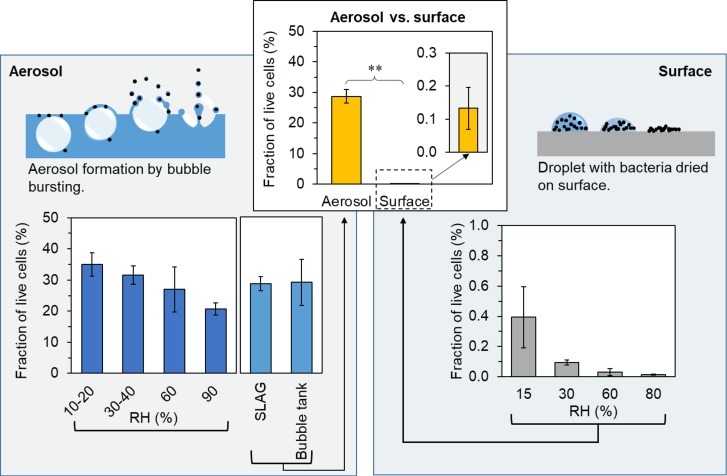
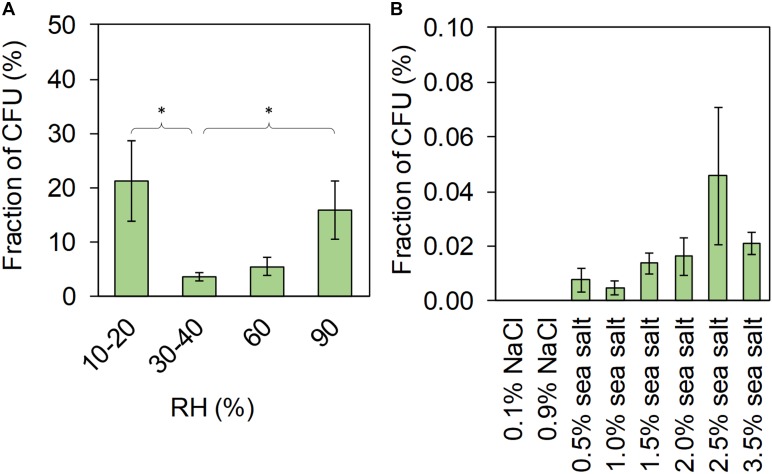
Airborne dispersal of microorganisms influences their biogeography, gene flow, atmospheric processes, human health and transmission of pathogens that affect humans, plants and animals. The extent of their impact depends essentially on cell-survival rates during the process of aerosolization. A central factor for cell-survival is water availability prior to and upon aerosolization. Also, the ability of cells to successfully cope with stress induced by drying determines their chances of survival. In this study, we used the ice-nucleation active, plant pathogenic strain R10.79 as a model organism to investigate the effect of drying on cell survival. Two forms of drying were simulated: drying of cells in small droplets aerosolized from a wet environment by bubble bursting and drying of cells in large droplets deposited on a surface. For drying of cells both in aerosol and surface droplets, the relative humidity (RH) was varied in the range between 10 and 90%. The fraction of surviving cells was determined by live/dead staining followed by flow cytometry. We also evaluated the effect of salt concentration in the water droplets on the survival of drying cells by varying the ionic strength between 0 and 700 mM using NaCl and sea salt. For both aerosol and surface drying, cell survival increased with decreasing RH ( < 0.01), and for surface drying, survival was correlated with increasing salt concentration ( < 0.001). Imaging cells with TEM showed shrunk cytoplasm and cell wall damage for a large fraction of aerosolized cells. Ultimately, we observed a 10-fold higher fraction of surviving cells when dried as aerosol compared to when dried on a surface. We conclude that the conditions, under which cells dry, significantly affect their survival and thus their success to spread through the atmosphere and colonize new environments as well as their ability to affect atmospheric processes.
微生物的空气传播影响其生物地理学、基因流动、大气过程、人类健康以及影响人类、植物和动物的病原体传播。其影响程度主要取决于雾化过程中的细胞存活率。细胞存活的一个关键因素是雾化前后的水分可利用性。此外,细胞成功应对干燥诱导应激的能力决定了它们的存活几率。在本研究中,我们使用冰核活性植物病原菌R10.79作为模式生物来研究干燥对细胞存活的影响。模拟了两种干燥形式:通过气泡破裂从潮湿环境中雾化的小液滴中的细胞干燥以及沉积在表面的大液滴中的细胞干燥。对于气溶胶和表面液滴中的细胞干燥,相对湿度(RH)在10%至90%之间变化。通过活/死染色后流式细胞术确定存活细胞的比例。我们还通过使用NaCl和海盐将离子强度在0至700 mM之间变化,评估了水滴中盐浓度对干燥细胞存活的影响。对于气溶胶干燥和表面干燥,细胞存活率均随RH降低而增加(<0.01),对于表面干燥,存活率与盐浓度增加相关(<0.001)。用透射电子显微镜成像细胞显示,大部分雾化细胞的细胞质收缩且细胞壁受损。最终,我们观察到与在表面干燥相比,气溶胶干燥时存活细胞的比例高10倍。我们得出结论,细胞干燥的条件显著影响其存活,进而影响其在大气中传播和定殖新环境的成功率以及影响大气过程的能力。