Department of Biomedical Informatics, School of Basic Medical Sciences, Peking University, Beijing, 100191, China.
Autism Research Center, Peking University Health Science Center, Beijing, 100191, China.
Sci Rep. 2018 Sep 18;8(1):13981. doi: 10.1038/s41598-018-32219-2.
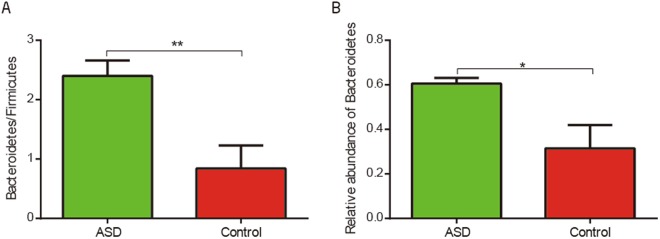
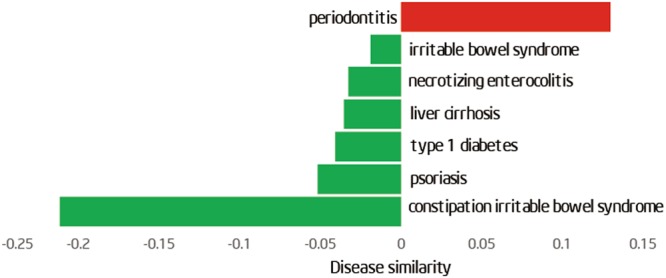
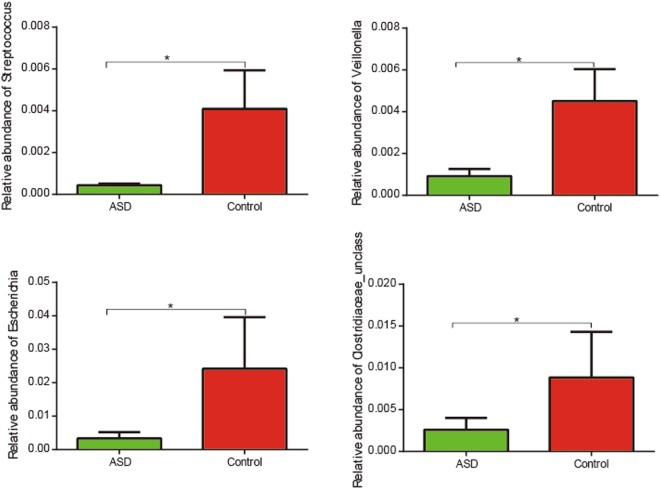
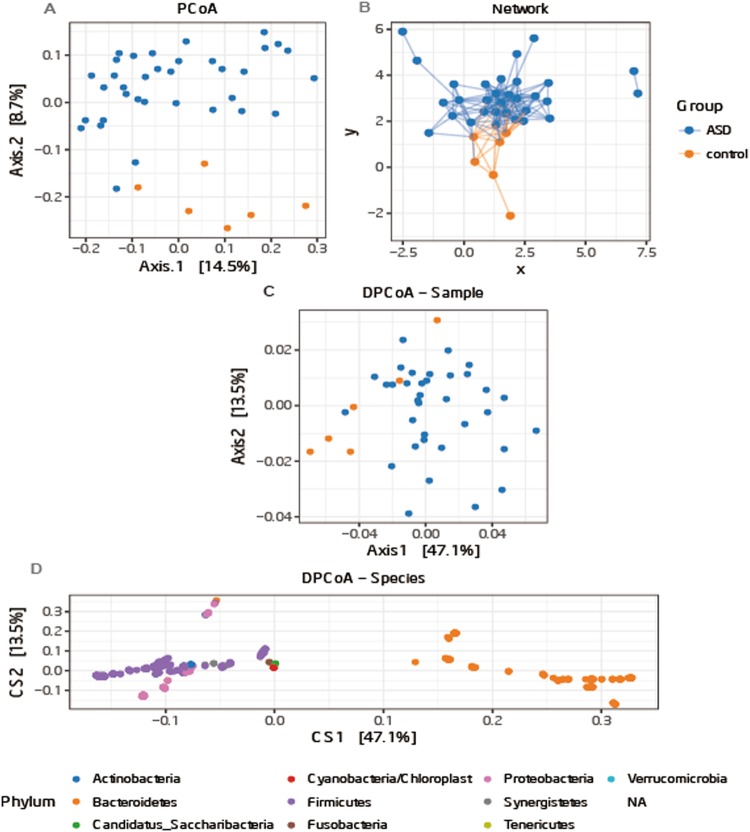
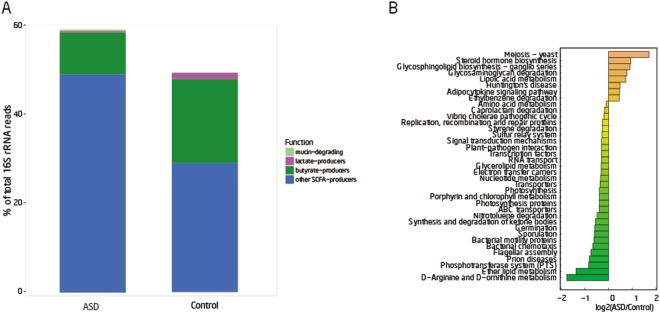
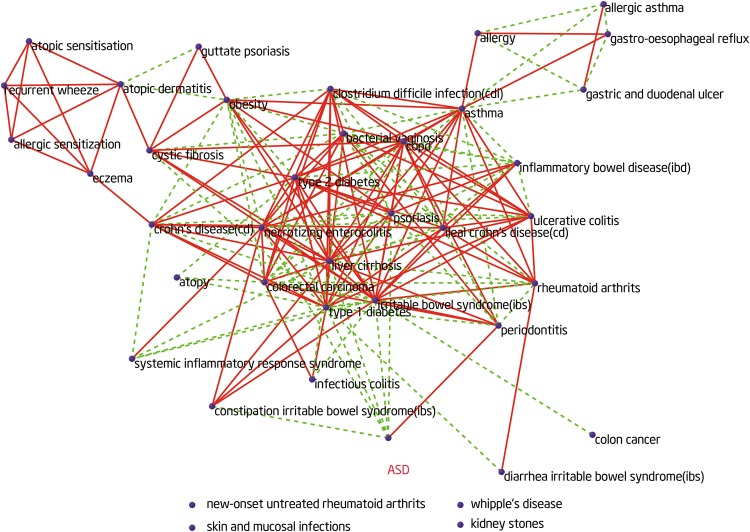
Autism spectrum disorder (ASD) is a set of complex neurodevelopmental disorders. Recent studies reported that children with ASD have altered gut microbiota profiles compared with typical development (TD) children. However, few studies on gut bacteria of children with ASD have been conducted in China. Here, in order to elucidate changes of fecal microbiota in children with ASD, 16S rRNA sequencing was conducted and the 16S rRNA (V3-V4) gene tags were amplified. We investigated differences in fecal microbiota between 35 children with ASD and 6 TD children. At the phylum level, the fecal microbiota of ASD group indicated a significant increase of the Bacteroidetes/Firmicutes ratio. At the genus level, we found that the relative abundance of Sutterella, Odoribacter and Butyricimonas was much more abundant in the ASD group whereas the abundance of Veillonella and Streptococcus was decreased significantly compared to the control group. Functional analysis demonstrated that butyrate and lactate producers were less abundant in the ASD group. In addition, we downloaded the association data set of microbe-disease from human microbe-disease association database and constructed a human disease network including ASD using our gut microbiome results. In this microbe-disease network based on microbe similarity of diseases, we found that ASD is positively correlated with periodontal, negatively related to type 1 diabetes. Therefore, these results suggest that microbe-based disease analysis is able to predict novel connection between ASD and other diseases and may play a role in revealing the pathogenesis of ASD.
自闭症谱系障碍(ASD)是一组复杂的神经发育障碍。最近的研究报告称,与典型发育(TD)儿童相比,自闭症谱系障碍儿童的肠道微生物群谱发生了改变。然而,在中国,针对自闭症谱系障碍儿童肠道细菌的研究很少。在这里,为了阐明自闭症谱系障碍儿童粪便微生物群的变化,我们进行了 16S rRNA 测序,并扩增了 16S rRNA(V3-V4)基因标签。我们调查了 35 名自闭症谱系障碍儿童和 6 名 TD 儿童粪便微生物群的差异。在门水平上,自闭症谱系障碍组的粪便微生物群显示出厚壁菌门/拟杆菌门比值显著增加。在属水平上,我们发现自闭症谱系障碍组中 Sutterella、Odoribacter 和 Butyricimonas 的相对丰度明显更高,而 Veillonella 和 Streptococcus 的丰度与对照组相比显著降低。功能分析表明,自闭症谱系障碍组中的丁酸和乳酸产生菌较少。此外,我们从人类微生物疾病关联数据库中下载了微生物-疾病关联数据集,并使用我们的肠道微生物组结果构建了一个包含自闭症谱系障碍的人类疾病网络。在这个基于疾病微生物相似性的微生物-疾病网络中,我们发现自闭症谱系障碍与牙周病呈正相关,与 1 型糖尿病呈负相关。因此,这些结果表明,基于微生物的疾病分析能够预测自闭症谱系障碍与其他疾病之间的新联系,并可能在揭示自闭症谱系障碍的发病机制方面发挥作用。