Department of Surgery, Clínica Universidad de Navarra, Pamplona, Spain.
Metabolic Research Laboratory, Clínica Universidad de Navarra, Pamplona, Spain.
Front Immunol. 2018 Dec 11;9:2918. doi: 10.3389/fimmu.2018.02918. eCollection 2018.
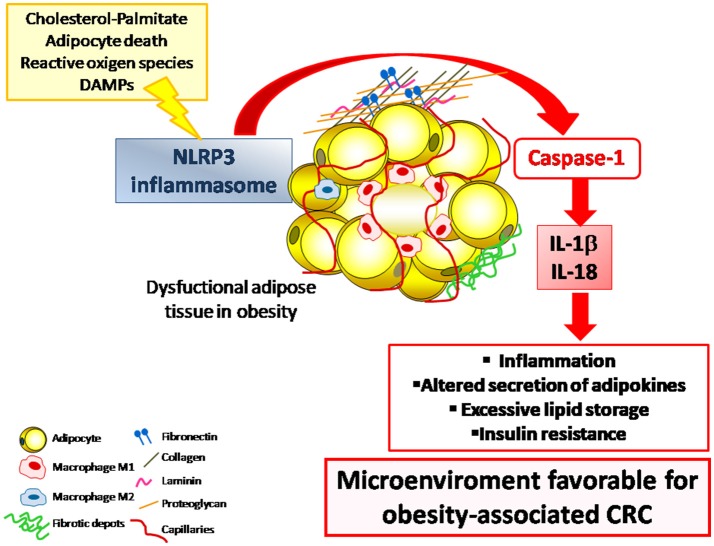
Emerging evidence reveals that adipose tissue-associated inflammation is a main mechanism whereby obesity promotes colorectal cancer risk and progression. Increased inflammasome activity in adipose tissue has been proposed as an important mediator of obesity-induced inflammation and insulin resistance development. Chronic inflammation in tumor microenvironments has a great impact on tumor development and immunity, representing a key factor in the response to therapy. In this context, the inflammasomes, main components of the innate immune system, play an important role in cancer development showing tumor promoting or tumor suppressive actions depending on the type of tumor, the specific inflammasome involved, and the downstream effector molecules. The inflammasomes are large multiprotein complexes with the capacity to regulate the activation of caspase-1. In turn, caspase-1 enhances the proteolytic cleavage and the secretion of the inflammatory cytokines interleukin (IL)-1β and IL-18, leading to infiltration of more immune cells and resulting in the generation and maintenance of an inflammatory microenvironment surrounding cancer cells. The inflammasomes also regulate pyroptosis, a rapid and inflammation-associated form of cell death. Recent studies indicate that the inflammasomes can be activated by fatty acids and high glucose levels linking metabolic danger signals to the activation of inflammation and cancer development. These data suggest that activation of the inflammasomes may represent a crucial step in the obesity-associated cancer development. This review will also focus on the potential of inflammasome-activated pathways to develop new therapeutic strategies for the prevention and treatment of obesity-associated colorectal cancer development.
新出现的证据表明,脂肪组织相关炎症是肥胖促进结直肠癌风险和进展的主要机制。脂肪组织中炎症小体活性的增加被认为是肥胖诱导炎症和胰岛素抵抗发展的重要介质。肿瘤微环境中的慢性炎症对肿瘤的发展和免疫有很大的影响,是对治疗反应的关键因素。在这种情况下,先天免疫系统的主要组成部分炎症小体在癌症发展中起着重要作用,根据肿瘤的类型、涉及的特定炎症小体和下游效应分子,表现出促进肿瘤或抑制肿瘤的作用。炎症小体是具有调节半胱天冬酶-1激活能力的大型多蛋白复合物。反过来,半胱天冬酶-1增强了炎性细胞因子白细胞介素(IL)-1β和 IL-18 的蛋白水解切割和分泌,导致更多免疫细胞的浸润,并导致癌细胞周围炎症微环境的产生和维持。炎症小体还调节细胞焦亡,这是一种快速的、与炎症相关的细胞死亡形式。最近的研究表明,炎症小体可以被脂肪酸和高葡萄糖水平激活,将代谢危险信号与炎症的激活和癌症的发展联系起来。这些数据表明,炎症小体的激活可能是肥胖相关癌症发展中的一个关键步骤。这篇综述还将重点讨论炎症小体激活途径在开发预防和治疗肥胖相关结直肠癌发展的新治疗策略方面的潜力。