Eyns Hanneke, Piérard Denis, De Wachter Elke, Eeckhout Leo, Vaes Peter, Malfroot Anne
Department of Pediatrics, Pediatric Pulmonology and Pediatric Infectious Diseases, Cystic Fibrosis Clinic, Universitair Ziekenhuis Brussel, Vrije Universiteit Brussel, Brussels, Belgium.
Department of Physical Medicine and Physiotherapy, Universitair Ziekenhuis Brussel, Vrije Universiteit Brussel, Brussels, Belgium.
Front Pediatr. 2018 Dec 18;6:403. doi: 10.3389/fped.2018.00403. eCollection 2018.
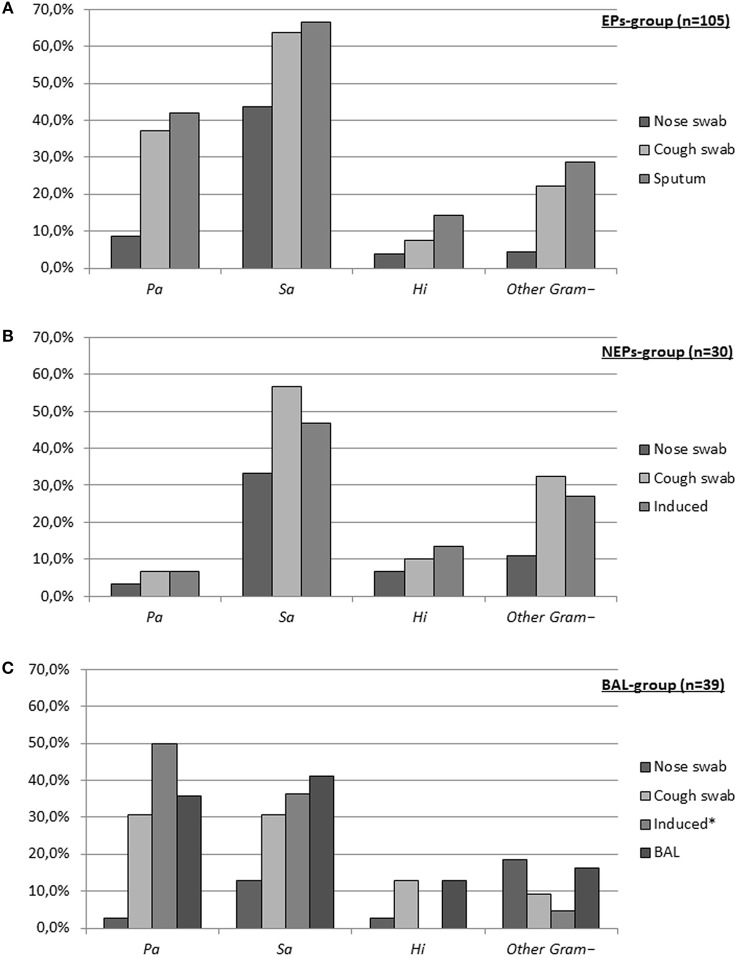
Different respiratory sampling methods exist to identify lower airway pathogens in patients with cystic fibrosis (CF), of which bronchoalveolar lavage (BAL), and expectorated sputum are considered the "gold standard." Because BAL cannot be repeated limitless, the diagnosis of lower respiratory tract infections in non-expectorating patients is challenging. Other sampling techniques are nasal swab, cough swab, and induced sputum. The purpose of this study (NCT02363764) was to compare concordance between the microbiological yield of nasal swab, cough swab, and expectorated sputum in expectorating patients; nasal swab, cough swab, and induced sputum in non-expectorating patients; nasal swab, cough swab, induced sputum, and BAL in patients requiring bronchoscopy ("BAL-group"); and to determine the clinical value of cough swab in non-expectorating patients with CF. Microbiological yield detected by these different sampling techniques was compared between and within 105 expectorating patients, 30 non-expectorating patients and BAL-group ( = 39) in a single CF clinic. Specificity, sensitivity, positive (PPV), and negative (NPV) predictive values were calculated. Overall low sensitivity (6.3-58.0%) and wide-ranging predictive values (0.0-100.0%) indicated that nasal swab was not appropriate to detect lower airway pathogens [ (), (), and ()] in all three patient groups. Microbiological yield, specificity, sensitivity, PPV, and NPV of cough swab and induced sputum were largely similar in non-expectorating patients and in BAL-group (except sensitivity (0.0%) of induced sputum for in BAL-group). Calculations for and could not be performed for non-expectorating patients because of low prevalence ( = 2 and = 3, respectively). In expectorating patients, concordance was found between cough swab and expectorated sputum, except for (sensitivity of 40.0%). Our findings suggest that cough swab might be helpful in detecting the presence of some typical CF pathogens in the lower airways of clinically stable patients with CF. However, in symptomatic patients, who are unable to expectorate and who have a negative cough swab and induced sample, BAL should be performed as it currently remains the "gold standard."
存在多种呼吸道采样方法用于识别囊性纤维化(CF)患者的下呼吸道病原体,其中支气管肺泡灌洗(BAL)和咳出的痰液被视为“金标准”。由于BAL不能无限制地重复进行,对于无法咳痰的患者,诊断下呼吸道感染具有挑战性。其他采样技术包括鼻拭子、咳嗽拭子和诱导痰。本研究(NCT02363764)的目的是比较咳痰患者中鼻拭子、咳嗽拭子和咳出痰液的微生物学检出率之间的一致性;无法咳痰患者中鼻拭子、咳嗽拭子和诱导痰的微生物学检出率之间的一致性;需要支气管镜检查的患者(“BAL组”)中鼻拭子、咳嗽拭子、诱导痰和BAL的微生物学检出率之间的一致性;并确定咳嗽拭子在无法咳痰的CF患者中的临床价值。在一家CF诊所中,对105例咳痰患者、30例无法咳痰患者和BAL组(n = 39)进行了比较,分析这些不同采样技术检测到的微生物学检出率在组间和组内的情况。计算了特异性、敏感性、阳性预测值(PPV)和阴性预测值(NPV)。总体而言,低敏感性(6.3 - 58.0%)和广泛的预测值(0.0 - 100.0%)表明,鼻拭子不适用于检测所有三组患者的下呼吸道病原体[()、()和()]。在无法咳痰的患者和BAL组中,咳嗽拭子和诱导痰的微生物学检出率、特异性、敏感性、PPV和NPV在很大程度上相似(BAL组中诱导痰对的敏感性为0.0%除外)。由于患病率较低(分别为 = 2和 = 3),无法对无法咳痰的患者进行和的计算。在咳痰患者中,除了(敏感性为40.0%)外,咳嗽拭子和咳出痰液之间存在一致性。我们的研究结果表明,咳嗽拭子可能有助于检测临床稳定的CF患者下呼吸道中一些典型的CF病原体。然而,对于有症状、无法咳痰且咳嗽拭子和诱导样本均为阴性的患者,应进行BAL,因为目前它仍然是“金标准”。