Jones Alicia R, Robbs Connor M, Edwards Caitlyn G, Walk Anne M, Thompson Sharon V, Reeser Ginger E, Holscher Hannah D, Khan Naiman A
Department of Kinesiology and Community Health, University of Illinois at Urbana-Champaign, Urbana, IL, United States.
College of Liberal Arts and Sciences, University of Illinois at Urbana-Champaign, Urbana, IL, United States.
Front Psychol. 2018 Dec 21;9:2650. doi: 10.3389/fpsyg.2018.02650. eCollection 2018.
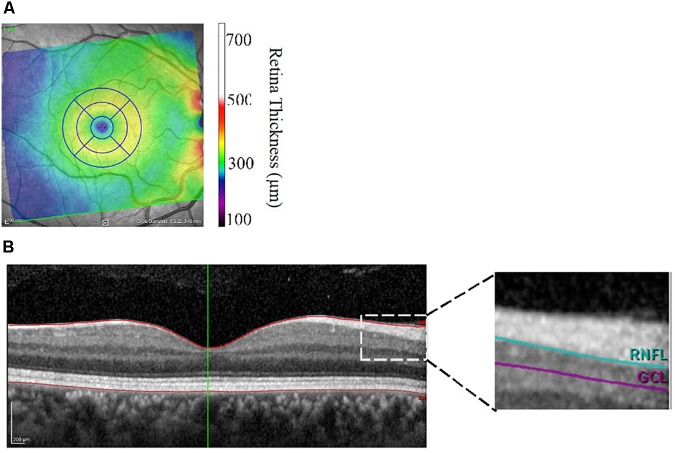
To investigate the relationship between retinal morphometric measures and intellectual abilities among adults with overweight and obesity. Adults between 25 and 45 years ( = 55, 38 females) with overweight or obesity (BMI ≥ 25.0 kg/m) underwent an optical coherence tomography (OCT) scan to assess retinal nerve fiber layer (RNFL) volume, ganglion cell layer (GCL) volume, macular volume, and central foveal thickness. Dual-Energy X-ray absorptiometry was used to assess whole-body adiposity (% Fat). The Kaufman Brief Intelligence Test-2 was used to assess general intelligence (IQ), fluid, and crystallized intelligence. Hierarchical linear regression analyses were performed to examine relationships between adiposity and intelligence measures following adjustment of relevant demographic characteristics and degree of adiposity (i.e., % Fat). Although initial bivariate correlations indicated that % Fat was inversely related to fluid intelligence, this relationship was mitigated by inclusion of other demographic factors, including age, sex, and education level. Regression analyses for primary outcomes revealed that RNFL was positively related to IQ and fluid intelligence. However, only GCL was positively related to crystallized intelligence. This work provides novel data linking specific retinal morphometric measures - assessed using OCT - to intellectual abilities among adults with overweight and obesity. www.clinicaltrials.gov, identifier NCT02740439.
为研究超重和肥胖成年人的视网膜形态测量指标与智力之间的关系。年龄在25至45岁之间(n = 55,女性38名)的超重或肥胖(BMI≥25.0kg/m²)成年人接受了光学相干断层扫描(OCT),以评估视网膜神经纤维层(RNFL)体积、神经节细胞层(GCL)体积、黄斑体积和中央凹厚度。采用双能X线吸收法评估全身肥胖程度(脂肪百分比)。使用考夫曼简易智力测验第二版评估一般智力(IQ)、流体智力和晶体智力。在调整了相关人口统计学特征和肥胖程度(即脂肪百分比)后,进行分层线性回归分析,以检验肥胖与智力测量指标之间的关系。尽管最初的双变量相关性表明脂肪百分比与流体智力呈负相关,但在纳入其他人口统计学因素(包括年龄、性别和教育水平)后,这种关系有所减弱。主要结局的回归分析显示,RNFL与IQ和流体智力呈正相关。然而,只有GCL与晶体智力呈正相关。这项研究提供了新的数据,将使用OCT评估的特定视网膜形态测量指标与超重和肥胖成年人的智力联系起来。ClinicalTrials.gov,标识符NCT02740439。