do Nascimento Kaut Natália Nogueira, Rabelo Ana Carolina Silveira, Araujo Glaucy Rodrigues, Taylor Jason Guy, Silva Marcelo Eustáquio, Pedrosa Maria Lúcia, Chaves Miriam Martins, Rossoni Junior Joamyr Victor, Costa Daniela Caldeira
Programa de Pós-graduação em Saúde e Nutrição, Escola de Nutrição, Universidade Federal de Ouro Preto (UFOP), Ouro Preto, MG, 35400-000, Brazil.
Programa de Pós-graduação em Ciências Biológicas, NUPEB, Universidade Federal de Ouro Preto (UFOP), Ouro Preto, MG, 35400-000, Brazil.
Evid Based Complement Alternat Med. 2018 Dec 4;2018:6532637. doi: 10.1155/2018/6532637. eCollection 2018.
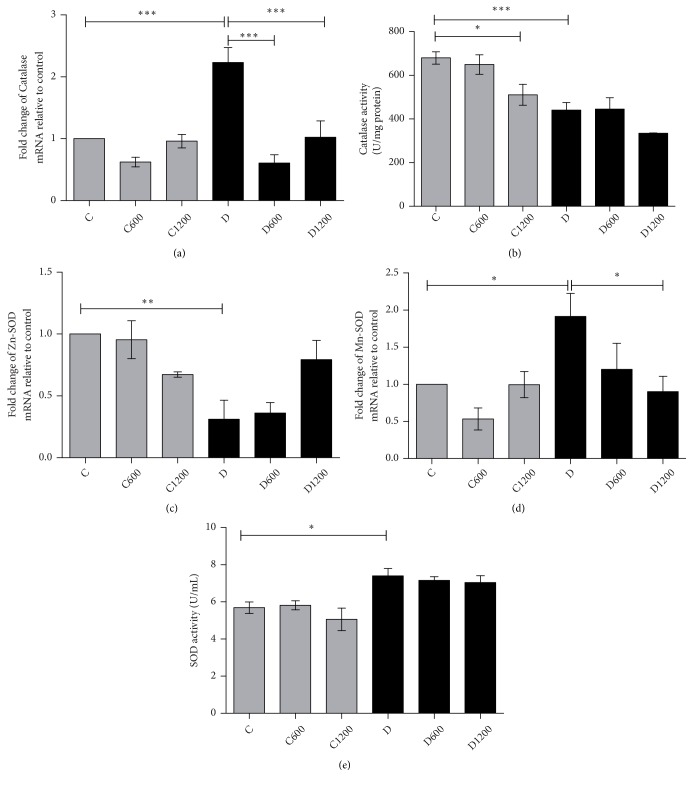
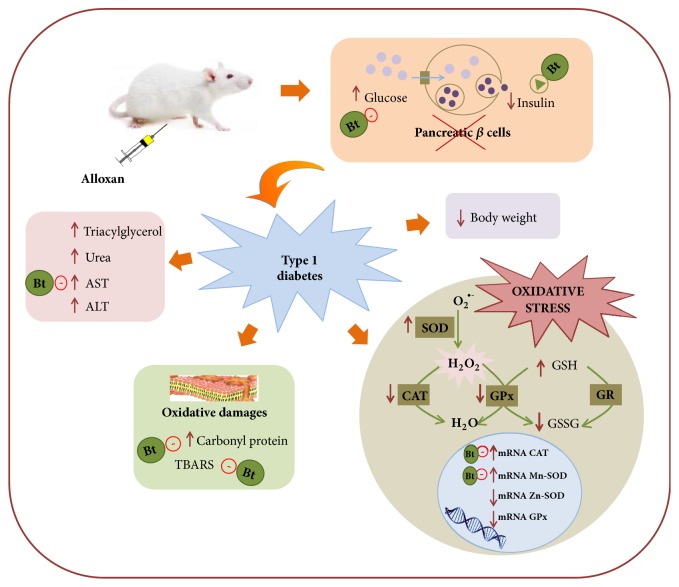
Diabetes mellitus is a metabolic disorder that causes severe complications due to the increased oxidative stress induced by disease. Many plants are popularly used in the treatment of diabetes, e.g., (carqueja). The aim of this study was to explore the potential application of the hydroethanolic extract in preventing redox stress induced by diabetes and its hypoglycemic properties. Experiments were conducted with 48 female rats, divided into 6 groups, named C (control), C600 (control + extract 600 mg/kg), C1200 (control + extract 1200 mg/kg), D (diabetic), D600 (diabetic + 600 mg/kg), and D1200 (diabetic + 1200 mg/kg). Type 1 diabetes was induced with alloxan, and the animals presented hyperglycemia and reduction in insulin and body weight. After seven days of experimentation, the nontreated diabetic group showed changes in biochemical parameters (urea, triacylglycerol, alanine aminotransferase, and aspartate aminotransferase) and increased carbonyl protein levels. Regarding the antioxidant enzymes, an increase in superoxide dismutase activity was observed but in comparison a decrease in catalase and glutathione peroxidase activity was noted which suggests that diabetic rats suffered redox stress. In addition, the mRNA of superoxide dismutase, catalase, and glutathione peroxidase enzymes were altered. Treatment of diabetic rats with extract resulted in an improved glycemic profile and liver function, decreased oxidative damage, and altered the expression of mRNA of the antioxidants enzymes. These results together suggest that hydroethanolic extract has a protective effect against diabetes.
糖尿病是一种代谢紊乱疾病,由于疾病诱导的氧化应激增加而导致严重并发症。许多植物被广泛用于治疗糖尿病,例如(卡克雅)。本研究的目的是探索该植物水乙醇提取物在预防糖尿病诱导的氧化还原应激及其降血糖特性方面的潜在应用。对48只雌性大鼠进行了实验,分为6组,分别命名为C(对照组)、C600(对照组 + 提取物600毫克/千克)、C1200(对照组 + 提取物1200毫克/千克)、D(糖尿病组)、D600(糖尿病组 + 600毫克/千克)和D1200(糖尿病组 + 1200毫克/千克)。用四氧嘧啶诱导1型糖尿病,动物出现高血糖以及胰岛素和体重下降。实验七天后,未治疗的糖尿病组显示生化参数(尿素、三酰甘油、丙氨酸氨基转移酶和天冬氨酸氨基转移酶)发生变化,羰基蛋白水平升高。关于抗氧化酶,观察到超氧化物歧化酶活性增加,但相比之下,过氧化氢酶和谷胱甘肽过氧化物酶活性下降,这表明糖尿病大鼠遭受了氧化还原应激。此外,超氧化物歧化酶、过氧化氢酶和谷胱甘肽过氧化物酶的mRNA也发生了改变。用该植物提取物治疗糖尿病大鼠可改善血糖状况和肝功能,减少氧化损伤,并改变抗氧化酶mRNA的表达。这些结果共同表明该植物水乙醇提取物对糖尿病具有保护作用。