Ilyushina Nataliya, Goumenou Marina, Stivaktakis Polychronis D, Vardavas Alexander I, Masaltsev Gleb, Averianova Nataliya, Dmitricheva Olga, Revazova Yulia, Tsatsakis Aristidis M, Rakitskii Valerii
The Federal Budgetary Establishment of Science "Federal Scientific Center of Hygiene named after F. F. Erisman" of the Federal Service for Surveillance on Consumer Rights Protection and Human Wellbeing, 2 Semashko street, Mytishchi, Moscow Oblast', 141014, Russian Federation.
Center of Toxicology Science & Research, Medical School, University of Crete, Heraklion, Crete, Greece.
Toxicol Rep. 2018 Dec 22;6:105-110. doi: 10.1016/j.toxrep.2018.12.006. eCollection 2019.
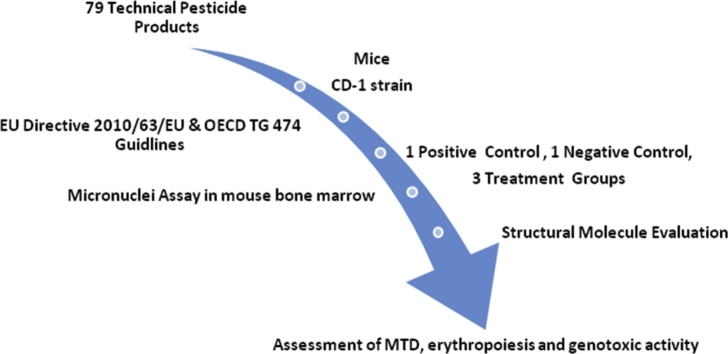
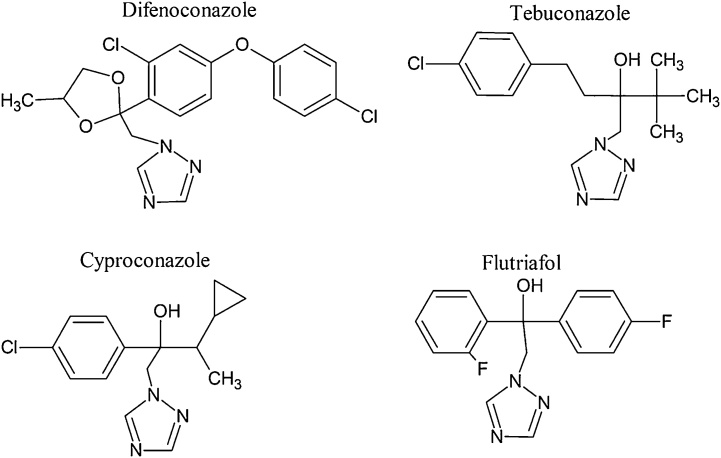
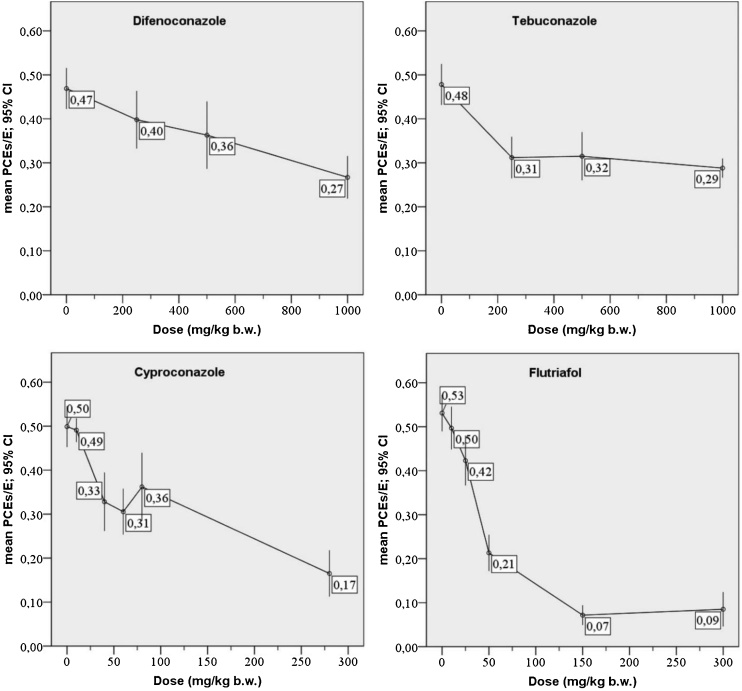
Effects of technical materials of pesticide active ingredients, belonging to various chemical classes, on erythropoiesis in mouse bone marrow were studied as part of the research on the pesticide mutagenic activity in micronucleus test. The purpose of the present study was to estimate the toxic action of the test substances on the target organ and the validity of the results of the micronucleus assay under conditions of erythropoiesis suppression. It was demonstrated that intragastrically administrated triazole pesticides reached bone marrow (target organ where micronucleus induction was assessed) and exerted an inhibitory effect on erythropoiesis. The effects of triazole pesticides were enhanced in the following order: difenoconazole ≤ tebuconazole < cyproconazole < flutriafol. Furthermore, an association between structural features of molecules and specific target organ activity of the test pesticides was observed. Based on the data on the general toxicity and the results of the evaluation of the effects on erythropoiesis, the maximum tolerated doses (MTDs) of 79 different technical materials of pesticides for CD-1 mice were determined.
作为农药微核试验致突变活性研究的一部分,对属于不同化学类别的农药活性成分技术材料对小鼠骨髓红细胞生成的影响进行了研究。本研究的目的是评估受试物质对靶器官的毒性作用以及在红细胞生成抑制条件下微核试验结果的有效性。结果表明,经胃内给药的三唑类农药可到达骨髓(评估微核诱导的靶器官)并对红细胞生成产生抑制作用。三唑类农药的作用效果按以下顺序增强:苯醚甲环唑≤戊唑醇<丙环唑<氟环唑。此外,还观察到受试农药分子结构特征与特定靶器官活性之间的关联。根据一般毒性数据和对红细胞生成影响的评估结果,确定了79种不同农药技术材料对CD-1小鼠的最大耐受剂量(MTD)。