Sinyuk Maksim, Mulkearns-Hubert Erin E, Reizes Ofer, Lathia Justin
Department of Biological, Geological, and Environmental Sciences, Cleveland State University, Cleveland, OH, United States.
Department of Cellular and Molecular Medicine, Lerner Research Institute, Cleveland Clinic, Cleveland, OH, United States.
Front Oncol. 2018 Dec 21;8:646. doi: 10.3389/fonc.2018.00646. eCollection 2018.
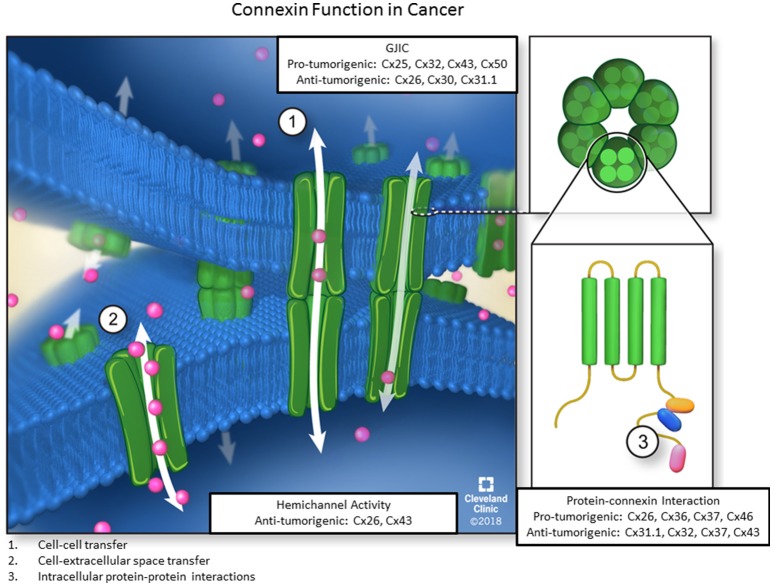
Despite concerted clinical and research efforts, cancer is a leading cause of death worldwide. Surgery, radiation, and chemotherapy have remained the most common standard-of-care strategies against cancer for decades. However, the side effects of these therapies demonstrate the need to investigate adjuvant novel treatment modalities that minimize the harm caused to healthy cells and tissues. Normal and cancerous cells require communication amongst themselves and with their surroundings to proliferate and drive tumor growth. It is vital to understand how intercellular and external communication impacts tumor cell malignancy. To survive and grow, tumor cells, and their normal counterparts utilize cell junction molecules including gap junctions (GJs), tight junctions, and adherens junctions to provide contact points between neighboring cells and the extracellular matrix. GJs are specialized structures composed of a family of connexin proteins that allow the free diffusion of small molecules and ions directly from the cytoplasm of adjacent cells, without encountering the extracellular milieu, which enables rapid, and coordinated cellular responses to internal and external stimuli. Importantly, connexins perform three main cellular functions. They enable direct gap junction intercellular communication (GJIC) between cells, form hemichannels to allow cell communication with the extracellular environment, and serve as a site for protein-protein interactions to regulate signaling pathways. Connexins themselves have been found to promote tumor cell growth and invasiveness, contributing to the overall tumorigenicity and have emerged as attractive anti-tumor targets due to their functional diversity. However, connexins can also serve as tumor suppressors, and therefore, a complete understanding of the roles of the connexins and GJs in physiological and pathophysiological conditions is needed before connexin targeting strategies are applied. Here, we discuss how the three aspects of connexin function, namely GJIC, hemichannel formation, and connexin-protein interactions, function in normal cells, and contribute to tumor cell growth, proliferation, and death. Finally, we discuss the current state of anti-connexin therapies and speculate which role may be most amenable for the development of targeting strategies.
尽管临床和研究工作协同推进,但癌症仍是全球主要的死亡原因。几十年来,手术、放疗和化疗一直是对抗癌症最常见的标准治疗策略。然而,这些疗法的副作用表明,有必要研究辅助性的新型治疗方式,以尽量减少对健康细胞和组织造成的损害。正常细胞和癌细胞需要彼此之间以及与周围环境进行沟通,才能增殖并推动肿瘤生长。了解细胞间和外部沟通如何影响肿瘤细胞的恶性程度至关重要。为了生存和生长,肿瘤细胞及其正常对应细胞利用包括缝隙连接(GJ)、紧密连接和黏附连接在内的细胞连接分子,在相邻细胞和细胞外基质之间提供接触点。GJ是由连接蛋白家族组成的特殊结构,允许小分子和离子直接从相邻细胞的细胞质中自由扩散,而无需穿过细胞外环境,这使得细胞能够对内部和外部刺激做出快速且协调的反应。重要的是,连接蛋白执行三种主要的细胞功能。它们使细胞之间能够进行直接的缝隙连接细胞间通讯(GJIC),形成半通道以允许细胞与细胞外环境进行通讯,并作为蛋白质 - 蛋白质相互作用的位点来调节信号通路。已发现连接蛋白本身可促进肿瘤细胞的生长和侵袭性,这对整体肿瘤发生有影响,并且由于其功能多样性,已成为有吸引力的抗肿瘤靶点。然而,连接蛋白也可以作为肿瘤抑制因子,因此,在应用针对连接蛋白的策略之前,需要全面了解连接蛋白和GJ在生理和病理生理条件下的作用。在此,我们讨论连接蛋白功能的三个方面,即GJIC、半通道形成和连接蛋白 - 蛋白质相互作用,在正常细胞中的功能,以及它们如何促进肿瘤细胞的生长、增殖和死亡。最后,我们讨论抗连接蛋白疗法的现状,并推测哪种作用可能最适合开发靶向策略。