Vanderbilt Genetics Institute, Vanderbilt University Medical Center, Nashville, TN, USA.
Human Genetics Center, School of Public Health, The University of Texas Health Science Center at Houston, Houston, TX, USA.
Hum Mol Genet. 2019 Apr 1;28(7):1212-1224. doi: 10.1093/hmg/ddy435.
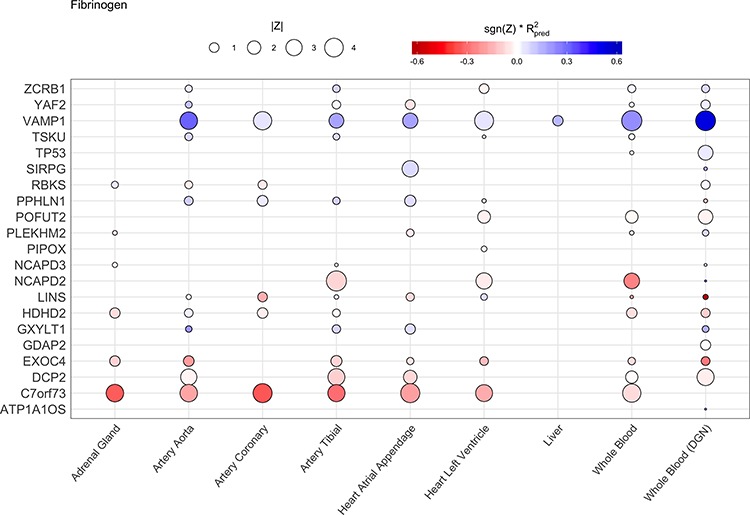
Interpretation of genetic association results is difficult because signals often lack biological context. To generate hypotheses of the functional genetic etiology of complex cardiometabolic traits, we estimated the genetically determined component of gene expression from common variants using PrediXcan (1) and determined genes with differential predicted expression by trait. PrediXcan imputes tissue-specific expression levels from genetic variation using variant-level effect on gene expression in transcriptome data. To explore the value of imputed genetically regulated gene expression (GReX) models across different ancestral populations, we evaluated imputed expression levels for predictive accuracy genome-wide in RNA sequence data in samples drawn from European-ancestry and African-ancestry populations and identified substantial predictive power using European-derived models in a non-European target population. We then tested the association of GReX on 15 cardiometabolic traits including blood lipid levels, body mass index, height, blood pressure, fasting glucose and insulin, RR interval, fibrinogen level, factor VII level and white blood cell and platelet counts in 15 755 individuals across three ancestry groups, resulting in 20 novel gene-phenotype associations reaching experiment-wide significance across ancestries. In addition, we identified 18 significant novel gene-phenotype associations in our ancestry-specific analyses. Top associations were assessed for additional support via query of S-PrediXcan (2) results derived from publicly available genome-wide association studies summary data. Collectively, these findings illustrate the utility of transcriptome-based imputation models for discovery of cardiometabolic effect genes in a diverse dataset.
遗传关联结果的解释具有挑战性,因为信号通常缺乏生物学背景。为了生成复杂心脏代谢特征的功能遗传病因假设,我们使用 PrediXcan(1)从常见变体估计基因表达的遗传决定成分,并确定通过特征具有差异预测表达的基因。PrediXcan 使用基因表达变体水平效应从遗传变异推断组织特异性表达水平在转录组数据中。为了探索跨不同祖先群体推断的遗传调节基因表达(GReX)模型的价值,我们评估了在欧洲血统和非洲血统样本中从 RNA 序列数据推断的表达水平的预测准确性全基因组,并使用欧洲衍生模型在非欧洲目标人群中发现了相当大的预测能力。然后,我们在包括血脂水平、体重指数、身高、血压、空腹血糖和胰岛素、RR 间隔、纤维蛋白原水平、因子 VII 水平以及白细胞和血小板计数在内的 15 个心脏代谢特征上测试了 GReX 的关联,在三个祖裔群体的 15755 个人中,结果在祖裔之间产生了 20 个新的基因表型关联达到实验范围的显著水平。此外,我们在特定于我们祖先的分析中确定了 18 个新的显著基因表型关联。通过查询来自公开可用全基因组关联研究汇总数据的 S-PrediXcan(2)结果,对顶级关联进行了额外支持的评估。总的来说,这些发现说明了基于转录组的推断模型在多样化数据集中发现心脏代谢效应基因的实用性。