Menzies Institute for Medical Research, University of Tasmania, Hobart, Australia.
Research Centre of Applied and Preventive Cardiovascular Medicine, University of Turku, Turku, Finland.
PLoS One. 2019 Jan 9;14(1):e0208491. doi: 10.1371/journal.pone.0208491. eCollection 2019.
Obesity has emerged as a major risk factor for non-communicable diseases in low and middle-income countries but may not follow typical socioeconomic status (SES)-related gradients seen in higher income countries. This study examines the associations between current and lifetime markers of SES and BMI categories (underweight, normal weight, overweight, obese) and central adiposity in Ghanaian adults.
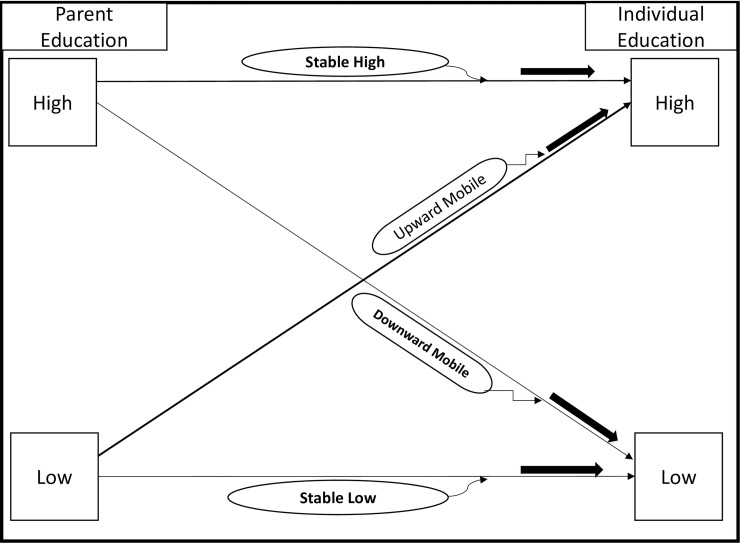
Data from 4,464 adults (2,610 women) who participated in the World Health Organization's Study on global AGEing and adult health (SAGE) Wave 2 were examined. Multilevel multinomial and binomial logistic regression models were used to examine associations. SES markers included parental education, individual education, intergenerational educational mobility and household wealth. Intergenerational educational mobility was classified: stable-low (low parental and low individual education), stable-high (high parental and high individual education), upwardly (low parental and high individual education), or downwardly mobile (high parental and low individual education).
The prevalence of obesity (12.9%) exceeded the prevalence of underweight (7.2%) in the population. High parental and individual education were significantly associated with higher odds of obesity and central adiposity in women. Compared to the stable low pattern, stable high (obesity: OR = 3.15; 95% CI: 1.96, 5.05; central adiposity: OR = 1.75; 95% CI: 1.03, 2.98) and upwardly (obesity: OR = 1.71; 95% CI: 11.13, 2.60; central adiposity: OR = 1.60; 95% CI: 1.08, 2.37) mobile education patterns were associated with higher odds of obesity and central adiposity in women, while stable high pattern was associated with higher odds of overweight (OR = 1.88; 95% CI: 1.11, 3.19) in men. Additionally, high compared to the lowest household wealth was associated with high odds of obesity and central adiposity in both sexes.
Stable high and upwardly mobile education patterns are associated with higher odds of obesity and central adiposity in women while the stable high pattern was associated with higher odds of overweight in men.
肥胖已成为中低收入国家非传染性疾病的主要危险因素,但它可能与高收入国家中常见的与社会经济地位(SES)相关的梯度不同。本研究探讨了加纳成年人当前和终身 SES 标志物与 BMI 类别(体重过轻、正常体重、超重、肥胖)和中心性肥胖之间的关系。
对参加世界卫生组织全球老龄化和成人健康研究(SAGE)第二波的 4464 名成年人(2610 名女性)的数据进行了分析。使用多层次多项和二项逻辑回归模型来检验关联。SES 标志物包括父母教育、个人教育、代际教育流动和家庭财富。代际教育流动分为:稳定低(父母和个人教育水平低)、稳定高(父母和个人教育水平高)、上升(父母教育水平低但个人教育水平高)或下降(父母教育水平高但个人教育水平低)。
该人群中肥胖的患病率(12.9%)超过了体重过轻的患病率(7.2%)。高父母教育和个人教育与女性肥胖和中心性肥胖的几率增加显著相关。与稳定低模式相比,稳定高(肥胖:OR = 3.15;95%CI:1.96,5.05;中心性肥胖:OR = 1.75;95%CI:1.03,2.98)和上升(肥胖:OR = 1.71;95%CI:11.13,2.60;中心性肥胖:OR = 1.60;95%CI:1.08,2.37)模式与女性肥胖和中心性肥胖的几率增加相关,而稳定高模式与男性超重的几率增加相关(OR = 1.88;95%CI:1.11,3.19)。此外,与最低家庭财富相比,高家庭财富与两性肥胖和中心性肥胖的几率增加相关。
稳定高和上升的教育模式与女性肥胖和中心性肥胖的几率增加相关,而稳定高模式与男性超重的几率增加相关。