Luria Shai, Talmud Daniel, Volk Ido, Liebergall Meir, Calderon-Margalit Ronit
Department of Orthopedic Surgery, Hadassah-Hebrew University Medical Center, Kiryat Hadassah, POB 12000, 91120, Jerusalem, Israel.
Braun School of Public Health and Community Medicine, Hebrew University, Jerusalem, Israel.
Isr J Health Policy Res. 2019 Jan 9;8(1):7. doi: 10.1186/s13584-018-0278-0.
Wrist and hand injuries are common and constitute a major economic burden. General injury prevention programs have failed to demonstrate a decrease in injury rates. We hypothesized that there are differences in injury patterns in culturally diverse subpopulations of a metropolitan area treated within the same medical system, which may partly explain the difficulties associated with injury prevention.
We conducted a survey of patients admitted to emergency departments of two hospitals in Jerusalem for wrist and hand injuries during a 3 month period. Patients were asked to complete a questionnaire regarding demographic data, injury type and mechanism. Injury type and mechanism were then compared for age, gender, level of education and degree of religiosity.
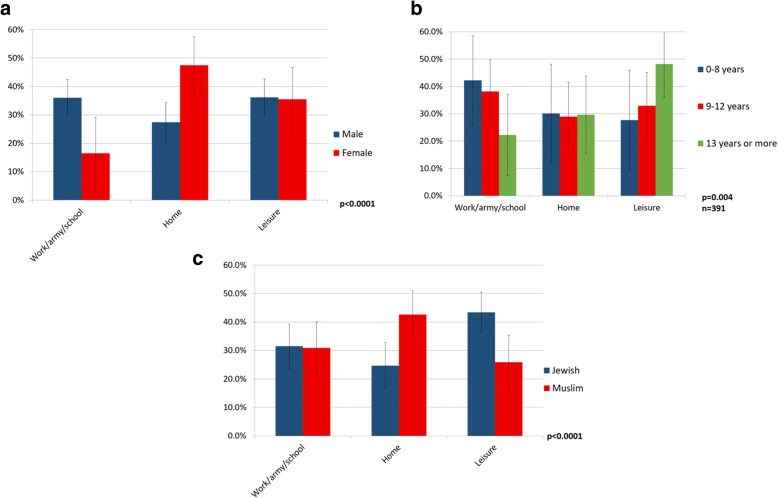
The questionnaire was completed by 799 patients (response rate 62%; 75% male; average age 27). Thirty-one percent reported they were injured at work, 33% at home and 36% during leisure activities. Data analysis showed that several subpopulations were found to be at risk as compared to their corresponding groups and relative proportion in the overall population of the city. These included contusions after falls in non-ultra-Orthodox Jewish women aged 65 years and over, crush injuries in ultra-Orthodox Jews under the age of 10 (53% vs. 14% for non ultra-Orthodox Jews, respectively) and Muslim teens. Muslims were injured more, especially at work, in comparison to their relative proportion in the population as a whole.
Different subpopulations at risk and different injury patterns of wrist and hand injuries were found in this culturally heterogeneous population. Awareness of these differences may be the first step when designing specific injury prevention programs in a culturally diverse population. A combined effort of community leaders and government agencies is needed to deal with the specific populations at risk, although legislation may be needed to limit some of the risks such as teens and specific work related hazards and exposures.
手腕和手部损伤很常见,构成了重大的经济负担。一般的伤害预防计划未能显示出伤害发生率的下降。我们推测,在同一医疗系统内接受治疗的大都市地区不同文化亚人群的损伤模式存在差异,这可能部分解释了伤害预防相关的困难。
我们对耶路撒冷两家医院急诊科在3个月期间因手腕和手部损伤入院的患者进行了调查。患者被要求填写一份关于人口统计学数据、损伤类型和机制的问卷。然后比较不同年龄、性别、教育水平和宗教虔诚程度的患者的损伤类型和机制。
799名患者完成了问卷(回复率62%;75%为男性;平均年龄27岁)。31%的患者报告他们在工作中受伤,33%在家中受伤,36%在休闲活动中受伤。数据分析表明,与城市总人口中的相应群体及其相对比例相比,有几个亚人群被发现处于风险中。这些包括65岁及以上非极端正统犹太女性跌倒后的挫伤、10岁以下极端正统犹太男性的挤压伤(分别为53%和14%,非极端正统犹太男性为14%)以及穆斯林青少年。与他们在整个人口中的相对比例相比,穆斯林受伤更多,尤其是在工作中。
在这个文化多元的人群中,发现了手腕和手部损伤的不同风险亚人群和不同损伤模式。认识到这些差异可能是在文化多元人群中设计特定伤害预防计划的第一步。需要社区领袖和政府机构共同努力来应对特定的风险人群,尽管可能需要立法来限制一些风险,如青少年以及与特定工作相关的危险和暴露。