Division of Public Health, NC Department of Health and Human Services, NC State Laboratory of Public Health.
Division of Public Health, NC Department of Health and Human Services, Communicable Disease Branch, Raleigh.
Sex Transm Dis. 2019 Apr;46(4):250-253. doi: 10.1097/OLQ.0000000000000974.
In this study, we evaluate the performance of the Syphilis Health Check (SHC) in clinical and laboratory settings using fingerstick whole blood and serum.
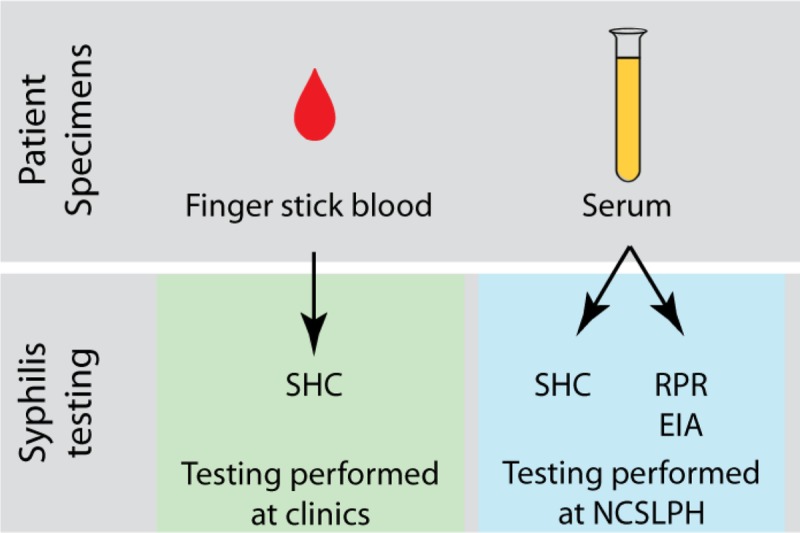
Fingerstick whole blood and serum specimens from adult patients (n = 562) without prior syphilis history presenting at 2 county health department STD clinics in North Carolina were tested. Fingerstick specimens were tested with the SHC in clinic, and serum specimens were tested at the North Carolina State Laboratory of Public Health with: (1) qualitative rapid plasma reagin, (2) treponemal EIA, and (3) SHC. Sensitivity and specificity were calculated with 95% confidence intervals.
The fingerstick whole blood had a sensitivity of 100% (7 of 7) and specificity of 95.7% (531 of 555), compared with consensus reference testing (CRT) (rapid plasma reagin and EIA reactive), but a sensitivity of 50% (8 of 16), and specificity of 95.9% (523 of 546), when compared with the treponemal EIA. Both laboratory-based SHC on serum and whole-blood SHC performed similarly, compared with CRT, and the treponemal EIA alone. Twenty-four specimens SHC reactive on whole blood were nonreactive by CRT. In 8 of these 24 cases, STD clinic staff reported difficulty reading the test line for the SHC. Of the fingerstick whole-blood SHC reactive specimens, only 14 of 31 were also serum SHC reactive.
The SHC on whole blood appears to be sensitive at detecting patients likely to have syphilis and could be an option for testing among high-risk populations. However, given challenges in interpreting SHC test results, adequate training of persons performing testing and ongoing quality assurance measures are key.
在这项研究中,我们评估了使用指尖全血和血清的梅毒健康检查(SHC)在临床和实验室环境中的性能。
对来自北卡罗来纳州 2 个县卫生部门 STD 诊所的无既往梅毒史的成年患者(n=562)的指尖全血和血清标本进行检测。在诊所使用 SHC 对指尖标本进行检测,并用北卡罗来纳州公共卫生实验室的以下方法对血清标本进行检测:(1)定性快速血浆反应素,(2)螺旋体 EIA,和(3)SHC。使用 95%置信区间计算灵敏度和特异性。
与共识参考检测(CRT)(快速血浆反应素和 EIA 阳性)相比,指尖全血的灵敏度为 100%(7/7),特异性为 95.7%(531/555),但与螺旋体 EIA 相比,灵敏度为 50%(8/16),特异性为 95.9%(523/546)。与 CRT 和单独的螺旋体 EIA 相比,基于实验室的血清 SHC 和全血 SHC 表现相似。24 份全血 SHC 阳性标本与 CRT 无反应。在这 24 例中,有 8 例 STD 诊所工作人员报告说难以读取 SHC 的测试线。在 24 例全血 SHC 阳性标本中,只有 14 例血清 SHC 也呈阳性。
全血 SHC 似乎对检测可能患有梅毒的患者具有敏感性,可能是高危人群检测的一种选择。然而,鉴于 SHC 测试结果解读的挑战,对进行测试的人员进行充分的培训以及持续的质量保证措施是关键。