Centre for Health and Environmental Risk Research, National Institute for Environmental Studies, Tsukuba, 305-8506, Japan.
Department of Public Health, School of Medicine, International University of Health and Welfare, Narita, 286-8686, Japan.
Environ Health Prev Med. 2019 Jan 10;24(1):6. doi: 10.1186/s12199-018-0755-7.
Over the past few decades, the Japanese Ministry of the Environment has been biomonitoring dioxins in the general Japanese population and, in response to public concerns, has taken measures to reduce dioxin exposure. The objectives of this study were to assess the current dioxin dietary intake and corresponding body burden in the Japanese and compare Japanese dioxin data from 2011 to 2016 and 2002-2010 surveys. We also examined the relationship between blood dioxins and health parameters/clinical biomarkers.
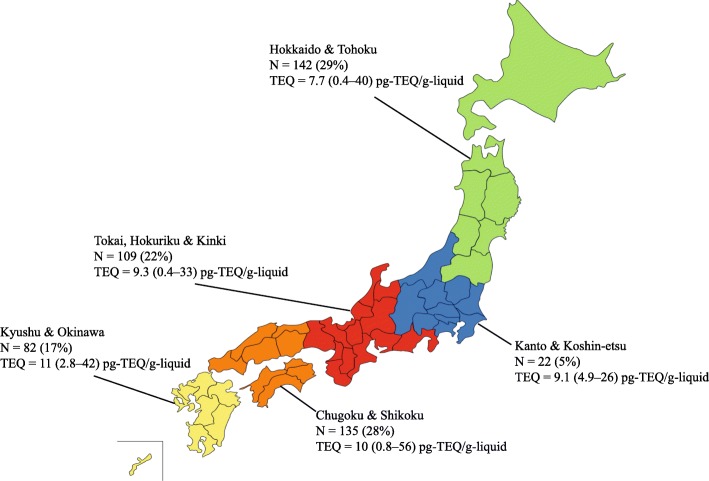
From 2011 to 2016, cross-sectional dioxin surveys were conducted on 490 Japanese (242 males and 248 females, aged 49.9 ± 7.6 years) from 15 Japanese prefectures. Blood (n = 490) and food samples (n = 90) were measured for 29 dioxin congeners including polychlorinated dibenzo-para-dioxins (PCDDs), polychlorinated dibenzofurans (PCDFs), and coplanar polychlorinated biphenyls (Co-PCBs) using gas chromatography coupled with high-resolution mass spectrometry. Using the 2006 World Health Organization toxic equivalence factors, the toxic equivalents (TEQs) were calculated. Clinical biomarkers and anthropometric parameters were also measured and information on lifestyle behaviours collected. Data imputations were applied to account for blood dioxins below the detection limit.
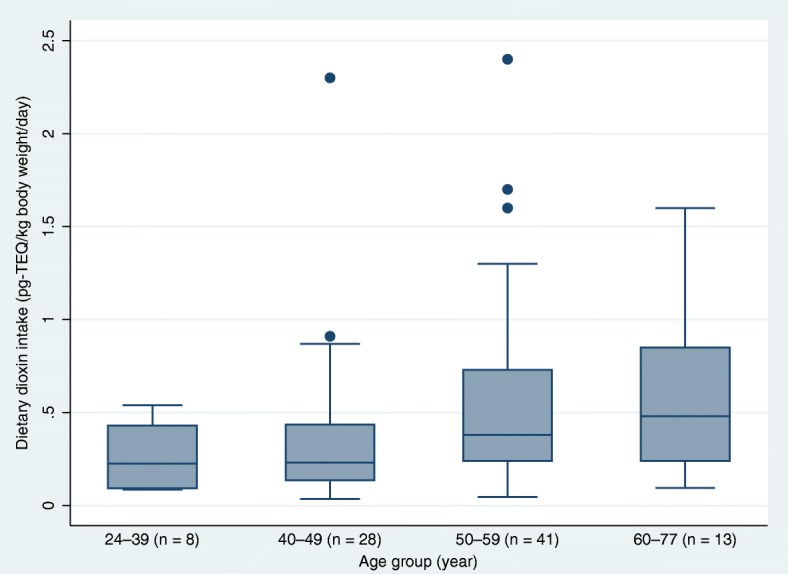
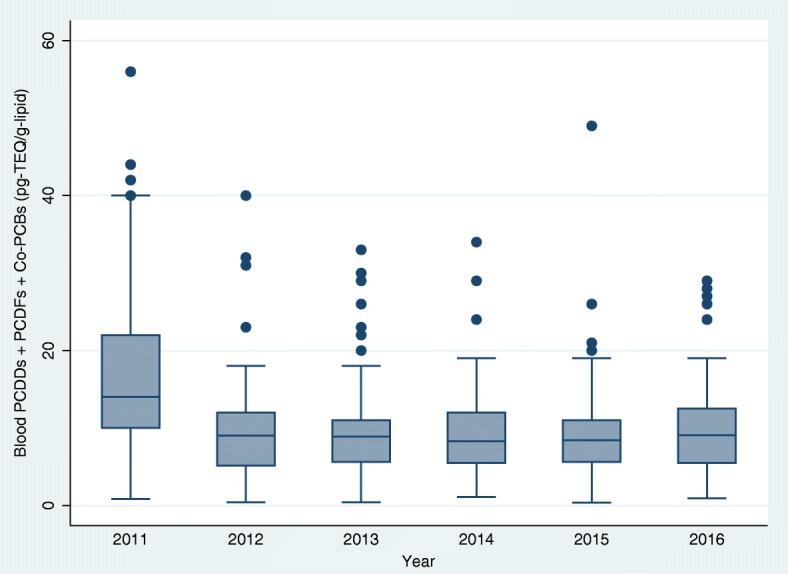
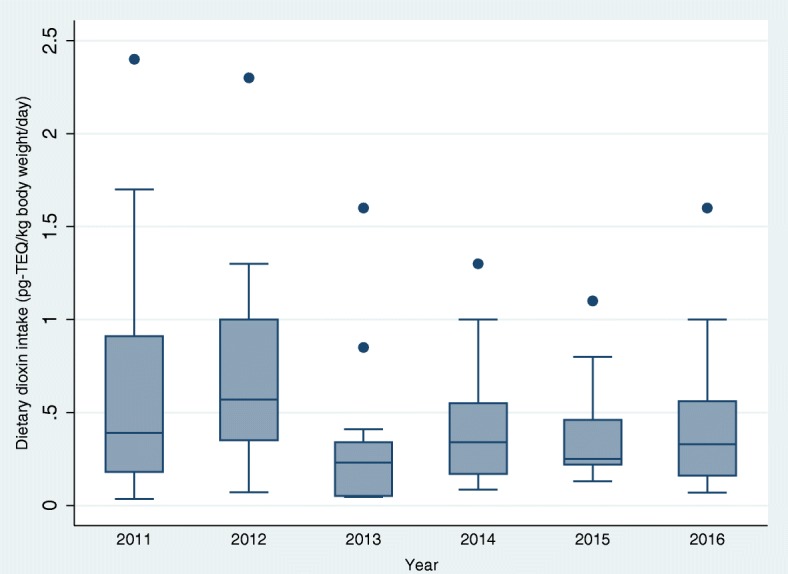
The median (95% confidence interval or CI) blood levels and dioxin dietary intake was respectively 9.4 (8.8-9.9) pg TEQ/g lipid and 0.3 (0.2-0.4) pg TEQ/kg body weight/day. The median blood dioxin level in the 2011-2016 survey was found to have decreased by 41.3% compared to the 2002-2010 surveys. Participants who were older were found to be more likely to have higher dioxin levels. Blood dioxins were also significantly associated with body mass index, triglycerides, docosahexaenoic acid, eicosapentaenoic acid, and dihomo-gamma-linoleic acid levels in blood. Furthermore, associations between blood dioxin and dietary dioxin intake were evident in the unadjusted models. However, after adjusting for confounders, blood dioxins were not found to be associated with dietary dioxin intake.
Blood dioxin levels declined over the past decade. This study showed that the measures and actions undertaken in Japan have possibly contributed to these reductions in the body burden of dioxins in the Japanese population.
在过去的几十年里,日本环境省一直在对日本普通人群中的二恶英进行生物监测,并针对公众的担忧采取了减少二恶英暴露的措施。本研究的目的是评估日本目前的二恶英饮食摄入量和相应的体内负荷,并将 2011 年至 2016 年和 2002-2010 年的日本二恶英数据进行比较。我们还研究了血液中二恶英与健康参数/临床生物标志物之间的关系。
2011 年至 2016 年,从日本 15 个县的 490 名日本人(242 名男性和 248 名女性,年龄 49.9±7.6 岁)中进行了二恶英横断面调查。测量了 490 名参与者的血液(n=490)和 90 名参与者的食物样本,用于 29 种二恶英同系物,包括多氯代二苯并对二恶英(PCDDs)、多氯代二苯并呋喃(PCDFs)和共平面多氯联苯(Co-PCBs),使用气相色谱法与高分辨率质谱法相结合。使用 2006 年世界卫生组织毒性等效因子,计算了毒性等效(TEQs)。还测量了临床生物标志物和人体测量参数,并收集了生活方式行为信息。应用数据插补法来计算低于检测限的血液中二恶英。
中位(95%置信区间或 CI)血液水平和二恶英饮食摄入量分别为 9.4(8.8-9.9)pg TEQ/g 脂质和 0.3(0.2-0.4)pg TEQ/kg 体重/天。与 2002-2010 年的调查相比,2011-2016 年调查中发现血液中二恶英水平中位数下降了 41.3%。研究发现,年龄较大的参与者体内的二恶英水平可能更高。血液中二恶英与血液中的体重指数、甘油三酯、二十二碳六烯酸、二十碳五烯酸和二高-γ-亚麻酸水平显著相关。此外,在未调整模型中,血液中二恶英与饮食中二恶英摄入之间存在关联。然而,在调整混杂因素后,血液中二恶英与饮食中二恶英摄入之间没有发现关联。
血液中二恶英水平在过去十年中下降。本研究表明,日本采取的措施和行动可能促成了日本人群中二恶英体内负荷的降低。