1 Laboratory of Addiction Genetics, Department of Pharmacology and Experimental Therapeutics, Boston University School of Medicine, Boston, MA, USA.
2 Department of Psychiatry, Boston University School of Medicine, Boston, MA, USA.
Mol Pain. 2019 Jan-Dec;15:1744806918825046. doi: 10.1177/1744806918825046.
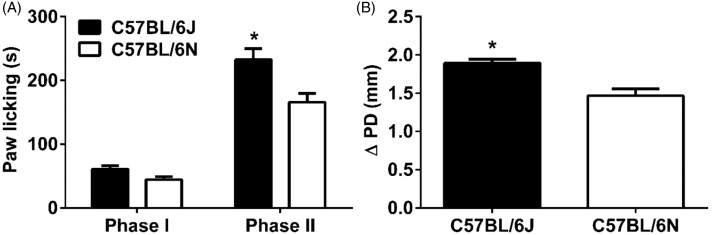
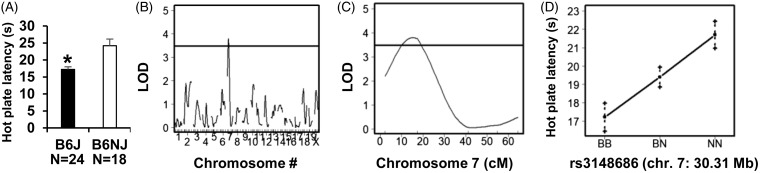
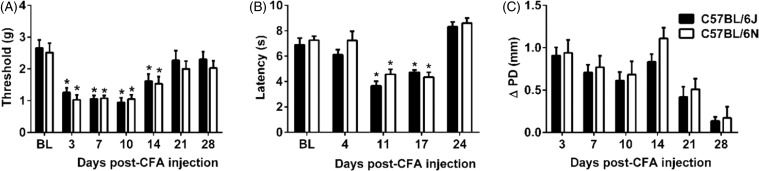
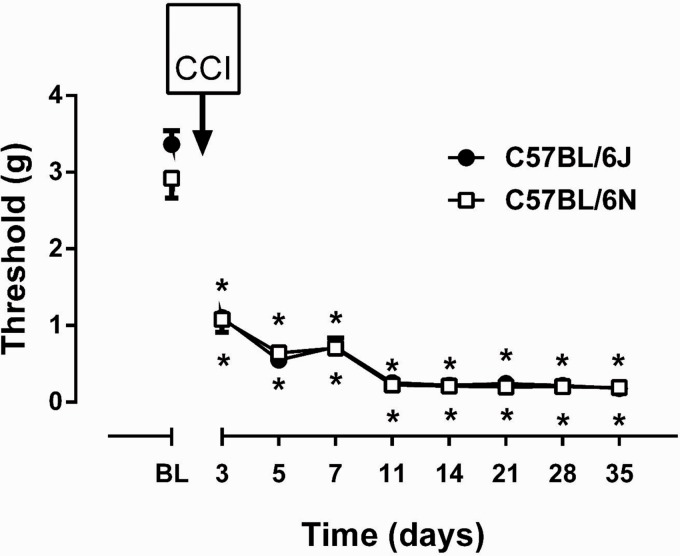
Sensitivity to different pain modalities has a genetic basis that remains largely unknown. Employing closely related inbred mouse substrains can facilitate gene mapping of nociceptive behaviors in preclinical pain models. We previously reported enhanced sensitivity to acute thermal nociception in C57BL/6J (B6J) versus C57BL/6N (B6N) substrains. Here, we expanded on nociceptive phenotypes and observed an increase in formalin-induced inflammatory nociceptive behaviors and paw diameter in B6J versus B6N mice (Charles River Laboratories). No strain differences were observed in mechanical or thermal hypersensitivity or in edema following the Complete Freund's Adjuvant model of inflammatory pain, indicating specificity in the inflammatory nociceptive stimulus. In the chronic constrictive nerve injury, a model of neuropathic pain, no strain differences were observed in baseline mechanical threshold or in mechanical hypersensitivity up to one month post-chronic constrictive nerve injury. We replicated the enhanced thermal nociception in the 52.5°C hot plate test in B6J versus B6N mice from The Jackson Laboratory. Using a B6J × B6N-F2 cross (N = 164), we mapped a major quantitative trait locus underlying hot plate sensitivity to chromosome 7 that peaked at 26 Mb (log of the odds [LOD] = 3.81, p < 0.01; 8.74 Mb-36.50 Mb) that was more pronounced in males. Genes containing expression quantitative trait loci associated with the peak nociceptive marker that are implicated in pain and inflammation include Ryr1, Cyp2a5, Pou2f2, Clip3, Sirt2, Actn4, and Ltbp4 (false discovery rate < 0.05). Future studies involving positional cloning and gene editing will determine the quantitative trait gene(s) and potential pleiotropy of this locus across pain modalities.
对不同疼痛模式的敏感性具有遗传基础,但这在很大程度上仍是未知的。使用密切相关的近交系小鼠亚系可以促进临床前疼痛模型中伤害感受行为的基因定位。我们之前曾报道过 C57BL/6J(B6J)与 C57BL/6N(B6N)亚系相比,对急性热伤害感受的敏感性增强。在这里,我们扩展了伤害感受表型,并观察到 B6J 与 B6N 小鼠福尔马林诱导的炎症性伤害感受行为和爪直径增加(Charles River Laboratories)。在完全弗氏佐剂诱导的炎症性疼痛模型中,没有观察到机械或热敏性或肿胀方面的品系差异,表明炎症性伤害感受刺激具有特异性。在神经病理性疼痛的慢性缩窄性神经损伤模型中,在慢性缩窄性神经损伤后一个月内,没有观察到基线机械阈值或机械敏化方面的品系差异。我们在来自 Jackson 实验室的 B6J 与 B6N 小鼠中复制了增强的热伤害感受。使用 B6J×B6N-F2 杂交(N=164),我们将一个主要的数量性状基因座映射到热板敏感性上,该基因座位于第 7 号染色体上,峰值为 26Mb(对数优势[LOD]=3.81,p<0.01;8.74 Mb-36.50 Mb),在雄性中更为明显。包含与峰值伤害感受标记物相关的表达数量性状基因座的基因,这些基因与疼痛和炎症有关,包括 Ryr1、Cyp2a5、Pou2f2、Clip3、Sirt2、Actn4 和 Ltbp4(错误发现率<0.05)。涉及定位克隆和基因编辑的未来研究将确定该基因座在不同疼痛模式下的数量性状基因和潜在的多效性。