Buresova Eva, Stock Emmelie, Paepe Dominique, Stammeleer Lisa, Vandermeulen Eva, Smets Pascale, Duchateau Luc, Lefebvre Herve P, Daminet Sylvie
The Small Animal Department, Ghent University, Merelbeke, Belgium.
The Department of Medical Imaging of Domestic Animals, Ghent University, Merelbeke, Belgium.
J Vet Intern Med. 2019 Mar;33(2):516-522. doi: 10.1111/jvim.15407. Epub 2019 Jan 11.
Measurement of serum creatinine (sCr) and urea nitrogen fail to detect decreased renal function in many hyperthyroid cats because of low muscle mass and glomerular hyperfiltration of affected cats. Serum symmetric dimethylarginine (sSDMA) is an earlier and more sensitive renal biomarker than sCr.
Evaluate sSDMA as a biomarker of renal function in hyperthyroid cats before (T0) and 1 month after (T1) radioiodine ( I) treatment.
Forty-seven client-owned hyperthyroid nonazotemic cats were evaluated at T0 and T1.
A prospective study in which sCr and sSDMA concentrations were determined in 47 hyperthyroid cats at T0 and at T1. Glomerular filtration rate (GFR) was estimated at T0 and T1 in 10 of these 47 cats using plasma exogenous creatinine clearance test.
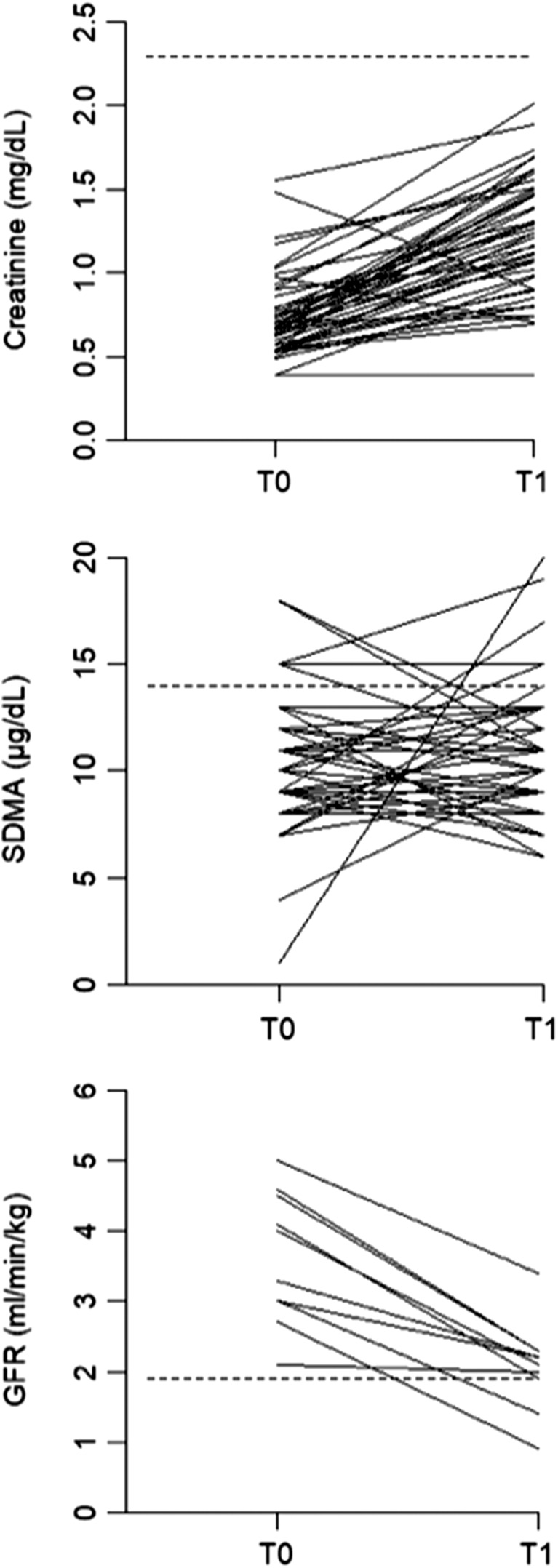
Serum SDMA was elevated (>14 μg/dL) in 6 of 47 cats at T0 and normalized after treatment in 4 of those cats. All cats remained nonazotemic after treatment. In 10 cats in which GFR was measured, correlation between GFR and sSDMA was low and not significant (τ = -0.35, P = .17 at T0 and τ = -.22, P = .41 at T1), whereas correlation between GFR and sCr was moderate and significant (τ = -0.52, P < .05 at T0 and τ = -.53, P = <.05 at T1).
Careful interpretation of mildly increased sSDMA with normal sCr in hyperthyroid cats is warranted as sSDMA values might normalize after resolution of hyperthyroidism in some cats. In this population of hyperthyroid cats, sSDMA was poorly correlated with GFR.
由于受影响猫的肌肉质量低和肾小球超滤,血清肌酐(sCr)和尿素氮的测量无法检测出许多甲状腺功能亢进猫的肾功能下降。血清对称二甲基精氨酸(sSDMA)是一种比sCr更早且更敏感的肾脏生物标志物。
评估sSDMA作为甲状腺功能亢进猫在放射性碘(I)治疗前(T0)和治疗后1个月(T1)肾功能的生物标志物。
47只客户拥有的非氮血症甲状腺功能亢进猫在T0和T1进行评估。
一项前瞻性研究,在47只甲状腺功能亢进猫的T0和T1测定sCr和sSDMA浓度。在这47只猫中的10只中,使用血浆外源性肌酐清除率试验在T0和T1估计肾小球滤过率(GFR)。
47只猫中有6只在T0时血清SDMA升高(>14μg/dL),其中4只猫在治疗后恢复正常。所有猫在治疗后仍保持非氮血症。在10只测量GFR的猫中,GFR与sSDMA之间的相关性较低且无统计学意义(T0时τ=-0.35,P=0.17;T1时τ=-0.22,P=0.41),而GFR与sCr之间的相关性中等且有统计学意义(T0时τ=-0.52,P<0.05;T1时τ=-0.53,P<0.05)。
鉴于某些猫甲状腺功能亢进症缓解后sSDMA值可能恢复正常,因此有必要对甲状腺功能亢进猫中sSDMA轻度升高而sCr正常的情况进行仔细解读。在这群甲状腺功能亢进猫中,sSDMA与GFR的相关性较差。