Infectious Diseases Research Laboratory, Department of Cellular and Molecular Sciences, School of Science and Philosophy, Universidad Peruana Cayetano Heredia, Lima, Peru.
Department of International Health, Johns Hopkins University Bloomberg School of Public Health, Baltimore, Maryland, United States of America.
PLoS Negl Trop Dis. 2019 Jan 11;13(1):e0007024. doi: 10.1371/journal.pntd.0007024. eCollection 2019 Jan.
The detection of Trypanosoma cruzi genetic material in clinical samples is considered an important diagnostic tool for Chagas disease. We have previously demonstrated that PCR using clot samples yields greater sensitivity than either buffy coat or whole blood samples. However, phenol-chloroform DNA extraction from clot samples is difficult and toxic. The objective of the present study was to improve and develop a more sensitive method to recover parasite DNA from clot samples for the diagnosis of Chagas disease.
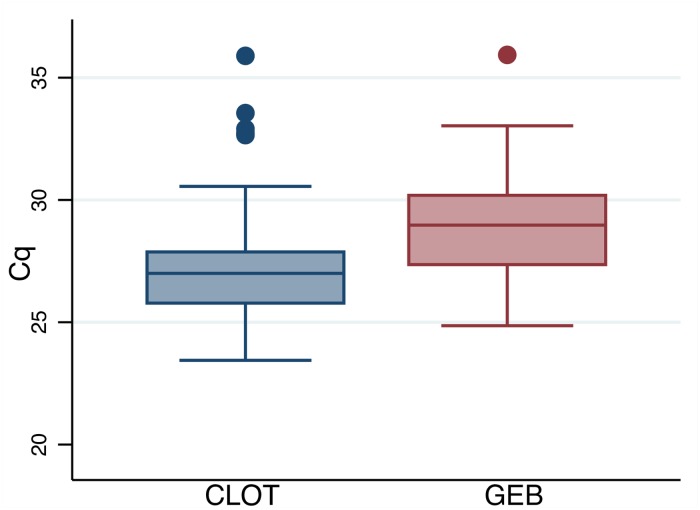
METHODOLOGY/PRINCIPAL FINDINGS: A total of 265 match pair samples of whole blood-guanidine (GEB) and clot samples were analyzed; 150 were from Chagas seropositive subjects. DNA was extracted from both whole blood-guanidine samples, using a previously standardized methodology, and from clot samples, using a newly developed methodology based on a combination of the FastPrep technique and the standard method for GEB extraction. A qPCR targeting the nuclear satellite sequences was used to compare the sample source and the extraction method. Of the 150 samples from Chagas positive individuals by serology, 47 samples tested positive by qPCR with DNA extracted by both GEB and clot, but an additional 13 samples tested positive only in DNA extracted from clot. No serology-negative samples resulted positive when tested by qPCR.
The new methodology for DNA extraction from clot samples improves the molecular diagnosis of Chagas disease.
检测临床样本中的克氏锥虫遗传物质被认为是查加斯病的重要诊断工具。我们之前已经证明,使用凝块样本进行 PCR 比使用血涂片或全血样本具有更高的灵敏度。然而,从凝块样本中提取酚氯仿 DNA 既困难又有毒。本研究的目的是改进和开发一种更敏感的方法,从凝块样本中回收寄生虫 DNA,用于诊断恰加斯病。
方法/主要发现:总共分析了 265 对全血-胍(GEB)和凝块样本,其中 150 份来自恰加斯病阳性个体。使用先前标准化的方法从全血-胍样本中提取 DNA,并使用新开发的方法从凝块样本中提取 DNA,该方法基于 FastPrep 技术和 GEB 提取的标准方法的组合。使用靶向核卫星序列的 qPCR 比较样本来源和提取方法。在通过血清学检测为阳性的 150 个恰加斯阳性个体样本中,有 47 个样本通过 qPCR 与使用 GEB 和凝块提取的 DNA 同时检测为阳性,但另外 13 个样本仅在从凝块中提取的 DNA 中检测为阳性。没有血清学阴性的样本在 qPCR 检测中呈阳性。
从凝块样本中提取 DNA 的新方法提高了恰加斯病的分子诊断水平。