Tsai Chun-Hao, Hung Chih-Hung, Kuo Che-Nan, Chen Cheng-Yu, Peng Yu-Ning, Shie Ming-You
School of Medicine, China Medical University, Taichung 40447, Taiwan.
Department of Orthopedics, China Medical University Hospital, Taichung 40447, Taiwan.
Materials (Basel). 2019 Jan 9;12(2):203. doi: 10.3390/ma12020203.
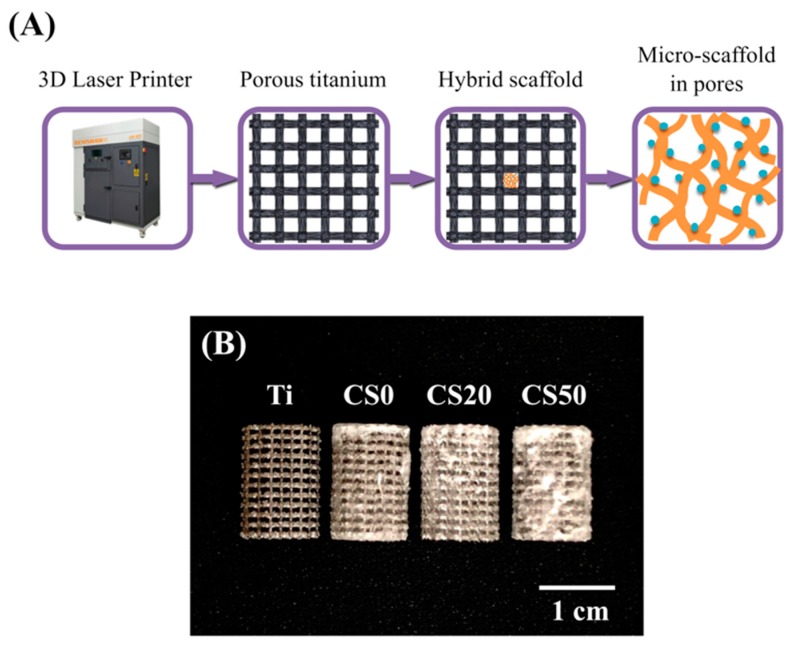
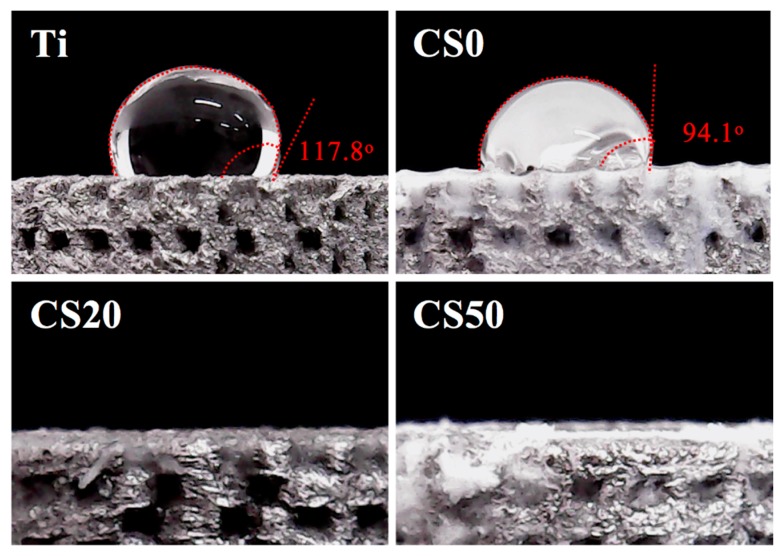
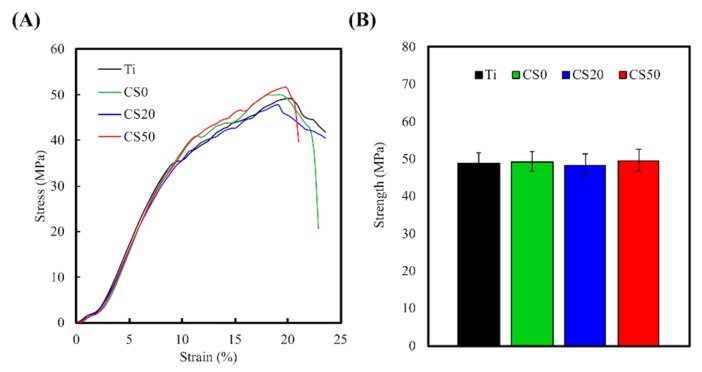
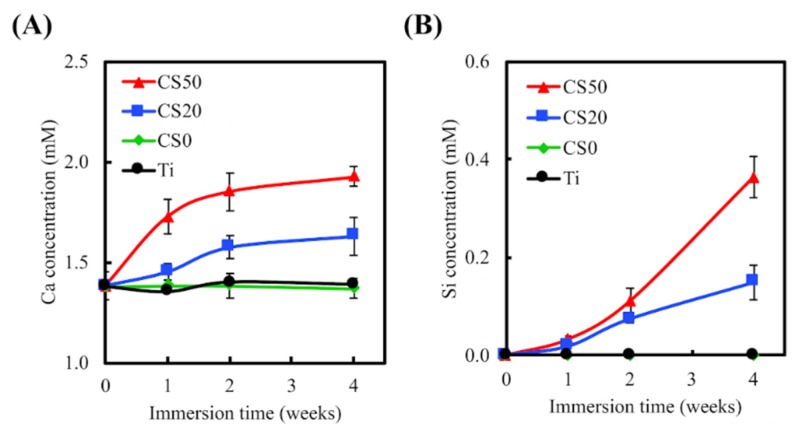
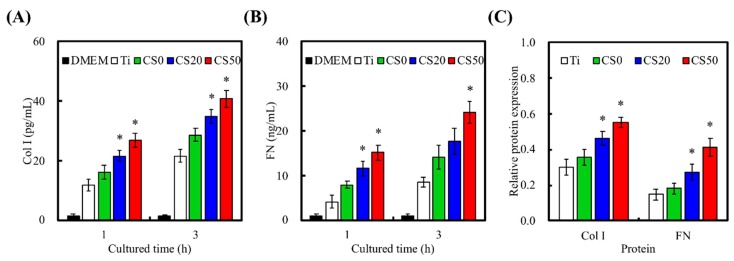
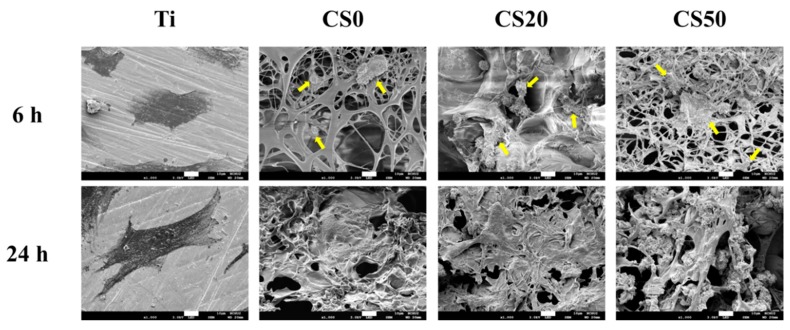
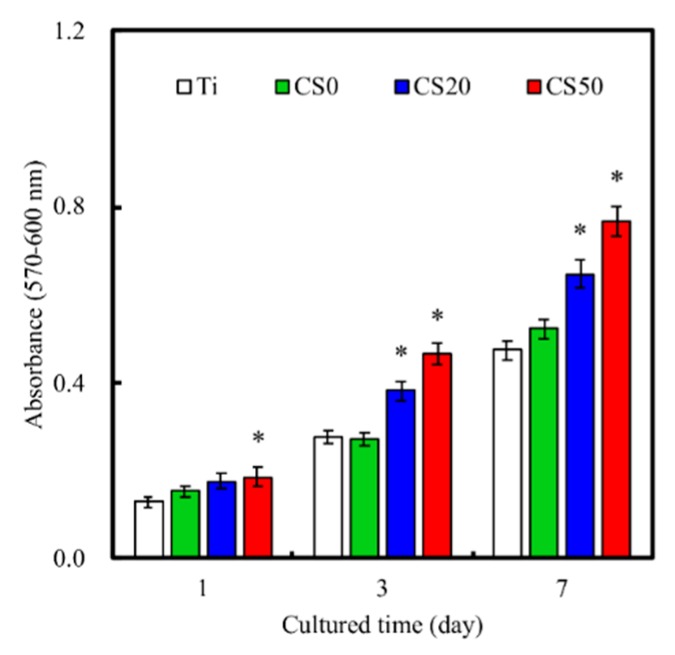
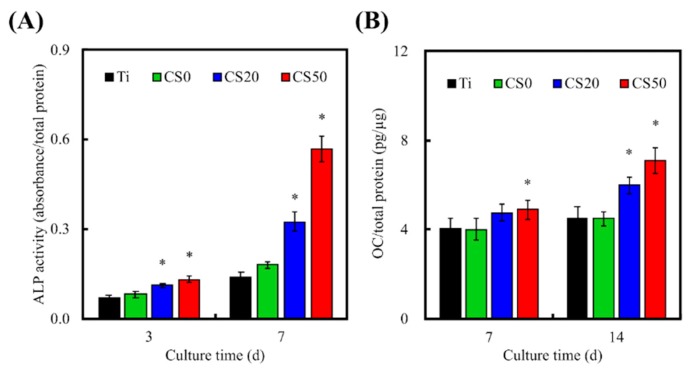
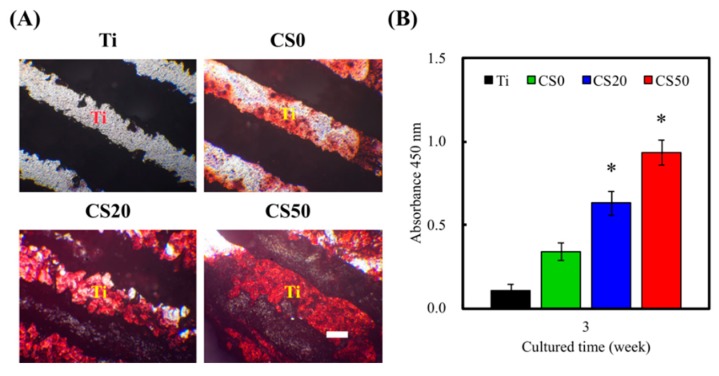
Recently, cases of bone defects have been increasing incrementally. Thus, repair or replacement of bone defects is gradually becoming a huge problem for orthopaedic surgeons. Three-dimensional (3D) scaffolds have since emerged as a potential candidate for bone replacement, of which titanium (Ti) alloys are one of the most promising candidates among the metal alloys due to their low cytotoxicity and mechanical properties. However, bioactivity remains a problem for metal alloys, which can be enhanced using simple immersion techniques to coat bioactive compounds onto the surface of Ti⁻6Al⁻4V scaffolds. In our study, we fabricated magnesium-calcium silicate (Mg⁻CS) and chitosan (CH) compounds onto Ti⁻6Al⁻4V scaffolds. Characterization of these surface-modified scaffolds involved an assessment of physicochemical properties as well as mechanical testing. Adhesion, proliferation, and growth of human Wharton's Jelly mesenchymal stem cells (WJMSCs) were assessed in vitro. In addition, the cell attachment morphology was examined using scanning electron microscopy to assess adhesion qualities. Osteogenic and mineralization assays were conducted to assess osteogenic expression. In conclusion, the Mg⁻CS/CH coated Ti⁻6Al⁻4V scaffolds were able to exhibit and retain pore sizes and their original morphologies and architectures, which significantly affected subsequent hard tissue regeneration. In addition, the surface was shown to be hydrophilic after modification and showed mechanical strength comparable to natural bone. Not only were our modified scaffolds able to match the mechanical properties of natural bone, it was also found that such modifications enhanced cellular behavior such as adhesion, proliferation, and differentiation, which led to enhanced osteogenesis and mineralization downstream. In vivo results indicated that Mg⁻CS/CH coated Ti⁻6Al⁻4V enhances the bone regeneration and ingrowth at the critical size bone defects of rabbits. These results indicated that the proposed Mg⁻CS/CH coated Ti⁻6Al⁻4V scaffolds exhibited a favorable, inducive micro-environment that could serve as a promising modification for future bone tissue engineering scaffolds.
近年来,骨缺损病例呈递增趋势。因此,骨缺损的修复或置换逐渐成为骨科医生面临的一大难题。三维(3D)支架应运而生,成为骨替代的潜在候选材料,其中钛(Ti)合金因其低细胞毒性和机械性能,成为金属合金中最有前景的候选材料之一。然而,生物活性仍是金属合金面临的一个问题,可以通过简单的浸泡技术将生物活性化合物涂覆在Ti⁻6Al⁻4V支架表面来增强其生物活性。在我们的研究中,我们在Ti⁻6Al⁻4V支架上制备了镁钙硅酸盐(Mg⁻CS)和壳聚糖(CH)化合物。对这些表面改性支架的表征包括物理化学性质评估以及力学测试。在体外评估了人脐带华通氏胶间充质干细胞(WJMSCs)的黏附、增殖和生长情况。此外,使用扫描电子显微镜检查细胞附着形态以评估黏附质量。进行了成骨和矿化测定以评估成骨表达。总之,Mg⁻CS/CH涂层的Ti⁻6Al⁻4V支架能够展现并保持孔径及其原始形态和结构,这对随后的硬组织再生有显著影响。此外,改性后的表面显示出亲水性,并具有与天然骨相当的机械强度。我们的改性支架不仅能够匹配天然骨的机械性能,还发现这种改性增强了细胞行为,如黏附、增殖和分化,从而导致下游成骨和矿化增强。体内结果表明,Mg⁻CS/CH涂层的Ti⁻6Al⁻4V可促进兔临界尺寸骨缺损处的骨再生和骨长入。这些结果表明,所提出的Mg⁻CS/CH涂层的Ti⁻6Al⁻4V支架展现出良好的、诱导性的微环境,有望成为未来骨组织工程支架的一种有前景的改性材料。