Traks Tanel, Keermann Maris, Prans Ele, Karelson Maire, Loite Ulvi, Kõks Gea, Silm Helgi, Kõks Sulev, Kingo Külli
Department of Dermatology and Venerology, University of Tartu, 31 Raja St, 50417, Tartu, Estonia.
Clinic of Dermatology, Tartu University Hospital, 31 Raja St, 50417, Tartu, Estonia.
BMC Med Genet. 2019 Jan 11;20(1):10. doi: 10.1186/s12881-018-0742-2.
Plaque psoriasis is a non-contagious skin disease in which characteristic red and flaky lesions result from a dysregulation involving both innate and adaptive immune mechanisms. Several cytokines have been implicated in these processes and lately interleukin (IL)-36 family members have become more recognised among them. Thus far, genetic studies have only investigated IL36RN gene of this family in relation to pustular psoriasis. Since IL36G has previously demonstrated markedly increased levels in plaque psoriasis patients and is linked to IL-23/IL-17 axis critical in psoriasis pathology, it was chosen to be the focus of current report.
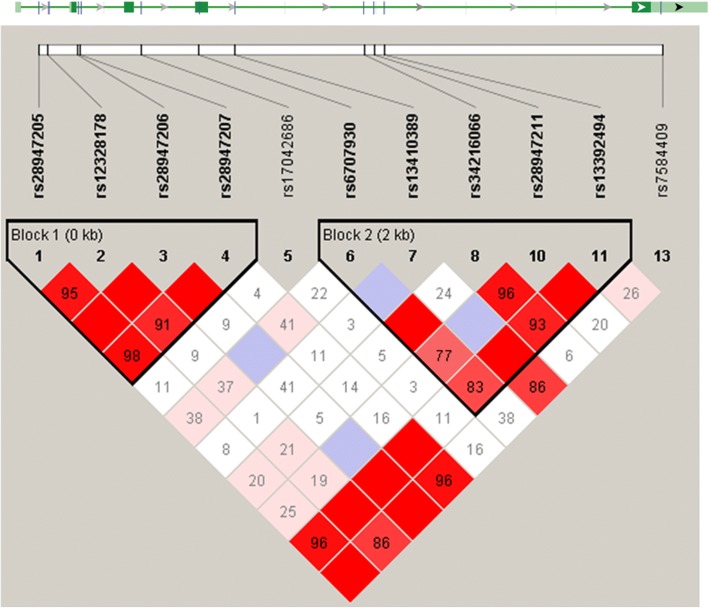
Eleven SNPs from IL36G region were genotyped in 728 plaque psoriasis patients and 320 healthy control individuals. Allele and haplotype frequencies between patients and controls were assessed by respective association tests. For more specific analyses, the patients were assigned into subgroups according to sex, age of disease onset, occurrence of psoriasis among relatives, seasonal aggravation, arthritis symptoms, body surface area (BSA) scores, and Psoriasis Area and Severity Index (PASI) scores.
The most significant results were obtained with SNPs rs28947206, rs28947207 and rs28947211 that were associated in entire plaque psoriasis analysis (multiple testing adjusted p value (p) = 0.0054, p = 0.0017 and p = 0.0001) and also several subgroups. The first two of those SNPs were included in the same haplotype block with rs28947205 and rs12328178, and two of the respective haplotypes, CAGC and TGTT, provided similarly significant associations (p = 0.0462 and p = 0.0047).
The associated SNPs of this study or those in linkage disequilibrium with them could potentially affect the functionality of IL-36γ cytokine, which in turn may impact plaque psoriasis pathology. For instance, these variants could influence IL-36γ expression or 3D structure, thereby altering its ability to induce chemokine production in keratinocytes and various immune cells. The precise mechanisms of these actions are currently unknown and out of the scope of this study. To conclude, the present genetic association results confirm the proposed role of IL-36γ in plaque psoriasis development, with corresponding causal effects to be determined in forthcoming research.
斑块状银屑病是一种非传染性皮肤病,其特征性的红色鳞屑性皮损是由先天性和适应性免疫机制失调所致。多种细胞因子参与了这些过程,近来白细胞介素(IL)-36家族成员在其中受到了更多关注。迄今为止,基因研究仅调查了该家族的IL36RN基因与脓疱型银屑病的关系。由于IL36G此前已证实在斑块状银屑病患者中水平显著升高,且与银屑病病理中关键的IL-23/IL-17轴相关,因此它被选为当前报告的重点。
对728例斑块状银屑病患者和320名健康对照个体进行了IL36G区域11个单核苷酸多态性(SNP)的基因分型。通过各自的关联测试评估患者和对照之间的等位基因和单倍型频率。为了进行更具体的分析,根据性别、发病年龄、亲属中银屑病的发生情况、季节性加重、关节炎症状、体表面积(BSA)评分以及银屑病面积和严重程度指数(PASI)评分将患者分为亚组。
在整个斑块状银屑病分析(多重检验校正p值(p)=0.0054、p =0.0017和p =0.0001)以及几个亚组中,SNP rs28947206、rs28947207和rs28947211获得了最显著的结果。其中前两个SNP与rs28947205和rs12328178包含在同一单倍型块中,相应的两个单倍型CAGC和TGTT也提供了类似的显著关联(p =0.0462和p =0.0047)。
本研究中相关的SNP或与它们处于连锁不平衡的SNP可能会潜在地影响IL-36γ细胞因子的功能,进而可能影响斑块状银屑病的病理过程。例如,这些变异可能影响IL-3