Reprofit International, Clinic of Reproductive Medicine, Hlinky 122, 603 00, Brno, Czech Republic.
Faculty of Medicine, Department of Histology and Embryology, Masaryk University, Kamenice 3, 625 00, Brno, Czech Republic.
J Assist Reprod Genet. 2019 Mar;36(3):445-452. doi: 10.1007/s10815-018-1393-0. Epub 2019 Jan 12.
The presence of metaphase II (MII) spindle together with the polar body (PB) indicates completion of oocyte maturation. This study was designed to explore if spindle imaging can be used to optimize timing of intracytoplasmic sperm injection (ICSI).
The study involved 916 oocytes from 234 conventionally stimulated ICSI cycles with an unexpectedly poor ovarian response. All PB-displaying oocytes were subjected to polarized light microscopy (PLM) prior to ICSI. When MII spindle was absent in the majority of oocytes, ICSI was postponed and performed after additional spindle imaging. Fertilization, embryo development, and clinical outcome were evaluated with respect to the observed spindle pattern.
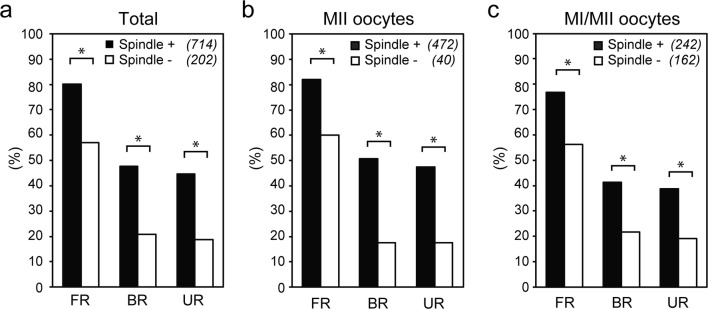
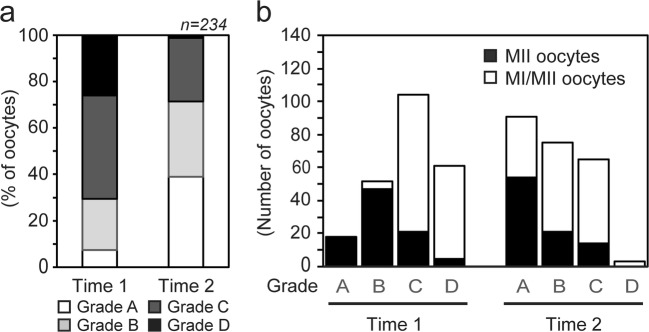
The visible spindle was absent in 32.64% of PB-displaying oocytes. The late-maturing oocytes extruding PB in vitro were less likely to exhibit a spindle signal than in vivo matured MII oocytes (38.86% vs. 89.84%). When fertilization was postponed, 59.39% of initially spindle-negative oocytes developed detectable MII spindle. Spindled eggs had significantly higher developmental potential, and the presence of the spindle has been identified as an independent measure for predicting the formation of the blastocyst. Embryos derived from spindle-positive oocytes also showed a higher chance to implant and develop to term. Notably, 11 children were conceived by finely timed fertilization of late-maturing oocytes which are normally discarded.
The study confirms the prognostic value of spindle imaging and demonstrates that immature oocytes can be clinically utilized and give rise to live births when the timing of ICSI is adjusted to their developmental stage.
中期 II (MII)纺锤体与极体(PB)的存在表明卵母细胞成熟完成。本研究旨在探讨纺锤体成像是否可用于优化胞质内精子注射(ICSI)的时机。
这项研究涉及 234 个常规刺激 ICSI 周期中 916 个卵子,这些卵子的卵巢反应出乎意料地差。所有显示 PB 的卵子在 ICSI 前均进行偏振光显微镜(PLM)检查。当大多数卵子中没有 MII 纺锤体时,推迟 ICSI 并在进行额外的纺锤体成像后进行。根据观察到的纺锤体模式评估受精、胚胎发育和临床结局。
可见纺锤体在 32.64%的显示 PB 的卵子中缺失。体外排出 PB 的晚期成熟卵子比体内成熟的 MII 卵子更不可能显示纺锤体信号(38.86%比 89.84%)。当受精被推迟时,最初纺锤体阴性的卵子中有 59.39%发育出可检测的 MII 纺锤体。有纺锤体的卵子具有显著更高的发育潜力,并且纺锤体的存在已被确定为预测囊胚形成的独立指标。来自有纺锤体的卵子的胚胎也显示出更高的着床和发育到足月的机会。值得注意的是,通过精细调整正常丢弃的晚期成熟卵子的受精时间,成功孕育了 11 名儿童。
该研究证实了纺锤体成像的预后价值,并表明不成熟的卵子可以在调整 ICSI 时机以适应其发育阶段时被临床利用并产生活产。