Kim Ji Hyun, Cho Kwang Ho, Jin Zhe Wu, Murakami Gen, Abe Hiroshi, Chai Ok Hee
Department of Anatomy and Institute of Medical Science, Chonbuk National University Medical School, Jeonju, Korea.
Department of Neurology, Wonkwang University School of Medicine and Hospital, Institute of Wonkwang Medical Science, Iksan, Korea.
Anat Cell Biol. 2018 Dec;51(4):266-273. doi: 10.5115/acb.2018.51.4.266. Epub 2018 Dec 29.
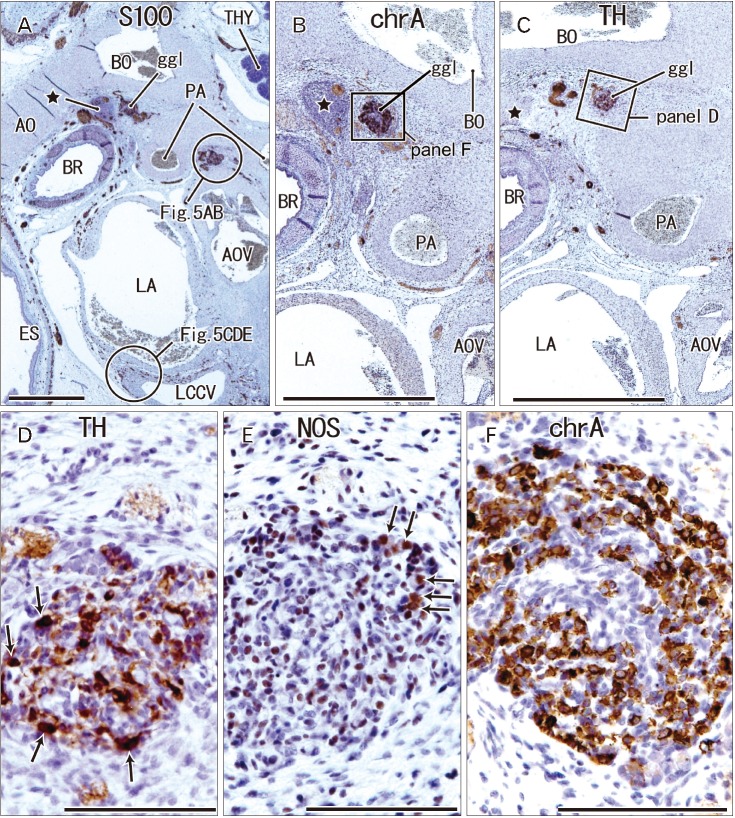
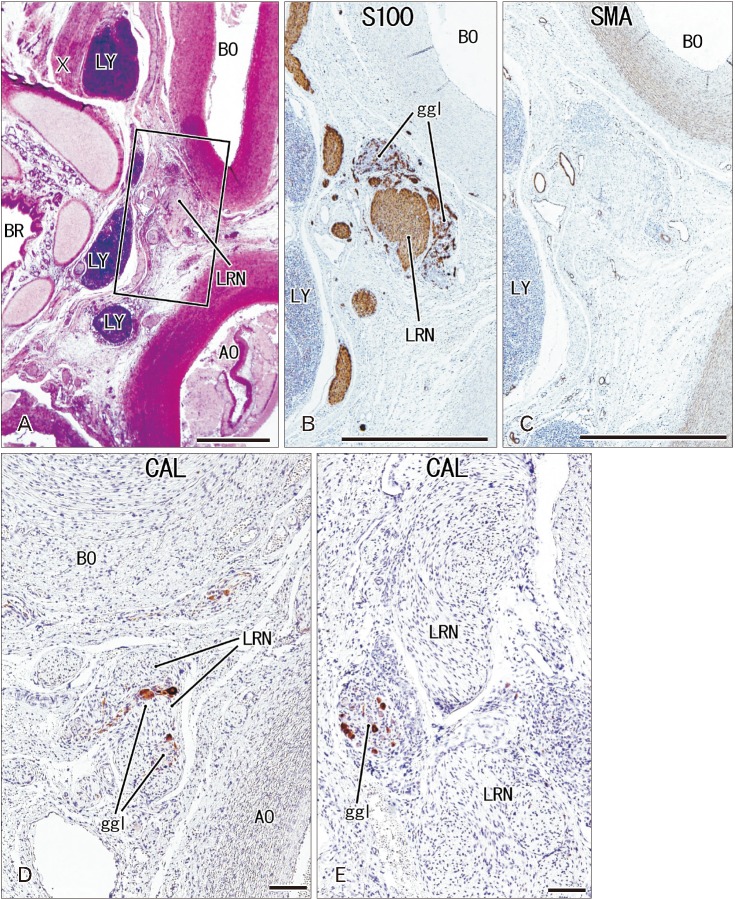
The ganglion cardiacum or juxtaductal body is situated along the left recurrent laryngeal nerve in the aortic window and is an extremely large component of the cardiac nerve plexus. This study was performed to describe the morphologies of the ganglion cardiacum or juxtaductal body in human fetuses and to compare characteristics with intracardiac ganglion. Ganglia were immunostained in specimens from five fetuses of gestational age 12-16 weeks and seven fetuses of gestational age 28-34 weeks. Many ganglion cells in the ganglia were positive for tyrosine hydroxylase (TH; sympathetic nerve marker) and chromogranin A, while a few neurons were positive for neuronal nitric oxide synthase (NOS; parasympathetic nerve marker) or calretinin. Another ganglion at the base of the ascending aorta carried almost the same neuronal populations, whereas a ganglion along the left common cardinal vein contained neurons positive for chromogranin A and NOS but no or few TH-positive neurons, suggesting a site-dependent difference in composite neurons. Mixtures of sympathetic and parasympathetic neurons within a single ganglion are consistent with the morphology of the cranial base and pelvic ganglia. Most of the intracardiac neurons are likely to have a non-adrenergic non-cholinergic phenotype, whereas fewer neurons have a dual cholinergic/noradrenergic phenotype. However, there was no evidence showing that chromogranin A- and/or calretinin-positive cardiac neurons corresponded to these specific phenotypes. The present study suggested that the ganglion cardiacum was composed of a mixture of sympathetic and parasympathetic neurons, which were characterized the site-dependent differences in and near the heart.
心神经节或导管旁体位于主动脉窗内的左喉返神经旁,是心脏神经丛的一个非常大的组成部分。本研究旨在描述人类胎儿心神经节或导管旁体的形态,并与心内神经节的特征进行比较。对来自5例孕龄12 - 16周胎儿和7例孕龄28 - 34周胎儿的标本进行神经节免疫染色。神经节中的许多神经节细胞酪氨酸羟化酶(TH;交感神经标志物)和嗜铬粒蛋白A呈阳性,而少数神经元神经元型一氧化氮合酶(NOS;副交感神经标志物)或钙视网膜蛋白呈阳性。升主动脉根部的另一个神经节所含神经元群体几乎相同,而沿左总主静脉的一个神经节含有嗜铬粒蛋白A和NOS阳性的神经元,但TH阳性神经元没有或很少,提示复合神经元存在部位依赖性差异。单个神经节内交感和副交感神经元的混合与颅底和盆腔神经节的形态一致。大多数心内神经元可能具有非肾上腺素能非胆碱能表型,而具有胆碱能/去甲肾上腺素能双重表型的神经元较少。然而,没有证据表明嗜铬粒蛋白A和/或钙视网膜蛋白阳性的心脏神经元与这些特定表型相对应。本研究表明,心神经节由交感和副交感神经元混合组成,其特征是心脏及其附近存在部位依赖性差异。