Kidney Research Center and Department of Nephrology, Linkou Chang Gung Memorial Hospital, Taoyuan, Taiwan.
Department of Medicine, Chang Gung University, Taoyuan, Taiwan.
PLoS One. 2019 Jan 14;14(1):e0210633. doi: 10.1371/journal.pone.0210633. eCollection 2019.
Lupus nephritis (LN) frequently progresses to end-stage renal disease. Finding a biomarker for LN and a predictor for the development of chronic kidney disease (CKD) is important for patients with systemic lupus erythematosus (SLE).
Ninety patients with SLE were divided into biopsy-proven LN (n = 54) and no kidney involvement (non-LN) (n = 36) groups and followed up for 54 months.
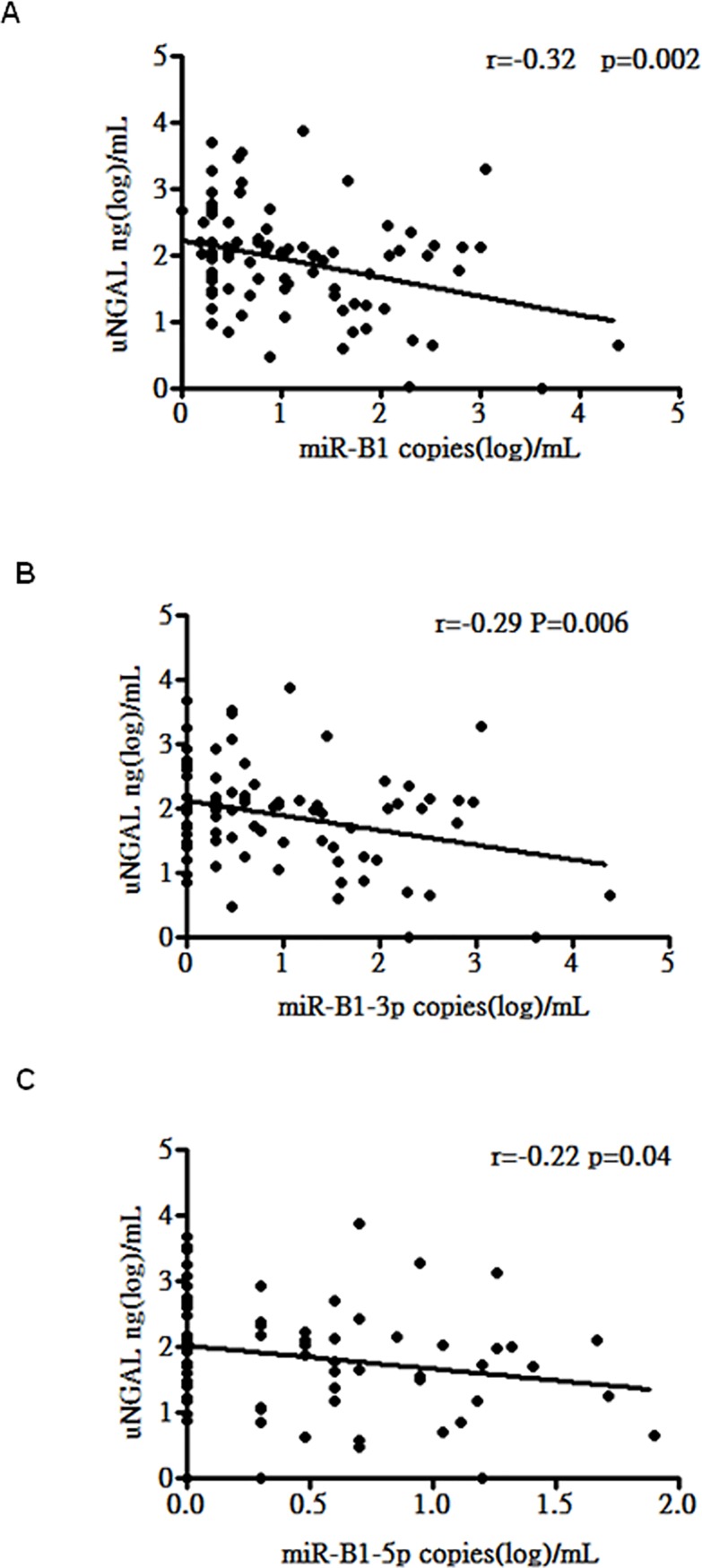
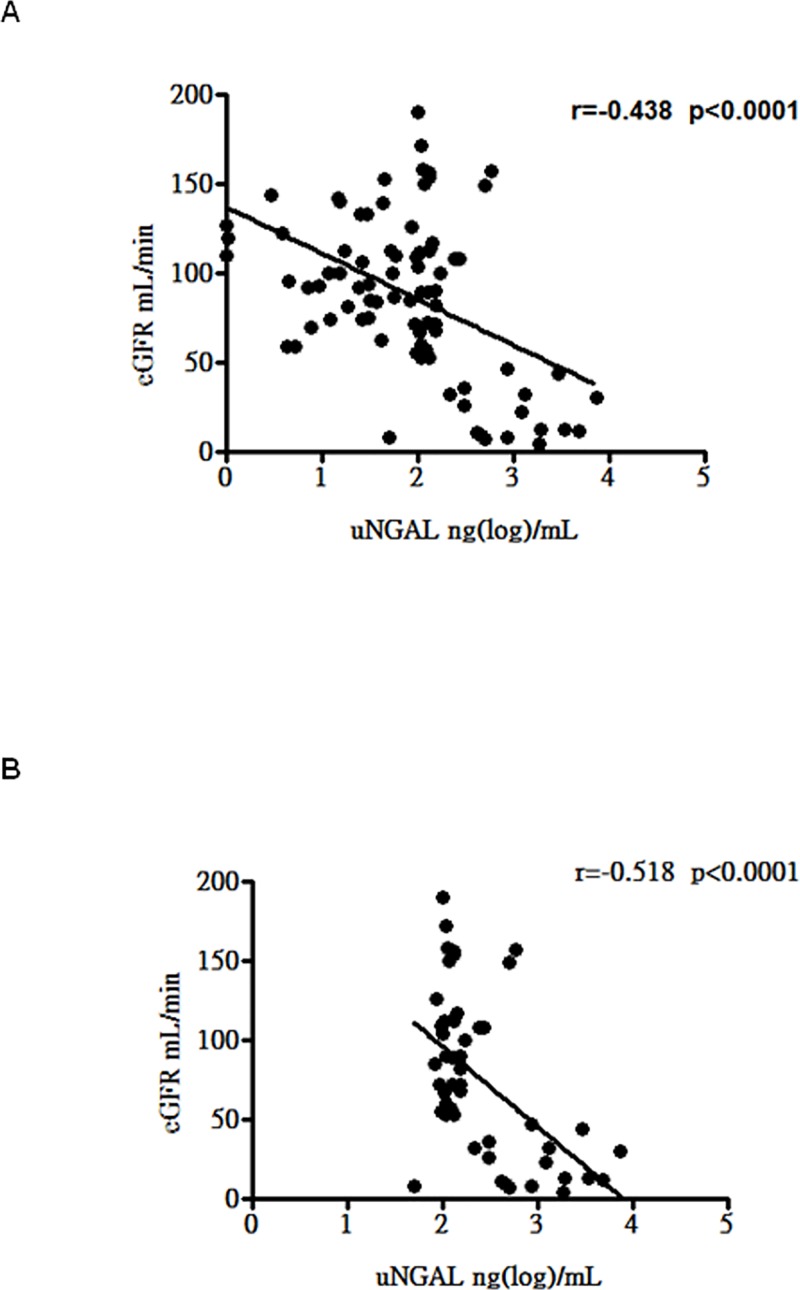
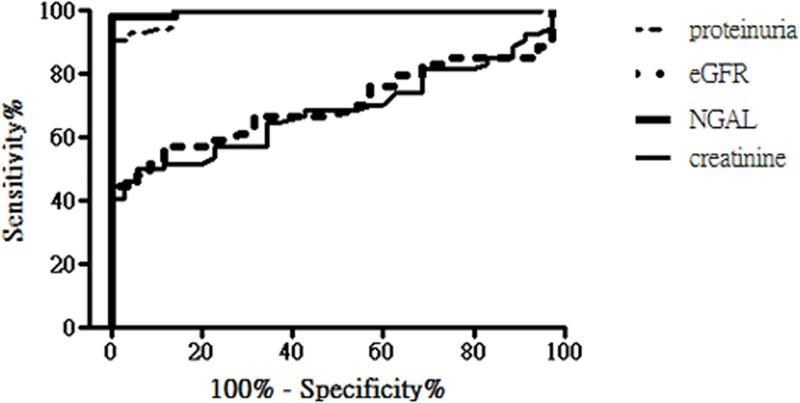
Of 36 patients with LN, 3 (5.6%) had class II disease, 3 (5.6%) had class III, 35 (64.8%) had class IV, 10 (18.5%) had class V, and 3 (5.6%) had class VI (advanced sclerosis). Compared to the non-LN group, patients in the LN group had higher autoimmunity evidenced by a higher proportion of low C3 and C4 levels, positive anti-double-stranded DNA antibody levels, and lower estimated glomerular filtration rates (eGFR). Urinary neutrophil gelatinase-associated lipocalin (uNGAL) levels were significantly higher in the LN group (LN vs non-LN, 670 vs 33 ng/mL, respectively). The patients with LN had a higher urinary polyomavirus BK (BKV) load (3.6 vs 3.0 log copies/mL) and a lower urinary BKV miRNA (miR-B1) 5p level (0.29 vs 0.55 log copies/mL, p = 0.025), while there was no significant difference in the level of miR-B1-3p. Urinary miR-B1-5p level but not urinary BKV load was negatively correlated with uNGAL level (r = -0.22, p = 0.004). At the cutoff value of 80 ng/mL, the receiver operating characteristic curve analysis showed that uNGAL level as a predictor of the presence of LN had a high sensitivity (98%) and specificity (100%) (area under the curve [AUC], 0.997; p < 0.001). During the 54-month follow-up period, 14 (7%) patients with LN and none of the non-LN patients developed CKD. Multivariate Cox regression analysis revealed that baseline uNGAL level was the only predictive factor for CKD development, while baseline serum creatinine level and eGFR were not.
An elevated urinary BKV viral load with a decreased level of miR-B1 implies the presence of LN. In addition, an increased uNGAL level is a good biomarker not only in predicting the presence of LN but also for prediction of CKD development in patients with SLE.
狼疮肾炎(LN)常进展为终末期肾病。寻找 LN 的生物标志物和慢性肾脏病(CKD)的预测因子对于系统性红斑狼疮(SLE)患者非常重要。
90 例 SLE 患者分为经活检证实的 LN(n=54)和无肾脏受累(非 LN)(n=36)两组,并随访 54 个月。
36 例 LN 患者中,3 例(5.6%)为 II 级疾病,3 例(5.6%)为 III 级,35 例(64.8%)为 IV 级,10 例(18.5%)为 V 级,3 例(5.6%)为 VI 级(晚期硬化)。与非 LN 组相比,LN 组患者的自身免疫更高,表现为 C3 和 C4 水平较低、抗双链 DNA 抗体水平较高、估算肾小球滤过率(eGFR)较低。LN 组患者的尿中性粒细胞明胶酶相关脂质运载蛋白(uNGAL)水平明显更高(LN 组 vs 非 LN 组,分别为 670 与 33ng/ml)。LN 组患者的尿 BK 多瘤病毒(BKV)负荷更高(3.6 与 3.0 log 拷贝/ml),尿 BKV microRNA(miR-B1)5p 水平更低(0.29 与 0.55 log 拷贝/ml,p=0.025),而 miR-B1-3p 水平无显著差异。尿 miR-B1-5p 水平与 uNGAL 水平呈负相关(r=-0.22,p=0.004),但尿 BKV 负荷与 uNGAL 水平无相关性。以 80ng/ml 为截断值,ROC 曲线分析显示 uNGAL 水平作为 LN 存在的预测因子具有高敏感性(98%)和特异性(100%)(曲线下面积[AUC],0.997;p<0.001)。在 54 个月的随访期间,14 例(7%)LN 患者和 0 例非 LN 患者发展为 CKD。多变量 Cox 回归分析显示,基线 uNGAL 水平是 CKD 发展的唯一预测因素,而基线血清肌酐水平和 eGFR 不是。
尿 BKV 病毒载量升高伴 miR-B1 水平降低提示存在 LN。此外,uNGAL 水平升高不仅是预测 LN 存在的良好生物标志物,也是预测 SLE 患者 CKD 发展的良好标志物。