Sheinkopf Stephen J, Levine Todd P, McCormick Carolyn E B, Puggioni Gavino, Conradt Elisabeth, Lagasse Linda L, Lester Barry M
Brown Center for the Study of Children at Risk, Women and Infants Hospital and the Rhode Island Consortium for Autism Research and Treatment, Providence, RI, United States; Department of Psychiatry & Human Behavior and Department of Pediatrics, Warren Alpert Medical School of Brown University, United States.
Brown Center for the Study of Children at Risk, Women and Infants Hospital and the Rhode Island Consortium for Autism Research and Treatment, Providence, RI, United States; Department of Psychiatry & Human Behavior and Department of Pediatrics, Warren Alpert Medical School of Brown University, United States.
Biol Psychol. 2019 Mar;142:13-18. doi: 10.1016/j.biopsycho.2019.01.003. Epub 2019 Jan 11.
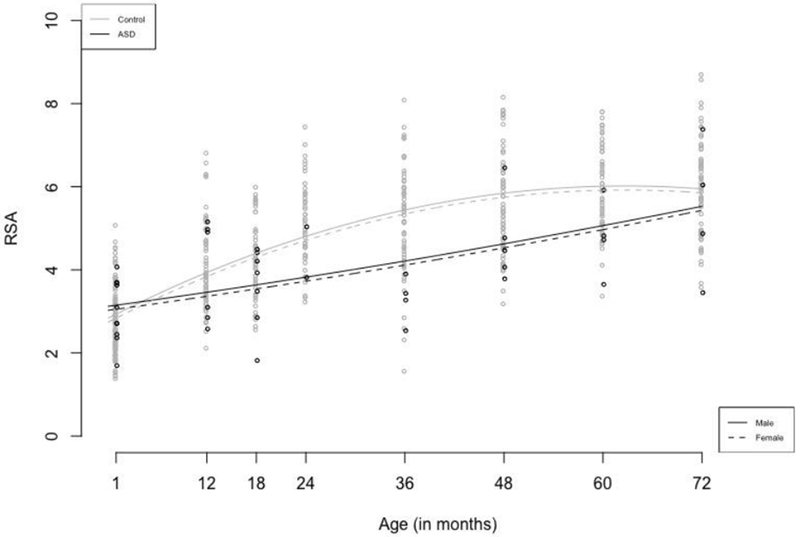
Deficits in social engagement emerge in autism during the infant and toddler period and may be related to emotion regulation and stress response systems. This study examined patterns of growth in autonomic functioning related to autism diagnosis and addresses the hypothesis that there are differences in autonomic functioning related to autism in infancy. Heart rate (HR) and respiratory sinus arrhythmia (RSA) were measured at 8 time points from 1 to 72 months of age in infants later diagnosed with autism (n = 12) and a non-autistic comparison group (n = 106). Multilevel models were used to describe the developmental course of HR and RSA and to test the effect of autism diagnosis on growth trajectories. Both groups showed an expected age-related decrease in HR and increase in RSA. Groups did not differ in the rate of decrease of HR over time. However, infants with autism demonstrated a smaller linear increase in RSA, indicating slower growth in RSA over time in comparison to controls. These results suggest that differences in physiological regulation may develop with age in autism. The slowed RSA growth in autism was most evident after 18 months of age, at a time when behavioral symptoms become prominent. This is consistent with the view that RSA is a marker of functional status in autism rather than a cause of social deficits in autism.
社交参与方面的缺陷在婴幼儿期的自闭症中就已出现,且可能与情绪调节和应激反应系统有关。本研究考察了与自闭症诊断相关的自主神经功能的发育模式,并验证了这样一个假设,即婴儿期自闭症患者的自主神经功能存在差异。对后来被诊断为自闭症的婴儿(n = 12)和非自闭症对照组(n = 106)在1至72个月大的8个时间点测量了心率(HR)和呼吸性窦性心律不齐(RSA)。使用多层次模型来描述HR和RSA的发育过程,并检验自闭症诊断对生长轨迹的影响。两组均呈现出预期的与年龄相关的HR下降和RSA增加。两组在HR随时间下降的速率上没有差异。然而,自闭症婴儿的RSA线性增加较小,表明与对照组相比,RSA随时间的增长较慢。这些结果表明,自闭症患者生理调节方面的差异可能会随着年龄增长而出现。自闭症中RSA生长减缓在18个月龄后最为明显,此时行为症状开始凸显。这与RSA是自闭症功能状态的一个指标而非自闭症社交缺陷原因的观点一致。