Department of Biochemistry and Molecular Biology, Dalhousie University, Sir Charles Tupper Medical Building, 5850 College Street, PO Box 15000, Halifax, Nova Scotia, B3H 4R2, Canada.
Present Address: Informatics Program, Ontario Institute for Cancer Research, 661 University Avenue, Suite 510, Toronto, ON, M5G 0A3, Canada.
BMC Genomics. 2019 Jan 14;20(1):38. doi: 10.1186/s12864-018-5412-4.
The process of gene fusion involves the formation of a single chimeric gene from multiple complete or partial gene sequences. Gene fusion is recognized as an important mechanism by which genes and their protein products can evolve new functions. The presence-absence of gene fusions can also be useful characters for inferring evolutionary relationships between organisms.
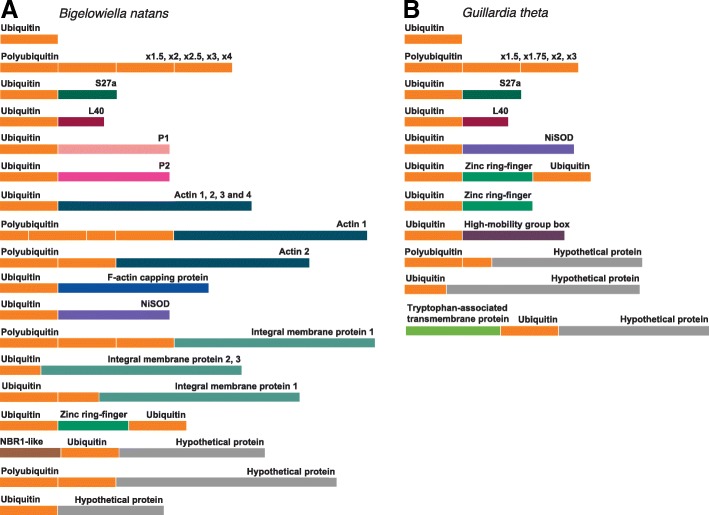
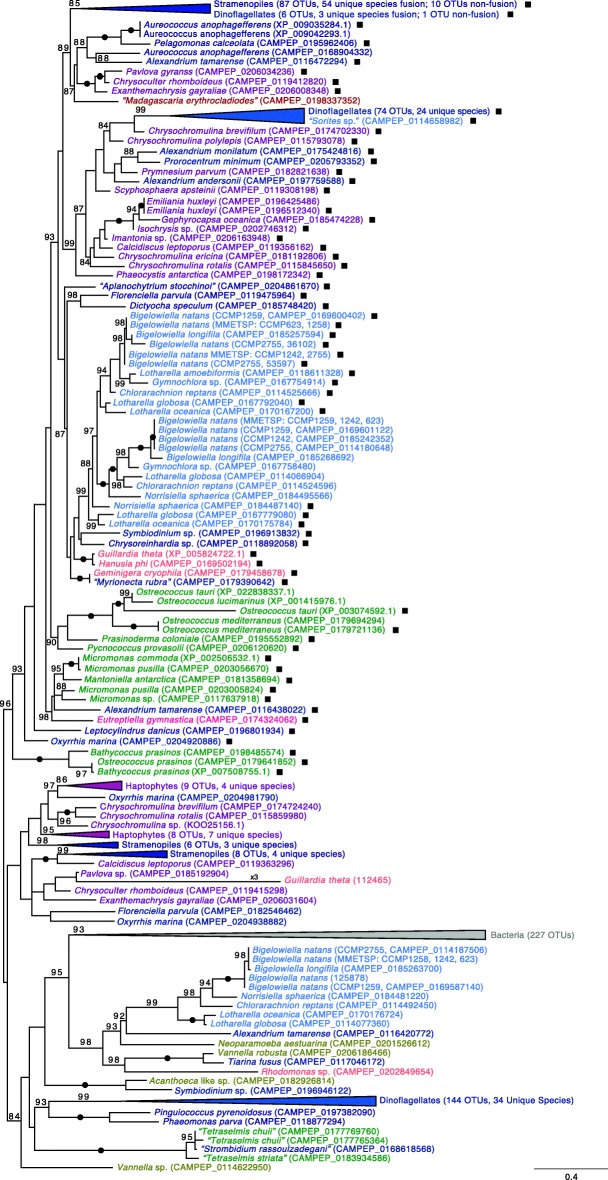
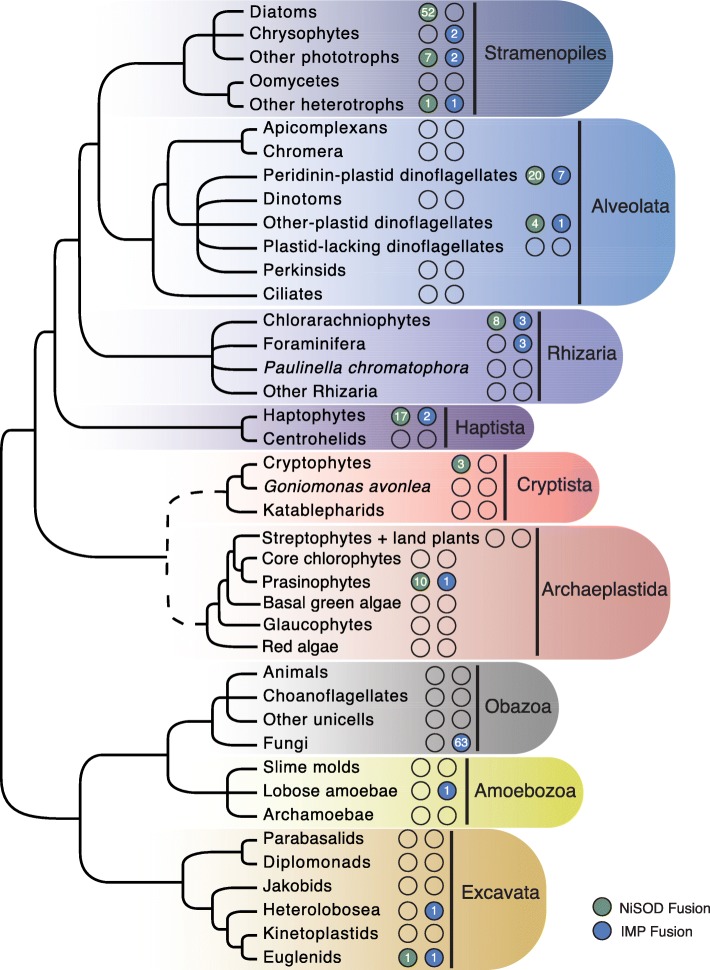
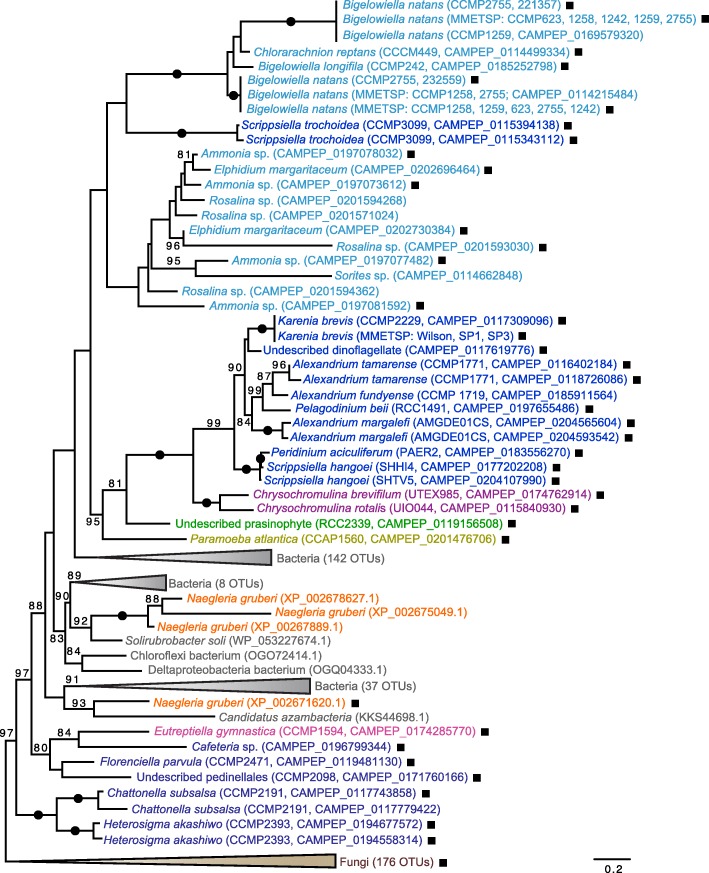
Here we show that the nuclear genomes of two unrelated single-celled algae, the cryptophyte Guillardia theta and the chlorarachniophyte Bigelowiella natans, possess an unexpected diversity of genes for ubiquitin fusion proteins, including novel arrangements in which ubiquitin occupies amino-terminal, carboxyl-terminal, and internal positions relative to its fusion partners. We explore the evolution of the ubiquitin multigene family in both genomes, and show that both algae possess a gene encoding an ubiquitin-nickel superoxide dismutase fusion protein (Ubiq-NiSOD) that is widely but patchily distributed across the eukaryotic tree of life - almost exclusively in phototrophs.
Our results suggest that ubiquitin fusion proteins are more common than currently appreciated; because of its small size, the ubiquitin coding region can go undetected when gene predictions are carried out in an automated fashion. The punctate distribution of the Ubiq-NiSOD fusion across the eukaryotic tree could serve as a beacon for the spread of plastids from eukaryote to eukaryote by secondary and/or tertiary endosymbiosis.
基因融合的过程涉及从多个完整或部分基因序列形成一个单一的嵌合基因。基因融合被认为是基因及其蛋白质产物进化出新功能的重要机制。基因融合的存在与否也可以作为推断生物之间进化关系的有用特征。
在这里,我们展示了两个无关的单细胞藻类,隐藻 Guillardia theta 和绿藻 Bigelowiella natans 的核基因组,拥有出人意料的多种泛素融合蛋白基因,包括泛素相对于其融合伙伴占据氨基末端、羧基末端和内部位置的新排列。我们探索了这两个基因组中泛素多基因家族的进化,并表明两种藻类都拥有一个编码泛素-镍超氧化物歧化酶融合蛋白(Ubiq-NiSOD)的基因,该蛋白广泛但不均匀地分布在真核生物的生命之树上——几乎只存在于光合生物中。
我们的结果表明,泛素融合蛋白比目前认为的更为普遍;由于其体积小,当以自动化方式进行基因预测时,泛素编码区可能会被忽略。Ubiq-NiSOD 融合蛋白在真核生物树上的点状分布可以作为质体通过二次和/或三次内共生从一个真核生物传播到另一个真核生物的标志。