• 文献检索
  • 文档翻译
  • 深度研究
  • 学术资讯
  • Suppr Zotero 插件Zotero 插件
  • 邀请有礼
  • 套餐&价格
  • 历史记录
应用&插件
Suppr Zotero 插件Zotero 插件浏览器插件Mac 客户端Windows 客户端微信小程序
定价
高级版会员购买积分包购买API积分包
服务
文献检索文档翻译深度研究API 文档MCP 服务
关于我们
关于 Suppr公司介绍联系我们用户协议隐私条款
关注我们

Suppr 超能文献

核心技术专利:CN118964589B侵权必究
粤ICP备2023148730 号-1Suppr @ 2026

文献检索

告别复杂PubMed语法,用中文像聊天一样搜索,搜遍4000万医学文献。AI智能推荐,让科研检索更轻松。

立即免费搜索

文件翻译

保留排版,准确专业,支持PDF/Word/PPT等文件格式,支持 12+语言互译。

免费翻译文档

深度研究

AI帮你快速写综述,25分钟生成高质量综述,智能提取关键信息,辅助科研写作。

立即免费体验

使用计算方法评估房室动力学模型中的参数可识别性:在传染病传播模型中的应用。

Assessing parameter identifiability in compartmental dynamic models using a computational approach: application to infectious disease transmission models.

作者信息

Roosa Kimberlyn, Chowell Gerardo

机构信息

Department of Population Health Sciences, School of Public Health, Georgia State University, Atlanta, GA, USA.

Division of International Epidemiology and Population Studies, Fogarty International Center, National Institute of Health, Bethesda, MD, USA.

出版信息

Theor Biol Med Model. 2019 Jan 14;16(1):1. doi: 10.1186/s12976-018-0097-6.

DOI:10.1186/s12976-018-0097-6
PMID:30642334
原文链接:https://pmc.ncbi.nlm.nih.gov/articles/PMC6332839/
Abstract

BACKGROUND

Mathematical modeling is now frequently used in outbreak investigations to understand underlying mechanisms of infectious disease dynamics, assess patterns in epidemiological data, and forecast the trajectory of epidemics. However, the successful application of mathematical models to guide public health interventions lies in the ability to reliably estimate model parameters and their corresponding uncertainty. Here, we present and illustrate a simple computational method for assessing parameter identifiability in compartmental epidemic models.

METHODS

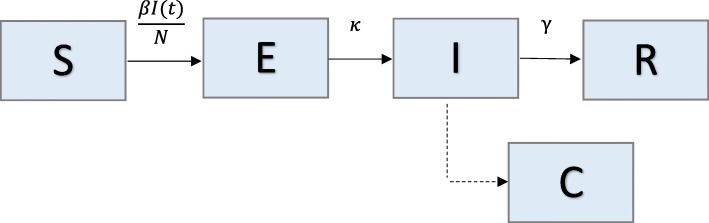
We describe a parametric bootstrap approach to generate simulated data from dynamical systems to quantify parameter uncertainty and identifiability. We calculate confidence intervals and mean squared error of estimated parameter distributions to assess parameter identifiability. To demonstrate this approach, we begin with a low-complexity SEIR model and work through examples of increasingly more complex compartmental models that correspond with applications to pandemic influenza, Ebola, and Zika.

RESULTS

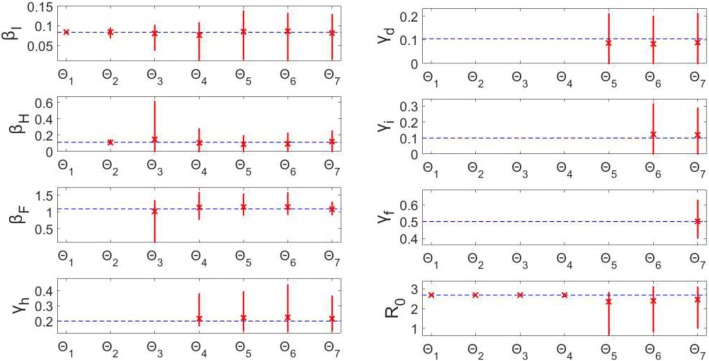
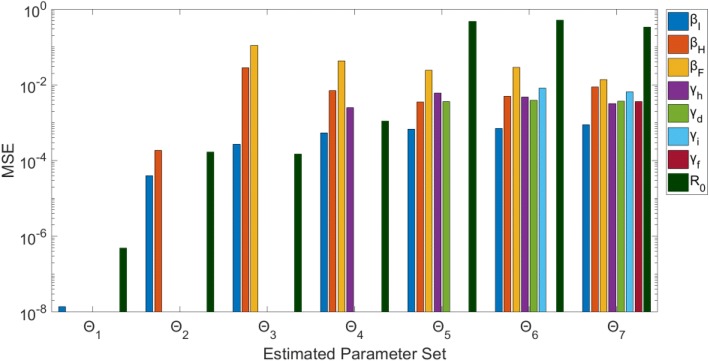
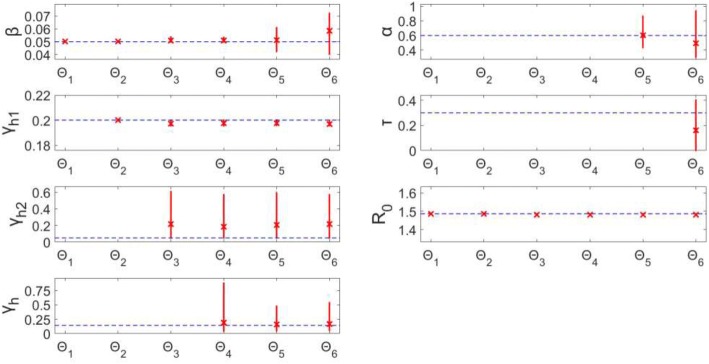
Overall, parameter identifiability issues are more likely to arise with more complex models (based on number of equations/states and parameters). As the number of parameters being jointly estimated increases, the uncertainty surrounding estimated parameters tends to increase, on average, as well. We found that, in most cases, R is often robust to parameter identifiability issues affecting individual parameters in the model. Despite large confidence intervals and higher mean squared error of other individual model parameters, R can still be estimated with precision and accuracy.

CONCLUSIONS

Because public health policies can be influenced by results of mathematical modeling studies, it is important to conduct parameter identifiability analyses prior to fitting the models to available data and to report parameter estimates with quantified uncertainty. The method described is helpful in these regards and enhances the essential toolkit for conducting model-based inferences using compartmental dynamic models.

摘要

背景

数学建模如今在疫情调查中经常被用于理解传染病动态的潜在机制、评估流行病学数据模式以及预测疫情发展轨迹。然而,数学模型成功应用于指导公共卫生干预措施的关键在于能够可靠地估计模型参数及其相应的不确定性。在此,我们提出并阐述一种用于评估 compartmental 疫情模型中参数可识别性的简单计算方法。

方法

我们描述了一种参数自抽样方法,用于从动态系统生成模拟数据,以量化参数不确定性和可识别性。我们计算估计参数分布的置信区间和均方误差,以评估参数可识别性。为了演示这种方法,我们从一个低复杂度的 SEIR 模型开始,并逐步分析越来越复杂的 compartmental 模型的示例,这些模型分别对应于大流行性流感、埃博拉和寨卡病毒的应用场景。

结果

总体而言,更复杂的模型(基于方程/状态和参数的数量)更有可能出现参数可识别性问题。随着联合估计的参数数量增加,估计参数周围的不确定性平均而言也往往会增加。我们发现,在大多数情况下,R 通常对影响模型中单个参数的参数可识别性问题具有稳健性。尽管其他单个模型参数的置信区间较大且均方误差较高,但仍可以精确且准确地估计 R。

结论

由于公共卫生政策可能会受到数学建模研究结果的影响,因此在将模型拟合到现有数据之前进行参数可识别性分析,并报告具有量化不确定性的参数估计值非常重要。所描述的方法在这些方面很有帮助,并增强了使用 compartmental 动态模型进行基于模型的推断的基本工具集。
https://cdn.ncbi.nlm.nih.gov/pmc/blobs/4c9d/6332839/6708b234b41e/12976_2018_97_Fig12_HTML.jpg
https://cdn.ncbi.nlm.nih.gov/pmc/blobs/4c9d/6332839/79d5682aa920/12976_2018_97_Fig1_HTML.jpg
https://cdn.ncbi.nlm.nih.gov/pmc/blobs/4c9d/6332839/03df684f4252/12976_2018_97_Fig2_HTML.jpg
https://cdn.ncbi.nlm.nih.gov/pmc/blobs/4c9d/6332839/4f4be851f62a/12976_2018_97_Fig3_HTML.jpg
https://cdn.ncbi.nlm.nih.gov/pmc/blobs/4c9d/6332839/8e7f5ba6642d/12976_2018_97_Fig4_HTML.jpg
https://cdn.ncbi.nlm.nih.gov/pmc/blobs/4c9d/6332839/a0efb9d4a9d8/12976_2018_97_Fig5_HTML.jpg
https://cdn.ncbi.nlm.nih.gov/pmc/blobs/4c9d/6332839/e91db0e2d569/12976_2018_97_Fig6_HTML.jpg
https://cdn.ncbi.nlm.nih.gov/pmc/blobs/4c9d/6332839/fe7d13029aba/12976_2018_97_Fig7_HTML.jpg
https://cdn.ncbi.nlm.nih.gov/pmc/blobs/4c9d/6332839/cdfef19df1d0/12976_2018_97_Fig8_HTML.jpg
https://cdn.ncbi.nlm.nih.gov/pmc/blobs/4c9d/6332839/afc77eac5676/12976_2018_97_Fig9_HTML.jpg
https://cdn.ncbi.nlm.nih.gov/pmc/blobs/4c9d/6332839/9caaa106edeb/12976_2018_97_Fig10_HTML.jpg
https://cdn.ncbi.nlm.nih.gov/pmc/blobs/4c9d/6332839/45224bd2c4ff/12976_2018_97_Fig11_HTML.jpg
https://cdn.ncbi.nlm.nih.gov/pmc/blobs/4c9d/6332839/6708b234b41e/12976_2018_97_Fig12_HTML.jpg
https://cdn.ncbi.nlm.nih.gov/pmc/blobs/4c9d/6332839/79d5682aa920/12976_2018_97_Fig1_HTML.jpg
https://cdn.ncbi.nlm.nih.gov/pmc/blobs/4c9d/6332839/03df684f4252/12976_2018_97_Fig2_HTML.jpg
https://cdn.ncbi.nlm.nih.gov/pmc/blobs/4c9d/6332839/4f4be851f62a/12976_2018_97_Fig3_HTML.jpg
https://cdn.ncbi.nlm.nih.gov/pmc/blobs/4c9d/6332839/8e7f5ba6642d/12976_2018_97_Fig4_HTML.jpg
https://cdn.ncbi.nlm.nih.gov/pmc/blobs/4c9d/6332839/a0efb9d4a9d8/12976_2018_97_Fig5_HTML.jpg
https://cdn.ncbi.nlm.nih.gov/pmc/blobs/4c9d/6332839/e91db0e2d569/12976_2018_97_Fig6_HTML.jpg
https://cdn.ncbi.nlm.nih.gov/pmc/blobs/4c9d/6332839/fe7d13029aba/12976_2018_97_Fig7_HTML.jpg
https://cdn.ncbi.nlm.nih.gov/pmc/blobs/4c9d/6332839/cdfef19df1d0/12976_2018_97_Fig8_HTML.jpg
https://cdn.ncbi.nlm.nih.gov/pmc/blobs/4c9d/6332839/afc77eac5676/12976_2018_97_Fig9_HTML.jpg
https://cdn.ncbi.nlm.nih.gov/pmc/blobs/4c9d/6332839/9caaa106edeb/12976_2018_97_Fig10_HTML.jpg
https://cdn.ncbi.nlm.nih.gov/pmc/blobs/4c9d/6332839/45224bd2c4ff/12976_2018_97_Fig11_HTML.jpg
https://cdn.ncbi.nlm.nih.gov/pmc/blobs/4c9d/6332839/6708b234b41e/12976_2018_97_Fig12_HTML.jpg

相似文献

1
Assessing parameter identifiability in compartmental dynamic models using a computational approach: application to infectious disease transmission models.使用计算方法评估房室动力学模型中的参数可识别性:在传染病传播模型中的应用。
Theor Biol Med Model. 2019 Jan 14;16(1):1. doi: 10.1186/s12976-018-0097-6.
2
Structural and Practical Identifiability Analysis of Zika Epidemiological Models.寨卡流行病学模型的结构和实用可识别性分析。
Bull Math Biol. 2018 Aug;80(8):2209-2241. doi: 10.1007/s11538-018-0453-z. Epub 2018 Jun 13.
3
Fitting dynamic models to epidemic outbreaks with quantified uncertainty: A Primer for parameter uncertainty, identifiability, and forecasts.用量化不确定性将动态模型拟合到疫情爆发:参数不确定性、可识别性和预测入门
Infect Dis Model. 2017 Aug;2(3):379-398. doi: 10.1016/j.idm.2017.08.001. Epub 2017 Aug 12.
4
ASAS-NANP symposium: Mathematical Modeling in Animal Nutrition: The power of identifiability analysis for dynamic modeling in animal science:a practitioner approach.ASAS-NANP 研讨会:动物营养中的数学建模:可识别性分析在动物科学动态建模中的作用:一种实践者的方法。
J Anim Sci. 2023 Jan 3;101. doi: 10.1093/jas/skad320.
5
Practical unidentifiability of a simple vector-borne disease model: Implications for parameter estimation and intervention assessment.简单的虫媒传染病模型的实际不可识别性:对参数估计和干预评估的影响。
Epidemics. 2018 Dec;25:89-100. doi: 10.1016/j.epidem.2018.05.010. Epub 2018 May 26.
6
Modeling county level COVID-19 transmission in the greater St. Louis area: Challenges of uncertainty and identifiability when fitting mechanistic models to time-varying processes.对大圣路易斯地区县级 COVID-19 传播的建模:拟合时变过程的机械模型时的不确定性和可识别性挑战。
Math Biosci. 2024 May;371:109181. doi: 10.1016/j.mbs.2024.109181. Epub 2024 Mar 25.
7
Profile likelihood-based analyses of infectious disease models.基于似然的传染病模型分析。
Stat Methods Med Res. 2018 Jul;27(7):1979-1998. doi: 10.1177/0962280217746444. Epub 2018 Mar 7.
8
Structural identifiability analysis of epidemic models based on differential equations: a tutorial-based primer.基于微分方程的传染病模型结构可识别性分析:基于教程的入门介绍。
J Math Biol. 2023 Nov 3;87(6):79. doi: 10.1007/s00285-023-02007-2.
9
Parameter estimation and uncertainty quantification for an epidemic model.参数估计和传染病模型的不确定性量化。
Math Biosci Eng. 2012 Jul;9(3):553-76. doi: 10.3934/mbe.2012.9.553.
10
Incorporating infectious duration-dependent transmission into Bayesian epidemic models.将感染持续时间依赖性传播纳入贝叶斯流行病模型。
Biom J. 2023 Mar;65(3):e2100401. doi: 10.1002/bimj.202100401. Epub 2022 Oct 26.

引用本文的文献

1
Impact of a New SARS-CoV-2 Variant on the Population: A Mathematical Modeling Approach.一种新型严重急性呼吸综合征冠状病毒2变体对人群的影响:一种数学建模方法。
Math Comput Appl. 2021 Jun;26(2). doi: 10.3390/mca26020025. Epub 2021 Mar 27.
2
Investigation of a two-patch within-host model of hepatitis B viral infection.乙肝病毒感染的双斑块宿主内模型研究。
ArXiv. 2025 Jul 30:arXiv:2507.23038v1.
3
Structural and Practical Identifiability of Phenomenological Growth Models for Epidemic Forecasting.用于疫情预测的现象学增长模型的结构与实际可识别性

本文引用的文献

1
Practical unidentifiability of a simple vector-borne disease model: Implications for parameter estimation and intervention assessment.简单的虫媒传染病模型的实际不可识别性:对参数估计和干预评估的影响。
Epidemics. 2018 Dec;25:89-100. doi: 10.1016/j.epidem.2018.05.010. Epub 2018 May 26.
2
Modeling and inference for infectious disease dynamics: a likelihood-based approach.传染病动力学的建模与推断:一种基于似然性的方法。
Stat Sci. 2018 Feb;33(1):57-69. doi: 10.1214/17-STS636. Epub 2018 Feb 2.
3
Fitting dynamic models to epidemic outbreaks with quantified uncertainty: A Primer for parameter uncertainty, identifiability, and forecasts.
Viruses. 2025 Mar 29;17(4):496. doi: 10.3390/v17040496.
4
Structural and Practical Identifiability of Phenomenological Growth Models for Epidemic Forecasting.用于疫情预测的现象学增长模型的结构与实际可识别性
ArXiv. 2025 Mar 27:arXiv:2503.17135v2.
5
Characterizing the interactions between influenza and respiratory syncytial viruses and their implications for epidemic control.描述流感病毒和呼吸道合胞病毒之间的相互作用及其对疫情控制的影响。
Nat Commun. 2024 Nov 20;15(1):10066. doi: 10.1038/s41467-024-53872-4.
6
Modeling the 2014-2015 Vesicular Stomatitis Outbreak in the United States Using an SEIR-SEI Approach.采用 SEIR-SEI 方法对美国 2014-2015 年水疱性口炎疫情进行建模。
Viruses. 2024 Aug 18;16(8):1315. doi: 10.3390/v16081315.
7
A data-driven analysis on the mediation effect of compartment models between control measures and COVID-19 epidemics.基于数据驱动的隔室模型在防控措施与新冠疫情之间的中介效应分析
Heliyon. 2024 Jun 29;10(13):e33850. doi: 10.1016/j.heliyon.2024.e33850. eCollection 2024 Jul 15.
8
A compartmental model for smoking dynamics in Italy: a pipeline for inference, validation, and forecasting under hypothetical scenarios.意大利吸烟动态的 compartmental 模型:在假设情景下进行推理、验证和预测的管道。
BMC Med Res Methodol. 2024 Jul 13;24(1):148. doi: 10.1186/s12874-024-02271-w.
9
SpatialWavePredict: a tutorial-based primer and toolbox for forecasting growth trajectories using the ensemble spatial wave sub-epidemic modeling framework.空间波预测:基于教程的入门和工具包,用于使用集合空间波亚流行建模框架预测增长轨迹。
BMC Med Res Methodol. 2024 Jun 7;24(1):131. doi: 10.1186/s12874-024-02241-2.
10
Parameter estimation in behavioral epidemic models with endogenous societal risk-response.具有内生社会风险反应的行为流行病模型中的参数估计。
PLoS Comput Biol. 2024 Mar 29;20(3):e1011992. doi: 10.1371/journal.pcbi.1011992. eCollection 2024 Mar.
用量化不确定性将动态模型拟合到疫情爆发:参数不确定性、可识别性和预测入门
Infect Dis Model. 2017 Aug;2(3):379-398. doi: 10.1016/j.idm.2017.08.001. Epub 2017 Aug 12.
4
Perspectives on model forecasts of the 2014-2015 Ebola epidemic in West Africa: lessons and the way forward.对2014 - 2015年西非埃博拉疫情模型预测的展望:经验教训与未来方向。
BMC Med. 2017 Mar 1;15(1):42. doi: 10.1186/s12916-017-0811-y.
5
Prevention and Control of Zika as a Mosquito-Borne and Sexually Transmitted Disease: A Mathematical Modeling Analysis.寨卡作为一种蚊媒和性传播疾病的预防和控制:数学建模分析。
Sci Rep. 2016 Jun 17;6:28070. doi: 10.1038/srep28070.
6
Estimation of the Basic Reproductive Number and Mean Serial Interval of a Novel Pathogen in a Small, Well-Observed Discrete Population.在一个规模较小、观察充分的离散人群中对新型病原体的基本繁殖数和平均潜伏期进行估计。
PLoS One. 2016 Feb 5;11(2):e0148061. doi: 10.1371/journal.pone.0148061. eCollection 2016.
7
Estimating dynamic transmission model parameters for seasonal influenza by fitting to age and season-specific influenza-like illness incidence.通过拟合年龄和特定季节的流感样疾病发病率来估计季节性流感的动态传播模型参数。
Epidemics. 2015 Dec;13:1-9. doi: 10.1016/j.epidem.2015.04.002. Epub 2015 May 2.
8
Ebola virus infection modeling and identifiability problems.埃博拉病毒感染建模与可识别性问题。
Front Microbiol. 2015 Apr 9;6:257. doi: 10.3389/fmicb.2015.00257. eCollection 2015.
9
An approximate Bayesian computation approach to parameter estimation in a stochastic stage-structured population model.一种随机阶段结构种群模型中参数估计的近似贝叶斯计算方法。
Ecology. 2014 May;95(5):1418-28. doi: 10.1890/13-1065.1.
10
Identifiability and estimation of multiple transmission pathways in cholera and waterborne disease.霍乱和水源性疾病多重传播途径的可识别性和估计。
J Theor Biol. 2013 May 7;324:84-102. doi: 10.1016/j.jtbi.2012.12.021. Epub 2013 Jan 16.