Department for Diagnostic and Interventional Radiology, UKD, Heinrich-Heine University Düsseldorf, Moorenstrasse 5, 40225, Düsseldorf, Germany.
Department and Hiller Research Unit for Rheumatology, UKD, Heinrich-Heine University Düsseldorf, Moorenstrasse 5, 40225, Düsseldorf, Germany.
Arthritis Res Ther. 2019 Jan 14;21(1):21. doi: 10.1186/s13075-018-1789-3.
The aim of the study was to evaluate a simplified version of the Rheumatoid Arthritis Magnetic Resonance Imaging Score (RAMRIS) for five joints of the hand (RAMRIS-5) in patients with early rheumatoid arthritis (RA) before and after the initiation of methotrexate (MTX) therapy using high-resolution, 3-T magnetic resonance imaging (MRI).
Twenty-eight patients with a seropositive, early RA (disease duration of less than 6 months (range 2-23 weeks)) according to 2010 American College of Rheumatology/European League Against Rheumatism (ACR/EULAR) criteria (mean age 56.8 years, range 39-74) were prospectively assessed with a baseline investigation including clinical assessment (disease activity score of 28 joints (DAS-28) and C-reactive protein (CRP)) and 3-T MRI of the clinically dominant hand. Follow-up visits were performed 3 and 6 months after initiation of a MTX therapy at baseline. MRI scans were analyzed in accordance with RAMRIS and the simplified RAMRIS-5.
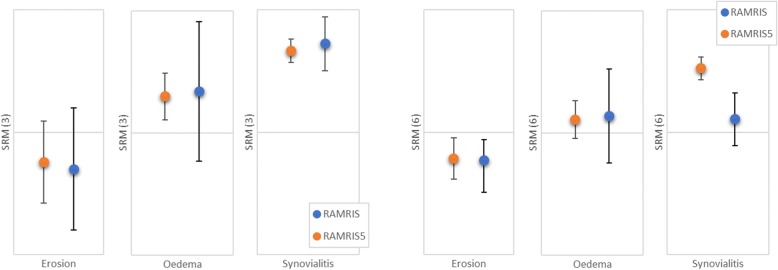
DAS-28 and CRP decreased significantly after initiation of MTX therapy. Even though erosion scores increased over time, RAMRIS and RAMRIS-5 also decreased significantly after the start of therapy. There was a strong correlation between the total RAMRIS-5 and RAMRIS at baseline (r = 0.838; P <0.001) and follow-up (3 months: r = 0.876; P <0.001; 6 months: r = 0.897; P <0.001). In the short term (3-month follow-up), RAMRIS and RAMRIS-5 demonstrated similar ability to detect changes for all subgroups (bone edema, erosion, and synovitis). In the long-term comparison (6-month follow-up), RAMRIS-5 also showed similar effectiveness when detecting changes in bone edema and erosion compared with RAMRIS. Deviations occurred regarding only synovitis, where change was slightly higher in RAMRIS-5: SRM (RAMRIS) = 0.07 ± 0.14; SRM (RAMRIS-5) = 0.34 ± 0.06.
Three-Tesla MRI-based RAMRIS-5 is a simplified and resource-saving RAMRIS score which compares favorably with the RAMRIS when detecting changes in early RA. Even though there is a slight abbreviation between RAMRIS-5 and the original score regarding the change of synovitis, it may be used for diagnosis and therapy monitoring in follow-up evaluations.
本研究旨在评估一种简化的 5 个手部关节的类风湿关节炎磁共振成像评分(RAMRIS-5),用于评估接受甲氨蝶呤(MTX)治疗前和治疗后早期类风湿关节炎(RA)患者的高分辨率 3T 磁共振成像(MRI)。
28 例血清阳性、早期 RA 患者(病程<6 个月(2-23 周)),符合 2010 年美国风湿病学会/欧洲抗风湿病联盟(ACR/EULAR)标准(平均年龄 56.8 岁,范围 39-74 岁),采用基线调查进行前瞻性评估,包括临床评估(28 个关节疾病活动评分(DAS-28)和 C 反应蛋白(CRP))和手部临床优势侧的 3T MRI。在基线时开始 MTX 治疗后,分别在 3 个月和 6 个月进行随访。MRI 扫描按照 RAMRIS 和简化的 RAMRIS-5 进行分析。
MTX 治疗开始后,DAS-28 和 CRP 明显下降。尽管侵蚀评分随时间增加,但 RAMRIS 和 RAMRIS-5 在治疗开始后也明显下降。在基线和随访时(3 个月:r=0.876;P<0.001;6 个月:r=0.897;P<0.001),总 RAMRIS-5 与 RAMRIS 之间存在很强的相关性。在短期(3 个月随访),RAMRIS 和 RAMRIS-5 对所有亚组(骨水肿、侵蚀和滑膜炎)的变化均具有相似的检测能力。在长期比较(6 个月随访)中,与 RAMRIS 相比,RAMRIS-5 在检测骨水肿和侵蚀变化方面也具有相似的效果。仅在滑膜炎方面存在差异,RAMRIS-5 的变化稍高:SRM(RAMRIS)=0.07±0.14;SRM(RAMRIS-5)=0.34±0.06。
基于 3T MRI 的 RAMRIS-5 是一种简化的、节省资源的 RAMRIS 评分,在检测早期 RA 的变化时与 RAMRIS 相比具有优势。尽管 RAMRIS-5 与原始评分在滑膜炎的变化方面存在轻微差异,但它可用于随访评估中的诊断和治疗监测。