ISGlobal, Hospital Clínic - Universitat de Barcelona, Barcelona, Spain.
Poverty and Equity Global Practice, The World Bank Group, Washington, D.C., USA.
J Glob Health. 2019 Jun;9(1):010410. doi: 10.7189/jogh.09.010410.
Maternal and reproductive health services are far from universalization and important gaps exist in their distribution across groups of women in sub-Saharan Africa (SSA). The aim of this study is to determine the magnitude of this unequal distribution of maternal and reproductive health-related opportunities and outcomes and to identify the major sources of inequality.
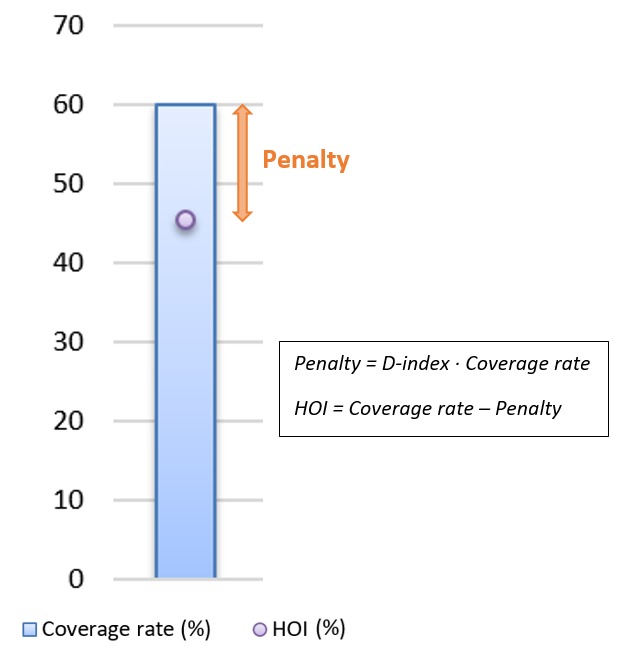
Demographic and Health Surveys data were used to analyse 15 opportunities for women of reproductive age (15-49), pregnant women and older adolescent girls (15-19), across 29 SSA countries. The tool employed is the Human Opportunity Index (HOI), a composite indicator that combines the availability of an opportunity (the coverage rate) with a measure of how equitably it is distributed among groups of women with different characteristics (or circumstances). Decompositions are used to assess the contribution of each individual circumstance to inequality.
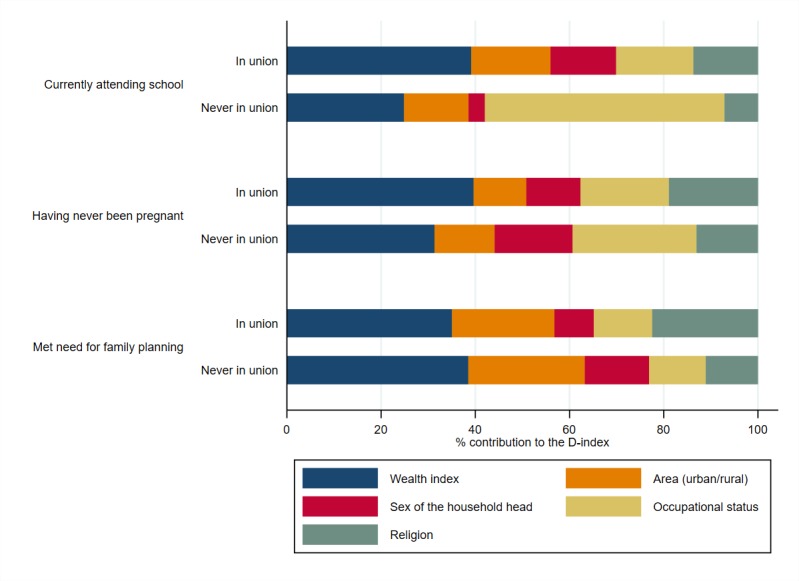
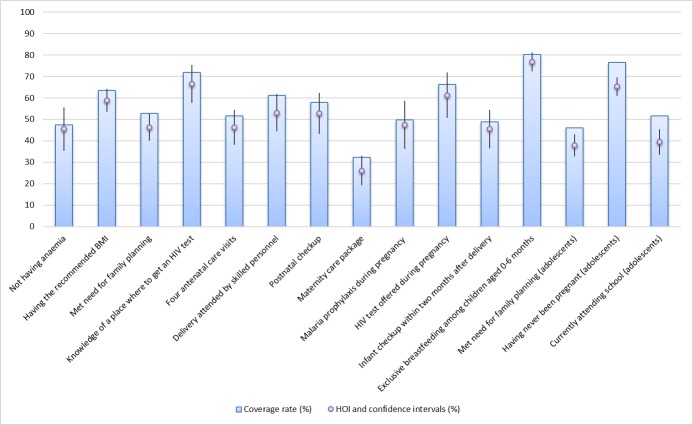
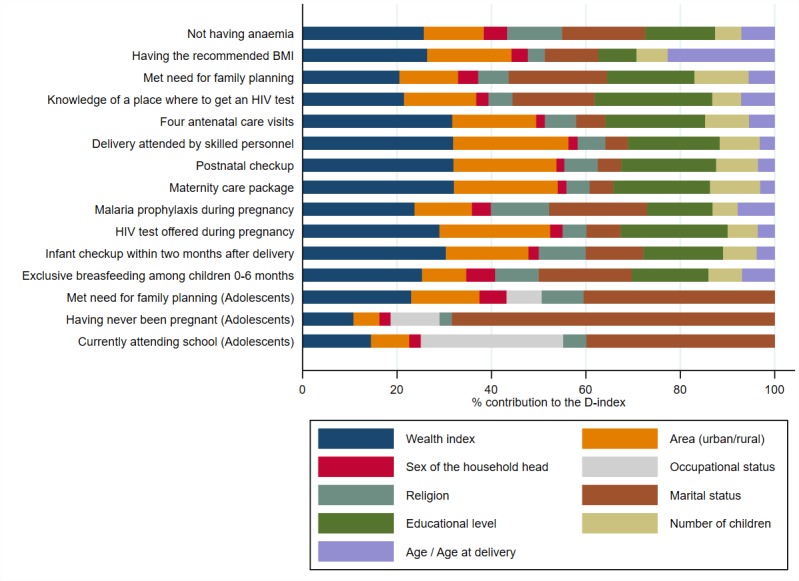
The maternity care package of services is found to have lowest average HOI (26%), while exclusive breastfeeding among children aged 0-6 months has the highest HOI (77%). The other indicators show low HOIs, sometimes lower than 50%, indicating low coverage and/or high inequality. Wealth, education and area of residence are the main contributors to inequality for women of reproductive age. Among adolescent girls, marital status is the major contributor.
Reproductive and maternal health opportunities for women in SSA are scarce and far from reaching the global goals set by the post 2015 agenda. Further progress in improving women's and adolescents' health and well-being can only be achieved by a strong expansion of coverage to produce a more equitable and efficient distribution of health care. Failure to do so will compromise the likelihood of achieving the post-2015 Sustainable Development Goals (SDG). New metrics such as the HOI allows better understanding of the nature of challenges to achieving equity in perinatal and reproductive health, and offers a tool for monitoring progress in implementing a strong equity agenda as a part of the SDG initiative.
在撒哈拉以南非洲(SSA),孕产妇和生殖健康服务远未普及,在妇女群体中的分布存在重大差距。本研究旨在确定孕产妇和生殖健康相关机会和结果分配不均的程度,并确定不平等的主要来源。
利用人口与健康调查数据,分析了 29 个 SSA 国家 15 项 15-49 岁育龄妇女、孕妇和 15-19 岁大龄少女的机会。所采用的工具是人类机会指数(HOI),这是一个综合指标,结合了机会的可及性(覆盖率)以及在具有不同特征(或情况)的妇女群体中公平分配的衡量标准。分解用于评估每个个别情况对不平等的贡献。
发现产妇保健服务套餐的平均 HOI 最低(26%),而 0-6 个月儿童的纯母乳喂养的 HOI 最高(77%)。其他指标的 HOI 较低,有时低于 50%,表明覆盖率低和/或不平等程度高。财富、教育和居住地是育龄妇女不平等的主要原因。在少女中,婚姻状况是主要原因。
SSA 妇女的生殖和孕产妇健康机会稀缺,远未达到 2015 年后议程设定的全球目标。要进一步改善妇女和青少年的健康和福祉,只能通过大力扩大覆盖面,实现医疗保健更公平、更有效的分配。否则,将影响实现 2015 年后可持续发展目标(SDG)的可能性。新的指标,如 HOI,允许更好地了解在围产期和生殖健康方面实现公平所面临的挑战的性质,并提供了一个工具,用于监测实施强有力的公平议程的进展情况,作为 SDG 倡议的一部分。