Department of Medicine Division of Hematology/Oncology, Rhode Island Hospital, Providence, Rhode Island.
Department of Emergency Medicine, Rhode Island Hospital, Providence, Rhode Island.
J Cell Physiol. 2019 Aug;234(8):14377-14388. doi: 10.1002/jcp.28139. Epub 2019 Jan 15.
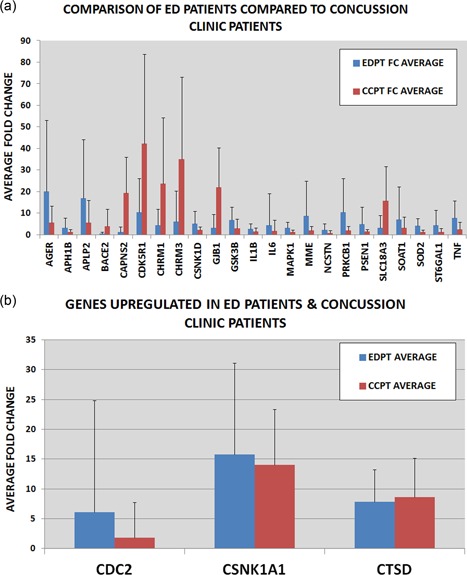
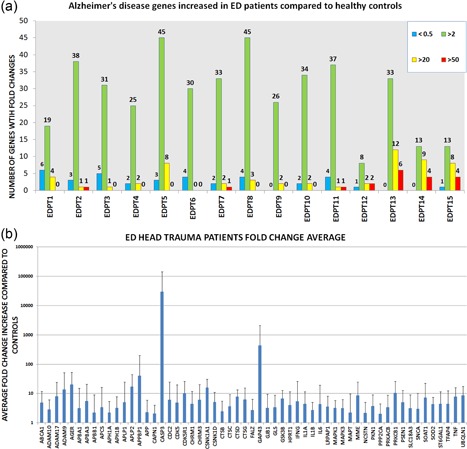
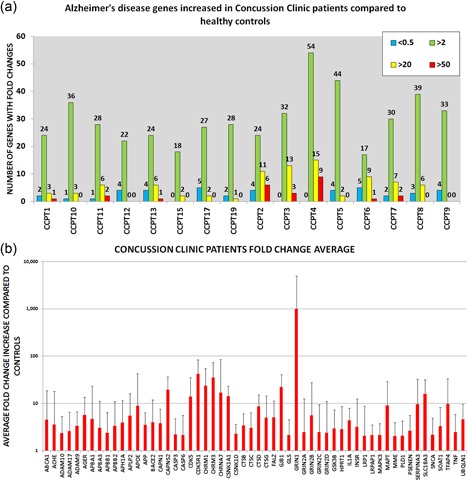
Traumatic brain injury (TBI) is a common cause of death and acquired disability in adults and children. Identifying biomarkers for mild TBI (mTBI) that can predict functional impairments on neuropsychiatric and neurocognitive testing after head trauma is yet to be firmly established. Extracellular vesicles (EVs) are known to traffic from the brain to the oral cavity and can be detected in saliva. We hypothesize the genetic profile of salivary EVs in patients who have suffered head trauma will differ from normal healthy controls, thus constituting a unique expression signature for mTBI. We enrolled a total of 54 subjects including for saliva sampling, 23 controls with no history of head traumas, 16 patients enrolled from an outpatient concussion clinic, and 15 patients from the emergency department who had sustained a head trauma within 24 hr. We performed real-time PCR of the salivary EVs of the 54 subjects profiling 96 genes from the TaqMan Human Alzheimer's disease array. Real-time PCR analysis revealed 57 (15 genes, p < 0.05) upregulated genes in emergency department patients and 56 (14 genes, p < 0.05) upregulated genes in concussion clinic patients when compared with controls. Three genes were upregulated in both the emergency department patients and concussion clinic patients: CDC2, CSNK1A1, and CTSD ( p < 0.05). Our results demonstrate that salivary EVs gene expression can serve as a viable source of biomarkers for mTBI. This study shows multiple Alzheimer's disease genes present after an mTBI.
创伤性脑损伤(TBI)是成人和儿童死亡和获得性残疾的常见原因。尚未确定能够预测头部创伤后神经精神病学和神经认知测试功能障碍的轻度 TBI(mTBI)的生物标志物。已知细胞外囊泡(EVs)从大脑到口腔运输,并可以在唾液中检测到。我们假设遭受头部创伤的患者的唾液 EVs 的遗传特征与正常健康对照者不同,从而构成 mTBI 的独特表达特征。我们总共招募了 54 名受试者,包括进行唾液采样的受试者,其中 23 名无头部创伤史的对照者,16 名来自门诊脑震荡诊所的患者,以及 15 名在 24 小时内遭受头部创伤的急诊科患者。我们对 54 名受试者的唾液 EVs 进行了实时 PCR,对 TaqMan Human Alzheimer's disease array 中的 96 个基因进行了分析。实时 PCR 分析显示,与对照组相比,急诊科患者中有 57 个(15 个基因,p<0.05)上调基因,脑震荡诊所患者中有 56 个(14 个基因,p<0.05)上调基因。急诊科患者和脑震荡诊所患者中有 3 个基因上调:CDC2、CSNK1A1 和 CTSD(p<0.05)。我们的结果表明,唾液 EVs 基因表达可以作为 mTBI 生物标志物的可行来源。这项研究表明,在 mTBI 后存在多种阿尔茨海默病基因。