University of Tennessee Health Science Center-Oak Ridge National Laboratory Center for Biomedical Informatics, Department of Pediatrics, University of Tennessee Health Science Center, Memphis.
Child and Adolescent Division, Department of Psychiatry, Weill Institute for Neurosciences, University of California, San Francisco.
JAMA Netw Open. 2019 Jan 4;2(1):e186963. doi: 10.1001/jamanetworkopen.2018.6963.
This study examines how different types of social network structures are associated with early cognitive development in children.
To assess how social relationships and structures are associated with early cognitive development and to elucidate whether variations in the mother's social networks alter a child's early cognitive development patterns.
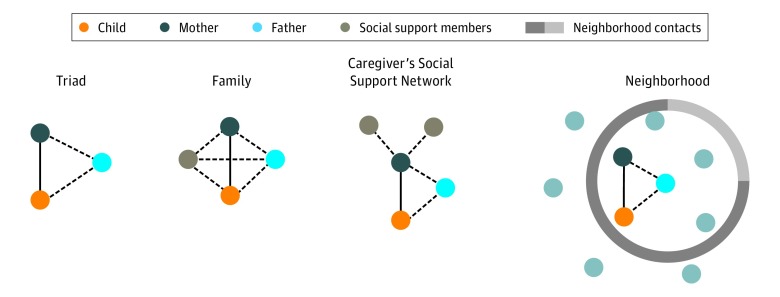
DESIGN, SETTING, AND PARTICIPANTS: This cohort study used data from 1082 mother-child pairs in the University of Tennessee Health Science Center-Conditions Affecting Neurocognitive Development and Learning and Early Childhood project to examine the association between networks of different levels of complexity (triad, family, and neighborhood) and child cognitive performance after adjustment for the mother's IQ, birth weight, and age, and the father's educational level. The final model was adjusted for the household poverty level. Data were collected from December 2006 through January 2014 and analyzed from October through November 2018.
The child-mother relationship, child-mother-father triad, family setting, child's dwelling network, mother's social support network, and neighborhood networks.
Measure of cognitive development of the child using Bayley Scales of Infant Development (BSID) at 2 years of age.
Of 1082 participants, 544 (50.3%) were males and 703 (65.1%) were African American; the mean (SD) age was 2.08 (0.12) years. Large family size had a negative association with early cognitive development, with a mean 2.21-point decrease in BSID coefficient score (95% CI, 0.40 to 4.02; P = .01). Mother's social support network size was positively associated early cognitive development, with a mean 0.40-point increase in BSID coefficient score (95% CI, 0.001 to 0.80; P = .05). Knowing many neighbors was not statistically significantly associated with early cognitive development, with a mean 1.39-point increase in BSID coefficient score (95% CI, -0.04 to 2.83; P = .06).
The findings suggest that maternal social relationships are associated with cognitive development in children and that social relationships beyond the mother-child-father triad are significantly associated with children's cognitive development. This study investigates the environmental influences on child health outcomes and, specifically, how early cognitive development is associated with social networks for the primary caregiver.
本研究探讨了不同类型的社会网络结构如何与儿童早期认知发展相关。
评估社会关系和结构与早期认知发展的关系,并阐明母亲社交网络的变化是否改变了孩子早期认知发展模式。
设计、地点和参与者:本队列研究使用了田纳西大学健康科学中心-影响神经认知发展和学习及幼儿项目中 1082 对母婴对的数据,以检查不同复杂程度的网络(三人组、家庭和社区)与儿童认知表现之间的关系,调整了母亲的智商、出生体重和年龄以及父亲的教育水平。最终模型调整了家庭贫困水平。数据于 2006 年 12 月至 2014 年 1 月收集,并于 2018 年 10 月至 11 月进行分析。
母子关系、母子父子三人组、家庭环境、儿童居住网络、母亲社会支持网络和社区网络。
使用贝利婴幼儿发育量表(BSID)在 2 岁时评估儿童的认知发育。
在 1082 名参与者中,544 名(50.3%)为男性,703 名(65.1%)为非裔美国人;平均(SD)年龄为 2.08(0.12)岁。大家庭规模与早期认知发展呈负相关,BSID 系数得分平均下降 2.21 分(95%CI,0.40 至 4.02;P=0.01)。母亲的社会支持网络规模与早期认知发展呈正相关,BSID 系数得分平均增加 0.40 分(95%CI,0.001 至 0.80;P=0.05)。认识许多邻居与早期认知发展没有统计学上的显著关联,BSID 系数得分平均增加 1.39 分(95%CI,-0.04 至 2.83;P=0.06)。
研究结果表明,母亲的社会关系与儿童的认知发展有关,而母子父子三人组之外的社会关系与儿童的认知发展显著相关。本研究调查了环境对儿童健康结果的影响,特别是早期认知发展与主要照顾者的社交网络的关系。