Department of Biological Chemistry, and.
Division of Hematology/Oncology, Department of Medicine, University of California, Irvine, Irvine, CA.
Blood Adv. 2019 Jan 22;3(2):122-131. doi: 10.1182/bloodadvances.2018026450.
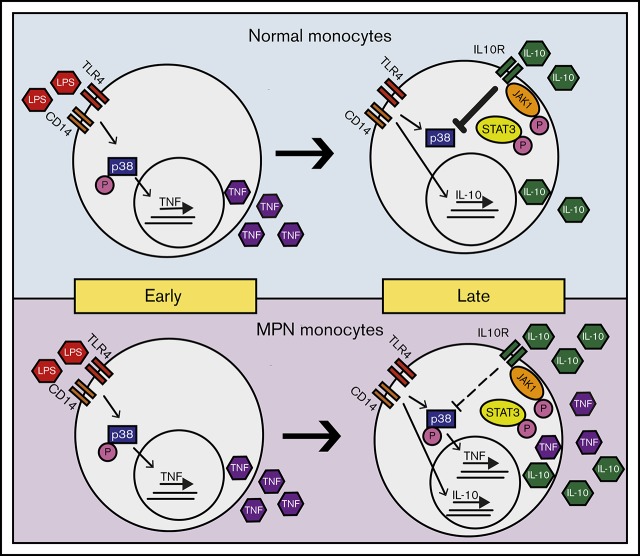
Patients with myeloproliferative neoplasms (MPN) have high levels of inflammatory cytokines, some of which drive many of the debilitating constitutional symptoms associated with the disease and may also promote expansion of the neoplastic clone. We report here that monocytes from patients with MPN have defective negative regulation of Toll-like receptor (TLR) signaling that leads to unrestrained production of the inflammatory cytokine tumor necrosis factor α (TNF-α) after TLR activation. Specifically, monocytes of patients with MPN are insensitive to the anti-inflammatory cytokine interleukin 10 (IL-10) that negatively regulates TLR-induced TNF-α production. This inability to respond to IL-10 is a not a direct consequence of , as the phenotype of persistent TNF-α production is a feature of and wild-type monocytes alike from -positive patients. Moreover, persistent TNF-α production was also discovered in the unaffected identical twin of a patient with MPN, suggesting it could be an intrinsic feature of those predisposed to acquire MPN. This work implicates sustained TLR signaling as not only a contributor to the chronic inflammatory state of MPN patients but also a potential predisposition to acquire MPN.
骨髓增殖性肿瘤(MPN)患者的炎症细胞因子水平较高,其中一些细胞因子可导致与疾病相关的许多使人衰弱的全身症状,并可能促进肿瘤克隆的扩张。我们在此报告,MPN 患者的单核细胞存在 Toll 样受体(TLR)信号的负调控缺陷,导致 TLR 激活后炎症细胞因子肿瘤坏死因子 α(TNF-α)的不受控制产生。具体而言,MPN 患者的单核细胞对负向调节 TLR 诱导的 TNF-α产生的抗炎细胞因子白细胞介素 10(IL-10)不敏感。这种对 IL-10 无反应的能力不是由于 所致,因为持续性 TNF-α产生的表型是 和阳性患者的野生型单核细胞的共同特征。此外,还在一名 MPN 患者的未受影响的同卵双胞胎中发现了持续性 TNF-α产生,这表明它可能是那些易患 MPN 的内在特征。这项工作表明,持续的 TLR 信号不仅是 MPN 患者慢性炎症状态的一个促成因素,也是获得 MPN 的潜在倾向。