Yeoh Yun Kit, Chen Zigui, Hui Mamie, Wong Martin C S, Ho Wendy C S, Chin Miu Ling, Ng Siew C, Chan Francis K L, Chan Paul K S
Department of Microbiology, Faculty of Medicine, The Chinese University of Hong Kong, Shatin, Hong Kong SAR, China.
Centre for Gut Microbiota Research, Faculty of Medicine, The Chinese University of Hong Kong, Shatin, Hong Kong SAR, China.
PeerJ. 2019 Jan 11;7:e6172. doi: 10.7717/peerj.6172. eCollection 2019.
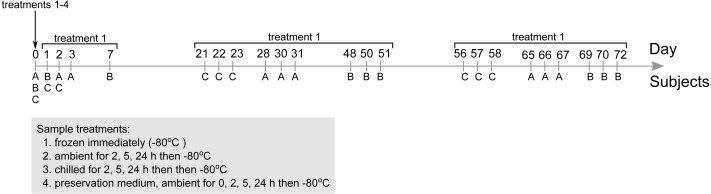
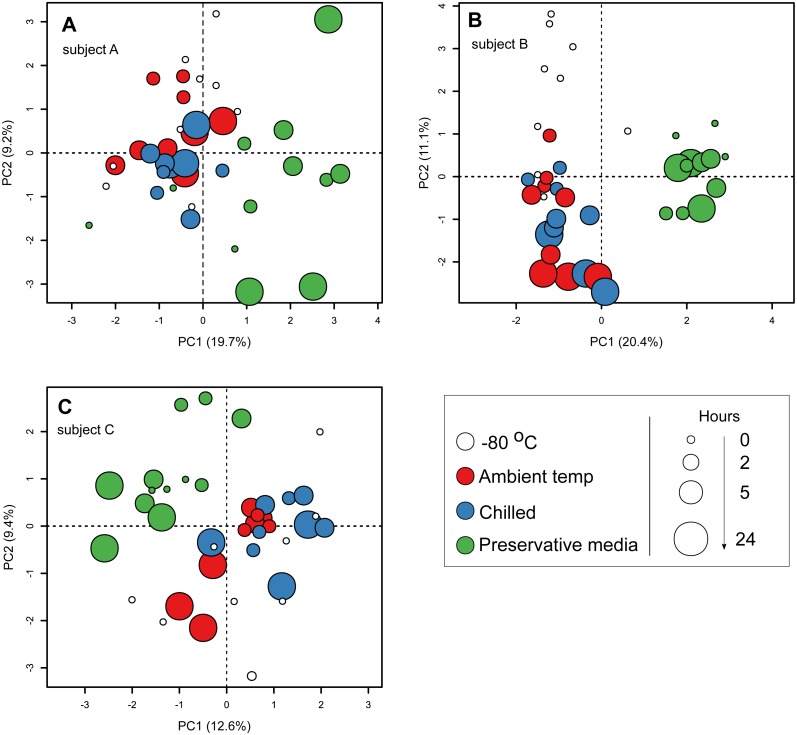
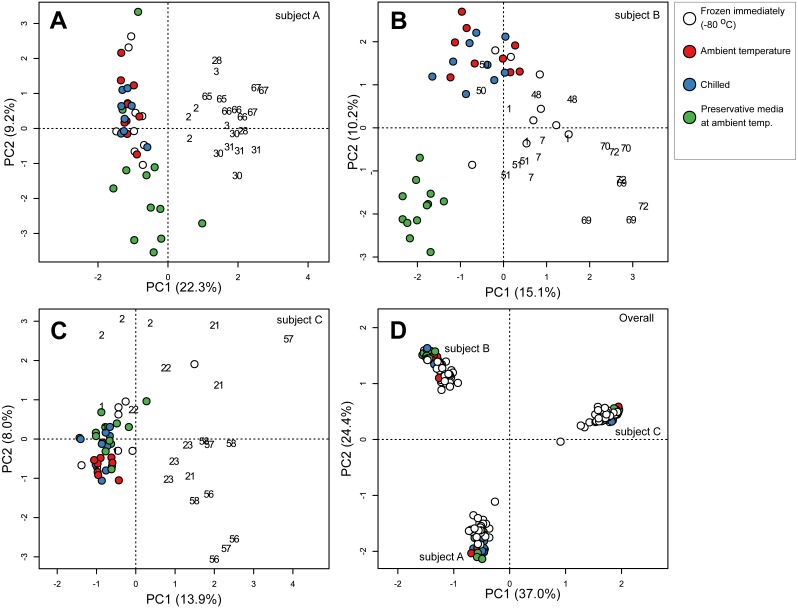
Stools are commonly used as proxies for studying human gut microbial communities as sample collection is straightforward, cheap and non-invasive. In large-scale human population surveys, however, sample integrity becomes an issue as it is not logistically feasible for researchers to personally collect stools from every participant. Instead, participants are usually given guidelines on sample packaging and storage, and asked to deliver their stools to a centralised facility. Here, we tested a number of delivery conditions (temperature, duration and addition of preservative medium) and assessed their effects on stool microbial community composition using 16S rRNA gene amplicon sequencing. The largest source of variability in stool community composition was attributable to inter-individual differences regardless of delivery condition. Although the relative effect of delivery condition on community composition was small compared to inter-individual variability (1.6% vs. 60.5%, permutational multivariate analysis of variance [PERMANOVA]) and temporal variation within subjects over 10 weeks (5.2%), shifts in microbial taxa associated with delivery conditions were non-systematic and subject-specific. These findings indicated that it is not possible to model or accurately predict shifts in stool community composition associated with sampling logistics. Based on our findings, we recommend delivery of fresh, preservative-free stool samples to laboratories within 2 hr either at ambient or chilled temperatures to minimise perturbations to microbial community composition. In addition, subsamples from different fractions of the same stool displayed a small (3.3% vs. 72.6% inter-individual variation, PERMANOVA) but significant effect on community composition. Collection of larger sample volumes for homogenisation is recommended.
粪便通常被用作研究人类肠道微生物群落的替代物,因为样本采集简单、成本低且非侵入性。然而,在大规模的人群调查中,样本完整性成为一个问题,因为研究人员亲自从每个参与者那里采集粪便在后勤上是不可行的。相反,通常会向参与者提供样本包装和储存指南,并要求他们将粪便送到一个集中的设施。在这里,我们测试了多种运送条件(温度、持续时间和添加保存培养基),并使用16S rRNA基因扩增子测序评估了它们对粪便微生物群落组成的影响。无论运送条件如何,粪便群落组成中最大的变异来源归因于个体间差异。尽管与个体间变异性相比,运送条件对群落组成的相对影响较小(置换多元方差分析[PERMANOVA]显示为1.6%对60.5%),且在10周内受试者内部的时间变化为5.2%,但与运送条件相关的微生物分类群的变化是非系统性的且因个体而异。这些发现表明,不可能对与采样后勤相关的粪便群落组成变化进行建模或准确预测。基于我们的发现,我们建议在2小时内将新鲜的、无防腐剂的粪便样本在环境温度或冷藏温度下送到实验室,以尽量减少对微生物群落组成的干扰。此外,来自同一粪便不同部分的子样本对群落组成显示出较小(PERMANOVA显示个体间变异为3.3%对72.6%)但显著的影响。建议采集更大体积的样本进行匀浆。