Sahoo Dipak Kumar, Jena Subhrakant, Dutta Juhi, Chakrabarty Suman, Biswal Himansu S
School of Chemical Sciences, National Institute of Science Education and Research, PO-Bhimpur-Padanpur, Via-Jatni, District-Khurda, PIN-752050, Bhubaneswar, India.
Homi Bhabha National Institute, Training School Complex, Anushakti Nagar, Mumbai 400094, India.
ACS Cent Sci. 2018 Dec 26;4(12):1642-1651. doi: 10.1021/acscentsci.8b00601. Epub 2018 Dec 4.
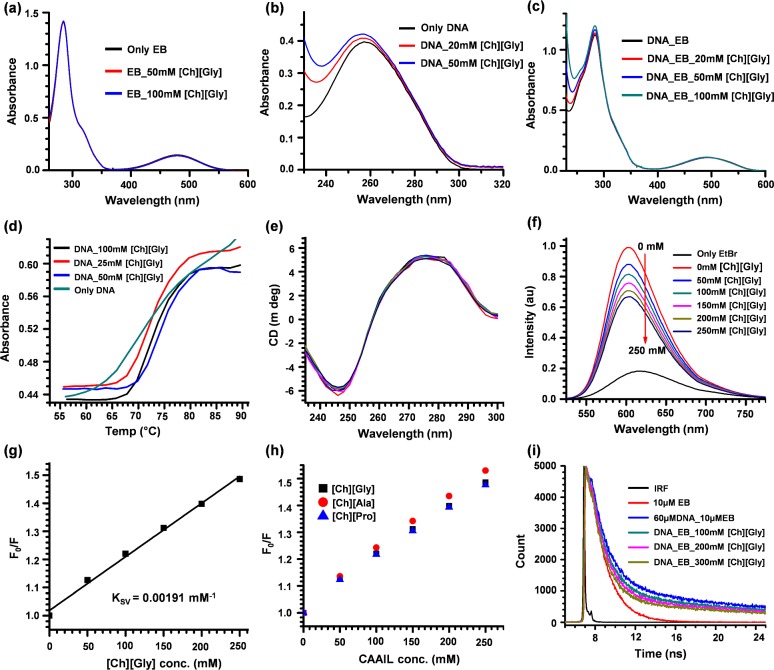
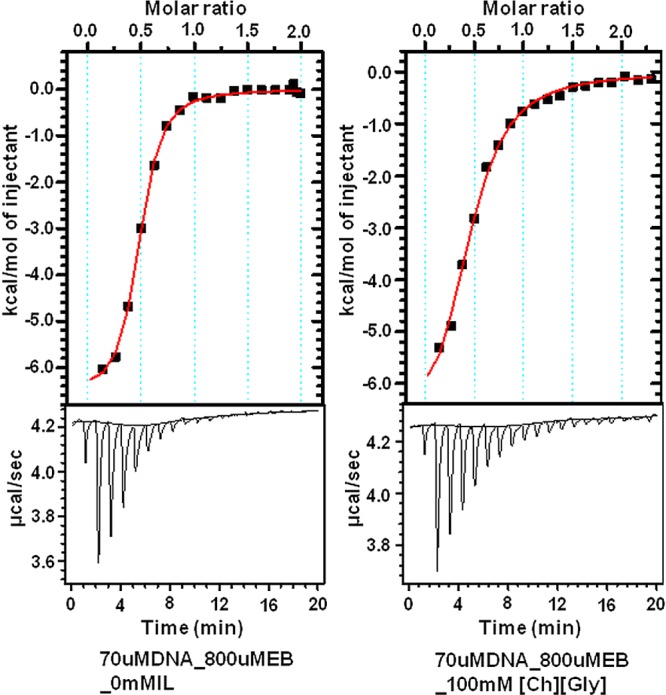
Long-term storage and stability of DNA is of paramount importance in biomedical applications. Ever since the emergence of ionic liquids (ILs) as alternate green solvents to aqueous and organic solvents, their exploration for the extraction and application of DNA need conscientious understanding of the binding characteristics and molecular interactions between IL and DNA. Choline amino acid ILs (CAAILs) in this regard seem to be promising due to their non-cytotoxic, completely biobased and environment-friendly nature. To unravel the key factors for the strength and binding mechanism of CAAILs with DNA, various spectroscopic techniques, molecular docking, and molecular dynamics simulations were employed in this work. UV-Vis spectra indicate multimodal binding of CAAILs with DNA, whereas dye displacement studies through fluorescence emission confirm the intrusion of IL molecules into the minor groove of DNA. Circular dichorism spectra show that DNA retains its native B-conformation in CAAILs. Both isothermal titration calorimetry and molecular docking studies provide an estimate of the binding affinity of DNA with CAAILs ≈ 4 kcal/mol. The heterogeneity in binding modes of CAAIL-DNA system with evolution of time was established by molecular dynamics simulations. Choline cation while approaching DNA first binds at surface through electrostatic interactions, whereas a stronger binding at minor groove occurs via van der Waals and hydrophobic interactions irrespective of anions considered in this study. We hope this result can encourage and guide the researchers in designing new bio-ILs for biomolecular studies in future.
在生物医学应用中,DNA的长期储存和稳定性至关重要。自从离子液体(ILs)作为水性和有机溶剂的替代绿色溶剂出现以来,对其用于DNA提取和应用的探索需要认真了解IL与DNA之间的结合特性和分子相互作用。胆碱氨基酸离子液体(CAAILs)在这方面似乎很有前景,因为它们具有无细胞毒性、完全基于生物且环境友好的特性。为了揭示CAAILs与DNA结合强度和机制的关键因素,本研究采用了各种光谱技术、分子对接和分子动力学模拟。紫外可见光谱表明CAAILs与DNA存在多模式结合,而通过荧光发射进行的染料置换研究证实了IL分子侵入DNA的小沟。圆二色光谱表明DNA在CAAILs中保留其天然B构象。等温滴定量热法和分子对接研究均估计DNA与CAAILs的结合亲和力约为4千卡/摩尔。通过分子动力学模拟确定了CAAIL-DNA系统结合模式随时间演变的异质性。胆碱阳离子在接近DNA时首先通过静电相互作用结合在表面,而无论本研究中考虑的阴离子如何,在小沟处通过范德华力和疏水相互作用发生更强的结合。我们希望这一结果能够鼓励和指导研究人员未来设计用于生物分子研究的新型生物离子液体。