Dinis Teresa B V, Sousa Fani, Freire Mara G
Department of Chemistry, CICECO - Aveiro Institute of Materials, University of Aveiro, Aveiro, Portugal.
CICS-UBI - Health Sciences Research Center, Universidade da Beira Interior, Covilhã, Portugal.
Front Bioeng Biotechnol. 2020 Oct 14;8:547857. doi: 10.3389/fbioe.2020.547857. eCollection 2020.
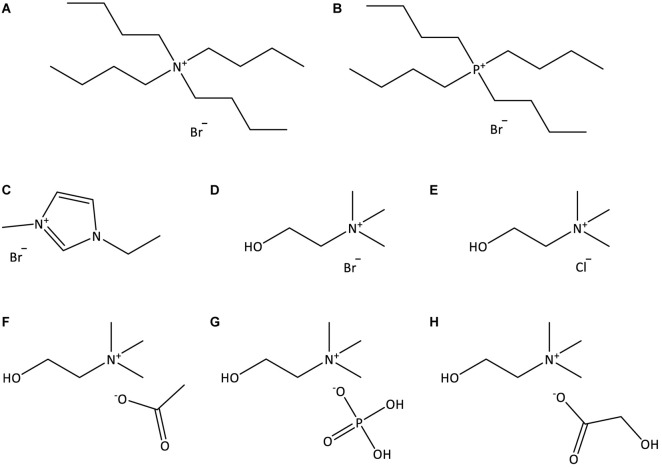
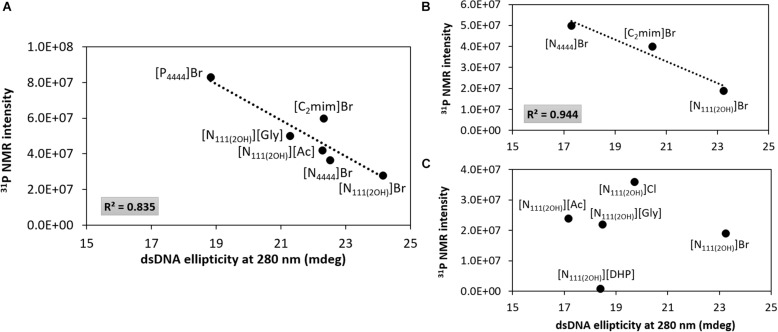
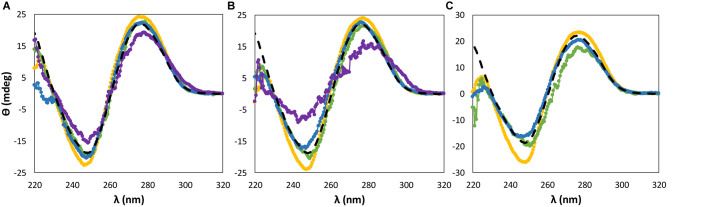
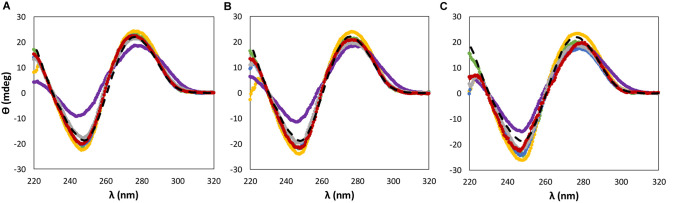
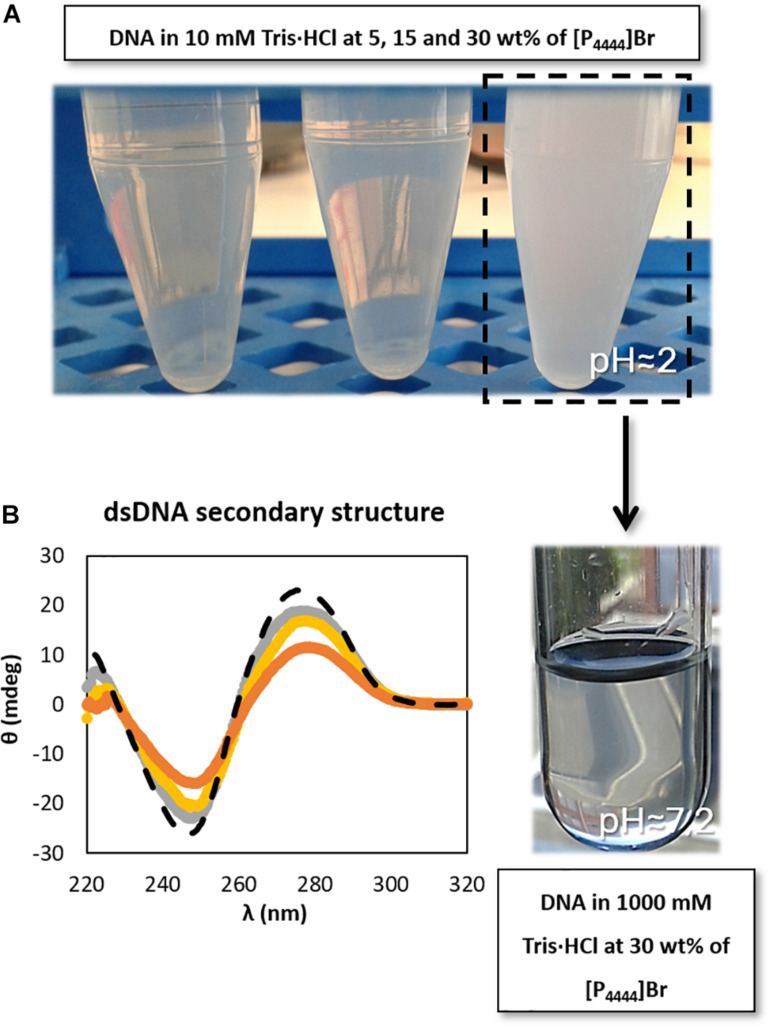
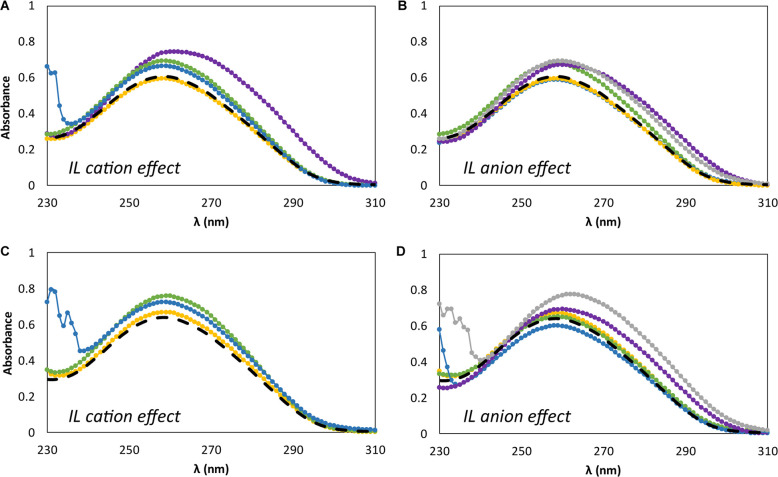
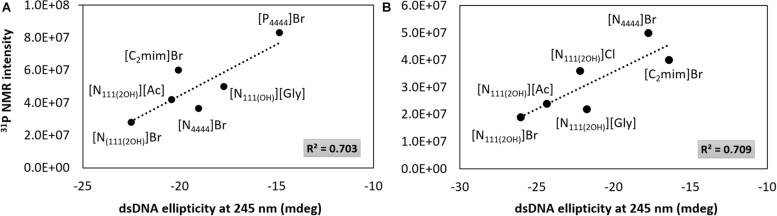
Deoxyribonucleic acid (DNA) carries the genetic information essential for the growth and functioning of living organisms, playing a significant role in life sciences research. However, the long-term storage and preservation of DNA, while ensuring its bioactivity, are still current challenges to overcome. In this work, aqueous solutions of ionic liquids (ILs) were investigated as potential preservation media for double stranded (dsDNA). A screening of several ILs, by combining the cholinium, tetrabutylammonium, tetrabutylphosphonium, and 1-ethyl-3-methylimidazolium, cations with the anions bromide, chloride, dihydrogen phosphate, acetate, and glycolate, was carried out in order to gather fundamental knowledge on the molecular features of ILs that improve the dsDNA stability. Different IL concentrations and the pH effect were also addressed. Circular dichroism (CD) spectroscopy was used to evaluate the conformational structure and stability of dsDNA. IL-DNA interactions were appraised by UV-Vis absorption spectrophotometry and P nuclear magnetic resonance (NMR) spectroscopy. The results obtained demonstrate that pH has a significant effect towards the dsDNA stability. Amongst the ILs investigated, cholinium-based ILs are the most promising class of ILs to preserve the dsDNA structure, in which electrostatic interactions between the cholinium cation and the DNA phosphate groups play a significant role as demonstrated by the P NMR data, being more relevant at higher IL concentrations. On the other hand, the denaturation of dsDNA mainly occurs with ILs composed of more hydrophobic cations and able to establish dispersive interactions with the nucleobases environment. Furthermore, the IL anion has a weaker impact when compared to the IL cation effect to interact with DNA molecules. The experimental data of this work provide relevant fundamental knowledge for the application of ILs in the preservation of nucleic acids, being of high relevance in the biotechnology field.
脱氧核糖核酸(DNA)携带着生物体生长和功能所必需的遗传信息,在生命科学研究中发挥着重要作用。然而,在确保DNA生物活性的同时,对其进行长期存储和保存仍是当前需要克服的挑战。在这项工作中,研究了离子液体(ILs)的水溶液作为双链(dsDNA)潜在保存介质的可能性。通过将胆碱、四丁基铵、四丁基鏻和1-乙基-3-甲基咪唑鎓阳离子与溴化物、氯化物、磷酸二氢盐、乙酸盐和乙醇酸盐阴离子相结合,对几种离子液体进行了筛选,以便收集有关改善dsDNA稳定性的离子液体分子特征的基础知识。还研究了不同的离子液体浓度和pH值的影响。圆二色性(CD)光谱用于评估dsDNA的构象结构和稳定性。通过紫外可见吸收分光光度法和磷核磁共振(NMR)光谱对离子液体与DNA的相互作用进行了评估。所得结果表明,pH值对dsDNA稳定性有显著影响。在所研究的离子液体中,基于胆碱的离子液体是保存dsDNA结构最有前景的一类离子液体,其中胆碱阳离子与DNA磷酸基团之间的静电相互作用起着重要作用,磷核磁共振数据证明了这一点,在较高的离子液体浓度下更为显著。另一方面,dsDNA的变性主要发生在由疏水性更强的阳离子组成且能够与核碱基环境建立色散相互作用的离子液体中。此外,与离子液体阳离子与DNA分子相互作用的影响相比,离子液体阴离子的影响较弱。这项工作的实验数据为离子液体在核酸保存中的应用提供了相关的基础知识,在生物技术领域具有高度相关性。