Division of Psychiatry, University College London, 6th Floor, Maple House, 149 Tottenham Court Road, London, W1T 7NF, UK.
Camden and Islington NHS Foundation Trust, London, UK.
Eur J Epidemiol. 2019 Jun;34(6):567-577. doi: 10.1007/s10654-019-00481-x. Epub 2019 Jan 16.
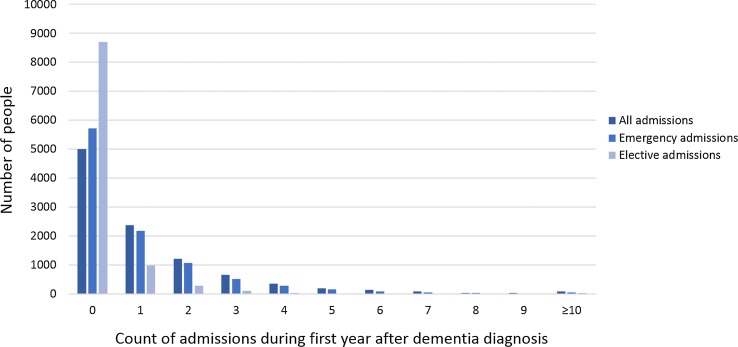
Hospitalisation of people with dementia is associated with adverse outcomes and high costs. We aimed to examine general, i.e. non-psychiatric, hospitalisation rates, changes since 2008 and factors associated with admission. We also aimed to compare admission rates of people with dementia with age-matched people without dementia. We conducted a cohort study of adults ≥ 65 years, with dementia diagnosed during the 2008-2016 study window, derived from a large secondary mental healthcare database in South London, UK. We used national general hospital records to identify emergency and elective hospitalisations. We calculated the cumulative incidence and rate of hospitalisation and examined predictors of hospitalisation using negative binomial regression, with multiple imputation for missing covariate data. We calculated age-standardised admission ratio for people with dementia compared to those without. Of 10,137 people, 50.6% were admitted to hospital in the year following dementia diagnosis and 75.9% were admitted during median 2.5 years follow-up. Annual admission rate was 1.26/person-year of which 0.90/person-year were in emergency. Emergency hospitalisation rate increased throughout the study period. Compared to controls without diagnosed dementia in the catchment area, the age-standardised emergency admission ratio for people with dementia was 2.06 (95% CI 1.95, 2.18). Male, older, white and socio-economically deprived people and those with clinically significant comorbid physical illness, depressed mood, activity of daily living or living condition problems had more hospitalisations. Emergency hospitalisations of people with dementia are higher than those without, and increasing. Many factors associated with admission are social and psychological, and may be targets for future interventions that aim to reduce avoidable admissions.
痴呆患者住院与不良后果和高成本相关。我们旨在检查一般的(即非精神科)住院率,自 2008 年以来的变化以及与入院相关的因素。我们还旨在比较痴呆患者与年龄匹配的无痴呆患者的入院率。我们对 2008-2016 年研究期间在英国伦敦南部大型二级精神保健数据库中诊断为痴呆的≥65 岁成年人进行了队列研究。我们使用国家普通医院记录来识别急诊和择期住院。我们计算了住院的累积发生率和发生率,并使用负二项回归检查住院的预测因素,对于缺失协变量数据采用多重插补。我们计算了痴呆患者与无痴呆患者的年龄标准化入院率。在 10137 人中,50.6%的人在痴呆诊断后的一年内住院,75.9%的人在中位 2.5 年的随访期间住院。年入院率为 1.26/人年,其中 0.90/人年为急诊。整个研究期间,急诊住院率呈上升趋势。与该人群中未被诊断为痴呆的对照者相比,痴呆患者的年龄标准化急诊入院率为 2.06(95%CI 1.95,2.18)。男性、年龄较大、白人、社会经济贫困者,以及有明显合并躯体疾病、情绪低落、日常生活活动或生活条件问题的患者,住院治疗的次数更多。痴呆患者的急诊住院率高于无痴呆患者,且呈上升趋势。许多与入院相关的因素是社会心理因素,可能是未来旨在减少非必要入院干预措施的目标。