Department of Biostatistics, University of Washington, Seattle, WA.
Fred Hutchinson Cancer Research Center Seattle, WA.
Med Decis Making. 2019 Feb;39(2):86-90. doi: 10.1177/0272989X18819479. Epub 2019 Jan 16.
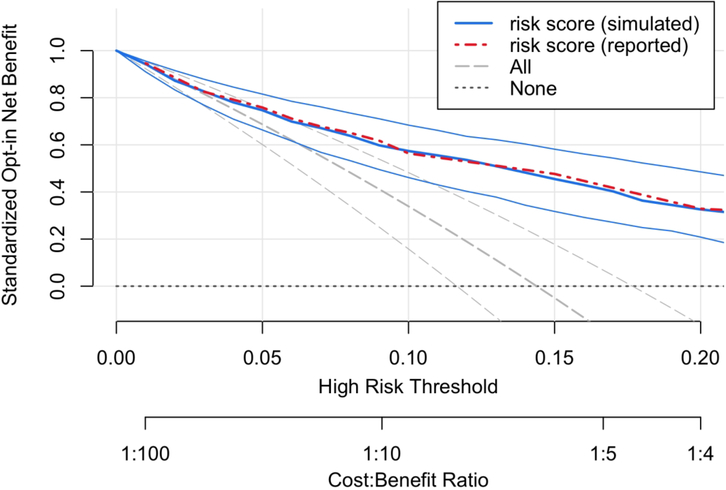
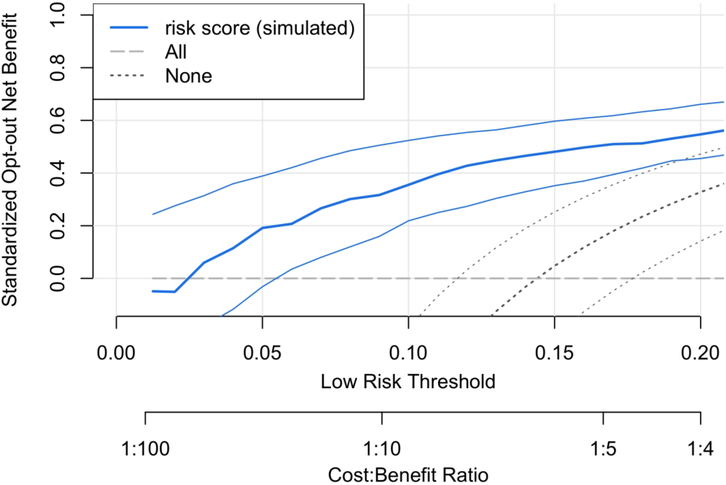
Decision curves are a tool for evaluating the population impact of using a risk model for deciding whether to undergo some intervention, which might be a treatment to help prevent an unwanted clinical event or invasive diagnostic testing such as biopsy. The common formulation of decision curves is based on an opt-in framework. That is, a risk model is evaluated based on the population impact of using the model to opt high-risk patients into treatment in a setting where the standard of care is not to treat. Opt-in decision curves display the population net benefit of the risk model in comparison to the reference policy of treating no patients. In some contexts, however, the standard of care in the absence of a risk model is to treat everyone, and the potential use of the risk model would be to opt low-risk patients out of treatment. Although opt-out settings were discussed in the original decision curve paper, opt-out decision curves are underused. We review the formulation of opt-out decision curves and discuss their advantages for interpretation and inference when treat-all is the standard.
决策曲线是一种用于评估使用风险模型来决定是否进行某种干预的人群影响的工具,这种干预可能是一种治疗方法,用于帮助预防不良的临床事件,或进行侵入性诊断测试,如活检。决策曲线的常见形式基于选择加入框架。也就是说,基于在标准治疗不进行治疗的情况下,使用模型选择高风险患者进行治疗的情况下,评估风险模型的人群影响。选择加入决策曲线显示了与不治疗任何患者的参考策略相比,风险模型的人群净收益。然而,在某些情况下,没有风险模型时的标准治疗方法是治疗所有人,风险模型的潜在用途是选择低风险患者不进行治疗。尽管原始决策曲线论文中讨论了选择退出设置,但选择退出决策曲线的使用并不广泛。我们回顾了选择退出决策曲线的公式,并讨论了在治疗所有患者为标准时,它们在解释和推断方面的优势。