Department of Parasitology and Research Centre for Drugs and Diagnostics, Liverpool School of Tropical Medicine, Pembroke Place, Liverpool, United Kingdom.
Research Foundation in Tropical Medicine and the Environment, Buea, Cameroon.
PLoS Negl Trop Dis. 2019 Jan 16;13(1):e0006356. doi: 10.1371/journal.pntd.0006356. eCollection 2019 Jan.
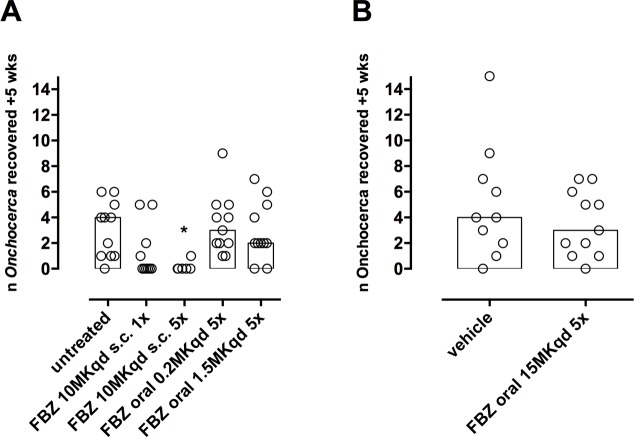
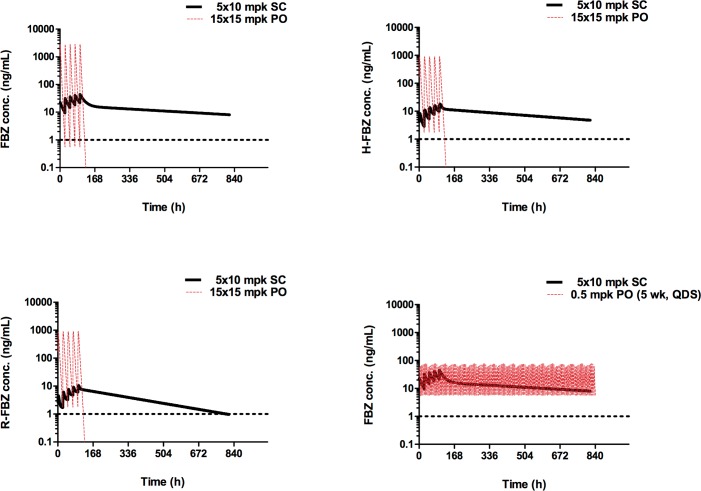
The Onchocerca ochengi adult implant and Brugia malayi microfilariemic Severe-Combined Immunodeficient (SCID) mouse models are validated screens to measure macrofilaricidal and microfilaricidal activities of candidate onchocerciasis drugs. The purpose of this study was to assess whether 5 daily sub-cutaneous (s.c.) injections of standard flubendazole (FBZ) suspension (10mg/kg), a single s.c. injection (10mg/kg) or 5 daily repeated oral doses of FBZ amorphous solid dispersion (ASD) formulation (0.2, 1.5 or 15mg/kg) mediated macrofilaricidal efficacy against O. ochengi male worms implanted into SCID mice. The direct microfilaricidal activity against circulating B. malayi microfilariae of single dose FBZ ASD formulation (2 or 40 mg/kg) was also evaluated and compared against the standard microfilaricide, ivermectin (IVM). Systemic exposures of FBZ/FBZ metabolites achieved following dosing were measured by pharmacokinetic (PK) bioanalysis. At necropsy, five weeks following start of FBZ SC injections, there were significant reductions in burdens of motile O. ochengi worms following multiple injections (93%) or single injection (82%). Further, significant proportions of mice dosed following multiple injections (5/6; 83%) or single injection (6/10; 60%) were infection negative (drug-cured). In comparison, no significant reduction in recovery of motile adult O. ochengi adult worms was obtained in any multiple-oral dosage group. Single oral-dosed FBZ did not mediate any significant microfilaricidal activity against circulating B. malayi mf at 2 or 7 days compared with >80% efficacy of single dose IVM. In conclusion, multiple oral FBZ formulation doses, whilst achieving substantial bioavailability, do not emulate the efficacy delivered by the parenteral route in vivo against adult O. ochengi. PK analysis determined FBZ efficacy was related to sustained systemic drug levels rather than achievable Cmax. PK modelling predicted that oral FBZ would have to be given at low dose for up to 5 weeks in the mouse model to achieve a matching efficacious exposure profile.
奥氏曼森线虫成虫植入和马来布鲁线虫微丝蚴重症联合免疫缺陷 (SCID) 小鼠模型已被验证可用于衡量候选盘尾丝虫病药物的杀成虫和杀微丝蚴活性。本研究的目的是评估 5 天皮下 (s.c.) 注射标准氟苯达唑 (FBZ) 混悬剂 (10mg/kg)、单次 s.c. 注射 (10mg/kg) 或 5 天重复口服 FBZ 无定形固体分散体 (ASD) 制剂 (0.2、1.5 或 15mg/kg) 对植入 SCID 小鼠的奥氏曼森线虫雄性成虫的杀成虫疗效是否存在差异。还评估和比较了单次剂量 FBZ ASD 制剂 (2 或 40mg/kg) 对循环的马来布鲁线虫微丝蚴的直接杀微丝蚴活性,并与标准杀微丝蚴药物伊维菌素 (IVM) 进行了比较。通过药代动力学 (PK) 生物分析测量 FBZ/FBZ 代谢物给药后的系统暴露。在 FBZ SC 注射开始后五周剖检时,多次注射 (93%) 或单次注射 (82%) 后可显著减少运动的奥氏曼森线虫虫体负荷。此外,多次注射 (5/6; 83%) 或单次注射 (6/10; 60%) 的小鼠中有很大比例被感染消除 (药物治愈)。相比之下,在任何多次口服剂量组中,均未观察到运动的奥氏曼森线虫成虫数量有显著减少。与单次剂量 IVM 的 80%以上疗效相比,单次口服 FBZ 对循环的马来布鲁线虫 mf 未表现出任何显著的杀微丝蚴活性。结论是,尽管多次口服 FBZ 制剂剂量实现了相当大的生物利用度,但在体内针对奥氏曼森线虫成虫时,无法模拟出其通过给药途径获得的疗效。PK 分析确定 FBZ 的疗效与持续的系统药物水平相关,而不是与 Cmax 相关。PK 模型预测,在小鼠模型中,为了达到匹配的有效暴露谱,口服 FBZ 可能需要低剂量给药长达 5 周。