Center for Biological Diversity, Oakland, California, United States of America.
Center for Biological Diversity, Tucson, Arizona, United States of America.
PLoS One. 2019 Jan 16;14(1):e0210164. doi: 10.1371/journal.pone.0210164. eCollection 2019.
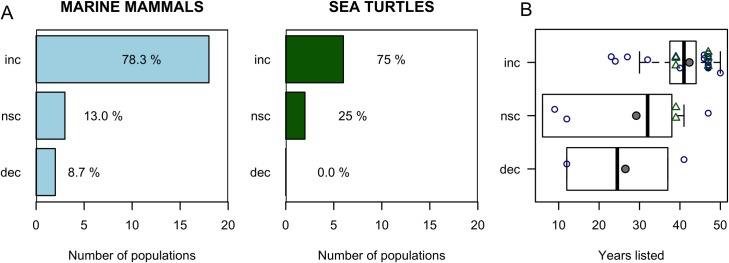
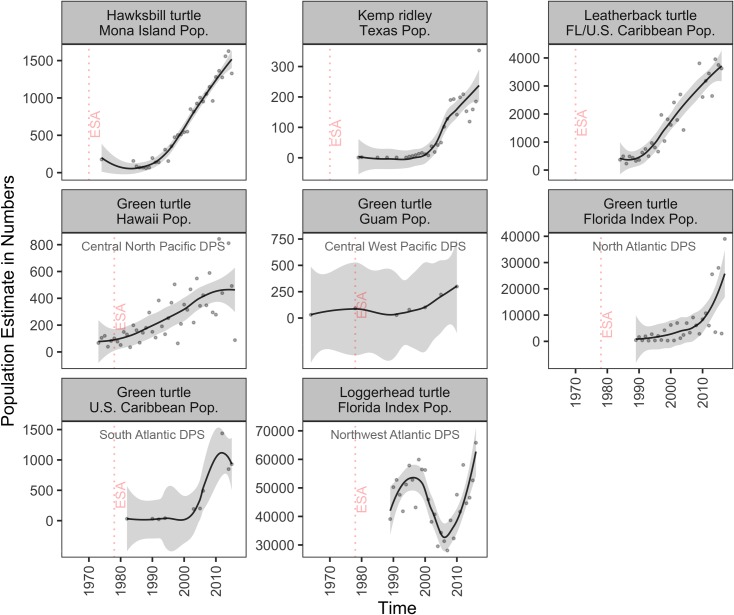
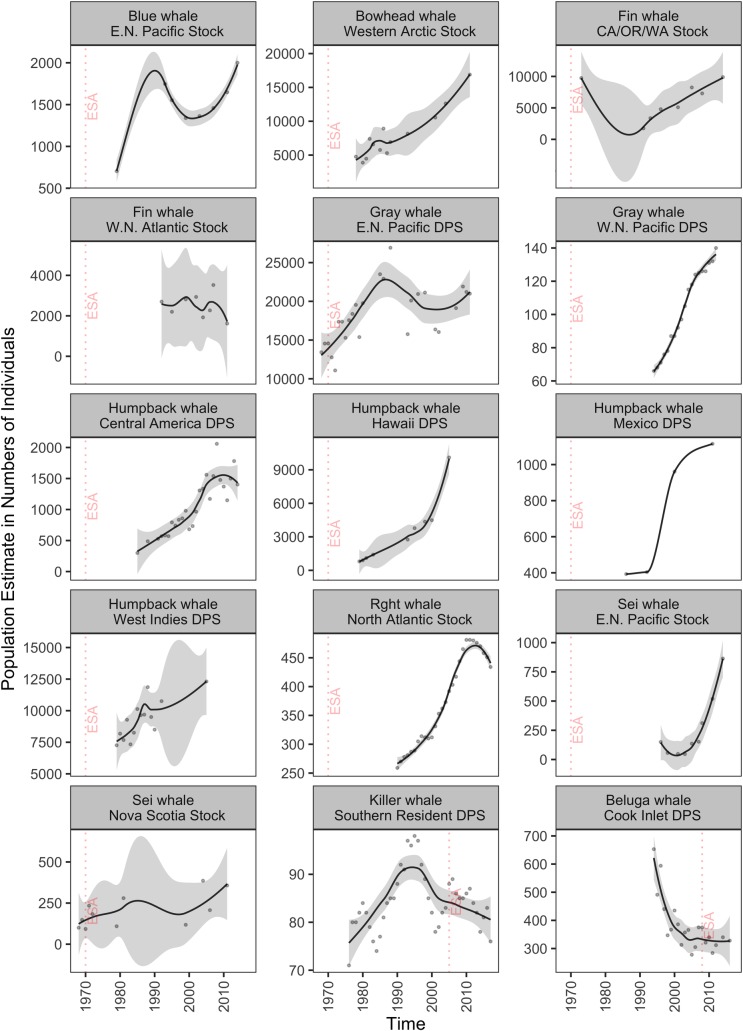
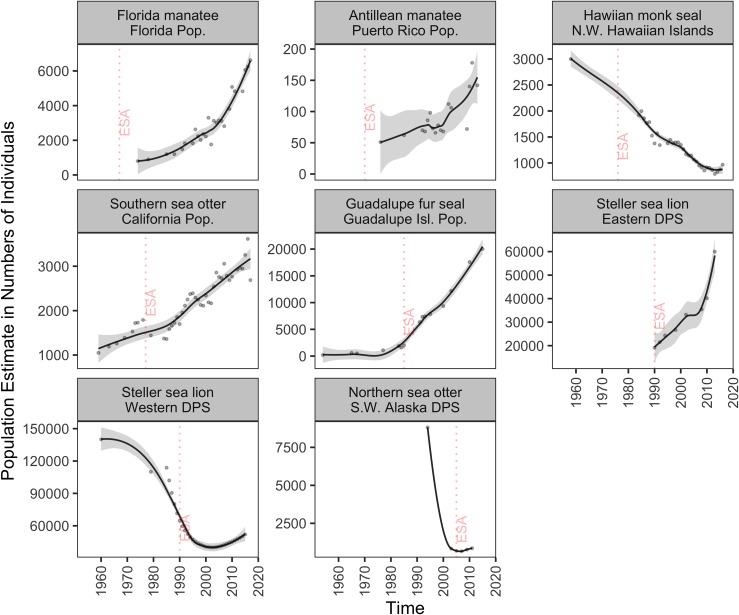
The U.S. Endangered Species Act (ESA) is a powerful environmental law protecting imperiled plants and animals, and a growing number of marine species have been protected under this law as extinction risk in the oceans has increased. Marine mammals and sea turtles comprise 38% of the 163 ESA-listed marine "species", which includes subspecies and distinct population segments, yet analyses of recovery trends after listing are lacking. Here we gathered the best available annual abundance estimates for geographically delimited populations of all 62 marine mammal and sea turtle species listed under the ESA. Of these, we chose representative populations of species that were listed before 2012, occur and reproduce in U.S. waters, and have data of sufficient quality and timespan for trend analyses. Thus, we quantitatively analyzed population trends, magnitude of population change, and recovery status for 23 and 8 representative populations of 14 marine mammal and 5 sea turtle species, respectively. Using generalized linear and non-linear models, we found that 18 marine mammal (78%) and 6 sea turtle (75%) populations significantly increased after listing; 3 marine mammal (13%) and 2 sea turtle (25%) populations showed non-significant changes; while 2 marine mammal (9%), but no sea turtle populations declined after ESA protection. Overall, the 24 populations that increased in abundance were from species listed for 20 years or more (e.g., large whales, manatees, and sea turtles). Conservation measures triggered by ESA listing such as ending exploitation, tailored species management, and fishery regulations, and other national and international measures, appear to have been largely successful in promoting species recovery, leading to the delisting of some species and to increases in most populations. These findings underscore the capacity of marine mammal and sea turtle species to recover from substantial geographical population declines when conservation actions are implemented in a timely and effective manner.
美国濒危物种法案(ESA)是一项强大的环境法规,保护濒危植物和动物,随着海洋物种灭绝风险的增加,越来越多的海洋物种受到该法案的保护。海洋哺乳动物和海龟构成了 163 种 ESA 列出的海洋“物种”中的 38%,其中包括亚种和独特的种群片段,但缺乏上市后恢复趋势的分析。在这里,我们收集了所有 62 种海洋哺乳动物和海龟物种的最佳可用年度丰度估计值,这些物种都在 ESA 下列出。在这些物种中,我们选择了在 2012 年之前列出的、在美属水域出现和繁殖的、具有足够质量和时间跨度进行趋势分析的代表性物种的种群。因此,我们分别对 14 种海洋哺乳动物和 5 种海龟的 23 个和 8 个代表性种群的种群趋势、种群变化幅度和恢复状况进行了定量分析。使用广义线性和非线性模型,我们发现,在上市后,18 种海洋哺乳动物(78%)和 6 种海龟(75%)种群显著增加;3 种海洋哺乳动物(13%)和 2 种海龟(25%)种群变化不显著;而 2 种海洋哺乳动物(9%),但没有海龟种群在 ESA 保护后下降。总的来说,在数量上增加的 24 个种群来自上市 20 年或更长时间的物种(如大型鲸鱼、海牛和海龟)。ESA 上市引发的保护措施,如停止开发、有针对性的物种管理、渔业法规以及其他国家和国际措施,似乎在促进物种恢复方面取得了很大成功,导致一些物种被除名,大多数种群数量增加。这些发现强调了海洋哺乳动物和海龟物种在及时有效地采取保护行动时,从重大的地理种群减少中恢复的能力。