Centre for Neuroendocrinology, Department of Anatomy, University of Otago, Dunedin 9016, New Zealand.
Int J Mol Sci. 2019 Jan 15;20(2):329. doi: 10.3390/ijms20020329.
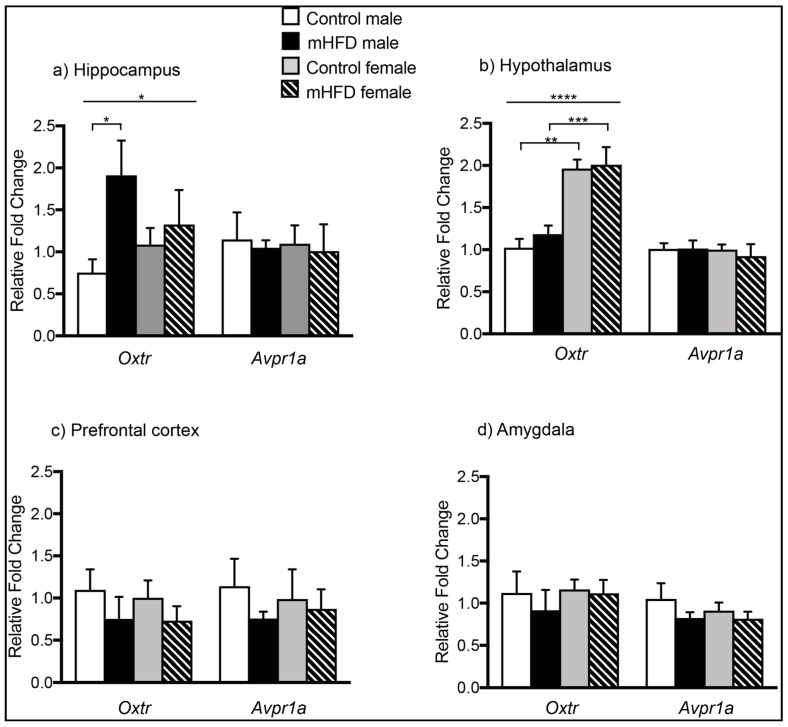
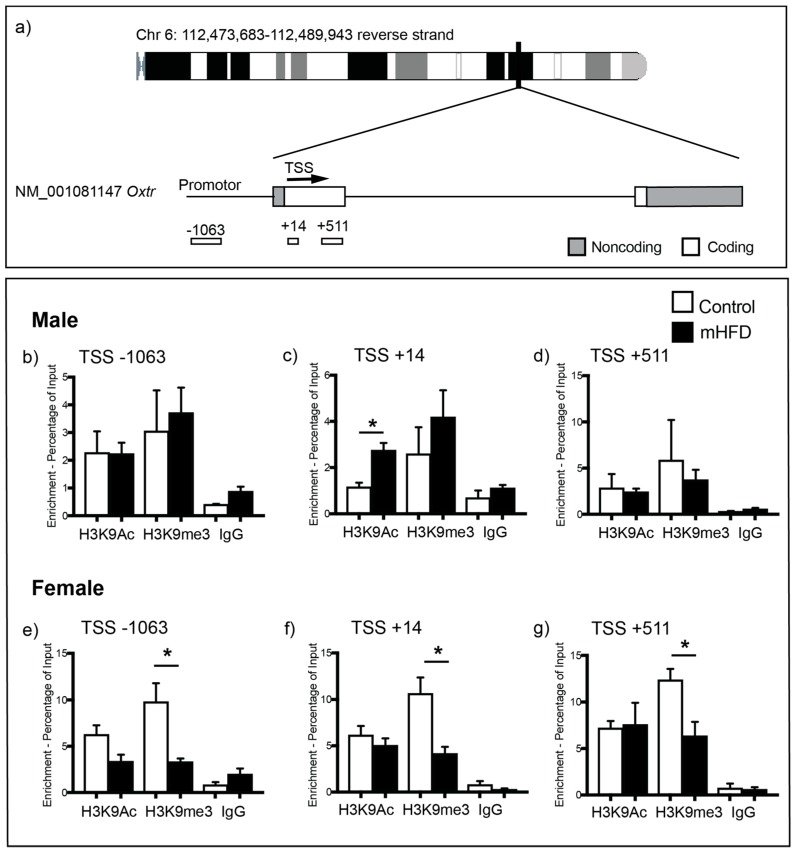
Maternal obesity during pregnancy increases risk for neurodevelopmental disorders in offspring, although the underlying mechanisms remain unclear. Epigenetic deregulation associates with many neurodevelopmental disorders, and recent evidence indicates that maternal nutritional status can alter chromatin marks in the offspring brain. Thus, maternal obesity may disrupt epigenetic regulation of gene expression during offspring neurodevelopment. Using a C57BL/6 mouse model, we investigated whether maternal high fat diet (mHFD)-induced obesity alters the expression of genes previously implicated in the etiology of neurodevelopmental disorders within the Gestational Day 17.5 (GD 17.5) offspring hippocampus. We found significant two-fold upregulation of oxytocin receptor () mRNA in the hippocampus of male, but not female, GD 17.5 offspring from mHFD-induced obese dams ( < 0.05). To determine whether altered histone binding at the gene promoter may underpin these transcriptional changes, we then performed chromatin immunoprecipitation (ChIP). Consistent with the transcriptional changes, we observed increased binding of active histone mark H3K9Ac at the transcriptional start site (TSS) in the hippocampus of mHFD male ( < 0.05), but not female, offspring. Together, these data indicate an increased vulnerability of male offspring to maternal obesity-induced changes in chromatin remodeling processes that regulate gene expression in the developing hippocampus, and contributes to our understanding of how early life nutrition affects the offspring brain epigenome.
母亲在怀孕期间肥胖会增加后代神经发育障碍的风险,尽管其潜在机制尚不清楚。表观遗传失调与许多神经发育障碍有关,最近的证据表明,母体营养状况可以改变后代大脑中的染色质标记。因此,母亲肥胖可能会破坏后代神经发育过程中基因表达的表观遗传调控。我们使用 C57BL/6 小鼠模型,研究了母体高脂肪饮食(mHFD)诱导的肥胖是否会改变在妊娠第 17.5 天(GD 17.5)后代海马体中先前与神经发育障碍病因相关的基因的表达。我们发现,mHFD 诱导肥胖母鼠的雄性 GD 17.5 后代海马体中的催产素受体()mRNA 表达显著上调了两倍(<0.05),而雌性后代则没有。为了确定基因启动子处的组蛋白结合改变是否是这些转录变化的基础,我们随后进行了染色质免疫沉淀(ChIP)。与转录变化一致,我们观察到 mHFD 雄性(<0.05),而不是雌性,后代海马体中活性组蛋白标记 H3K9Ac 在基因转录起始位点(TSS)的结合增加。这些数据表明,雄性后代对母体肥胖诱导的染色质重塑过程中基因表达调控的改变更为敏感,这有助于我们了解早期生活营养如何影响后代大脑的表观基因组。