Cardio-Thoracic-Vascular Department, Policlinico S. Orsola-Malpighi, Università di Bologna, Via Albertoni 15, 40138, Bologna, Italy.
Cardiology Department, Hospital S. Valentino, Treviso, Montebelluna, Italy.
BMC Cardiovasc Disord. 2019 Jan 16;19(1):20. doi: 10.1186/s12872-018-0986-y.
Chronic obstructive pulmonary disease (COPD) and heart failure (HF) often coexist. Moreover, elderly patients suffering from HF have a higher incidence of COPD, which further complicates their clinical condition. Indacaterol/glycopirronium has shown benefits in the treatment of COPD, with few cardiologic adverse effects. We evaluated the safety and efficacy of this therapy in patients with history of HF.
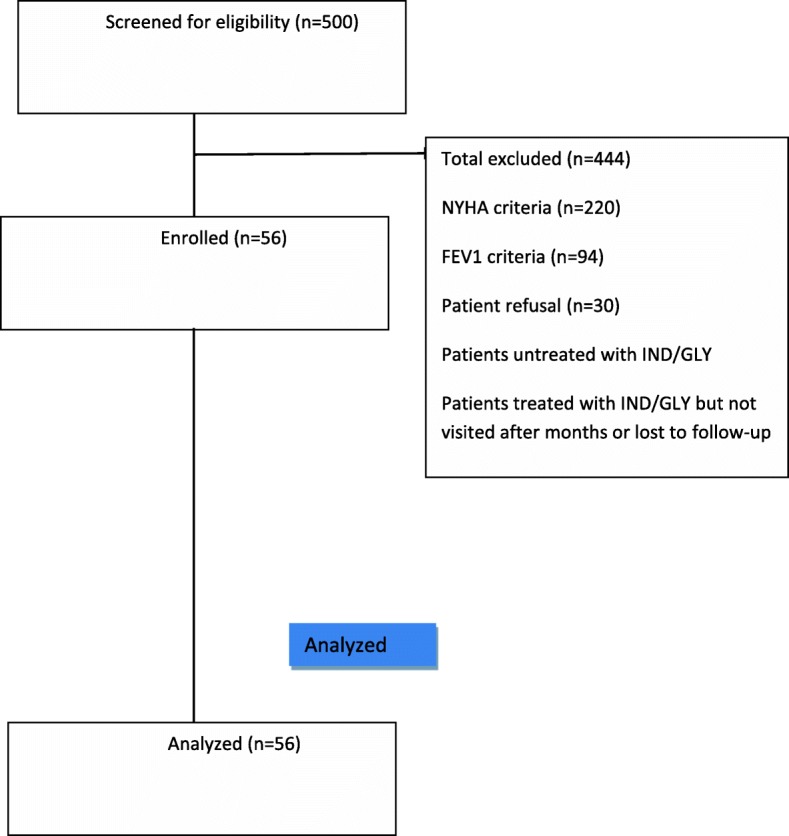
We enrolled 56 patients with a history of HF (New York Heart Association [NYHA] classes II and III) and stable COPD. We evaluated blood samples, clinical assessment, echocardiograms and basal spirometry at baseline and after 6 months of therapy with indacaterol/glycopirronium. In addition, the number of re-hospitalizations during the treatment period was evaluated.
The treatment was well tolerated. Brain natriuretic peptide (BNP) levels were significantly reduced compared with baseline (p < 0.001) after 6 months of treatment, and a higher percentage of patients improved their clinical status compared with baseline (p < 0.001). Minor changes were noted in the hemodynamic and metabolic parameters. Significant improvements in the echocardiographic parameters were noted in HF with reduced ejection fraction (HFrEF) patients. All respiratory parameters (forced expiratory volume in 1 s [FEV1], FEV1/forced vital capacity [FVC] ratio and COPD Assessment Test [CAT] scores) improved significantly (p < 0.001). No hospitalizations owing to HF or COPD exacerbation occurred. One patient died of respiratory failure.
Indacaterol/glycopirronium was well-tolerated and effective in the treatment of COPD in this cohort of patients with a history of HF. Further studies are needed to clarify whether this compound can have a direct role in improving overall cardiovascular function.
慢性阻塞性肺疾病(COPD)和心力衰竭(HF)常同时存在。此外,老年 HF 患者中 COPD 的发病率更高,这使他们的临床情况更加复杂。茚达特罗/格隆溴铵在 COPD 的治疗中显示出益处,且对心血管系统的不良影响较少。我们评估了该治疗方案在有 HF 病史的患者中的安全性和疗效。
我们纳入了 56 名有 HF 病史(纽约心脏协会 [NYHA] Ⅱ级和Ⅲ级)和稳定 COPD 的患者。我们在基线和治疗 6 个月后评估了血液样本、临床评估、超声心动图和基础肺功能。此外,还评估了治疗期间的再住院次数。
该治疗方案耐受良好。与基线相比,治疗 6 个月后脑钠肽(BNP)水平显著降低(p<0.001),与基线相比,有更高比例的患者临床状况得到改善(p<0.001)。血流动力学和代谢参数有轻微变化。射血分数降低的心力衰竭(HFrEF)患者的超声心动图参数有显著改善。所有呼吸参数(1 秒用力呼气量 [FEV1]、FEV1/用力肺活量 [FVC] 比值和 COPD 评估测试 [CAT] 评分)均显著改善(p<0.001)。无因 HF 或 COPD 恶化而导致的住院。1 例患者因呼吸衰竭死亡。
在该 HF 病史患者队列中,茚达特罗/格隆溴铵治疗 COPD 耐受良好且有效。需要进一步的研究来阐明该化合物是否能直接改善整体心血管功能。