Verma Babita K, Subramaniam Pushpavanam, Vadigepalli Rajanikanth
Daniel Baugh Institute for Functional Genomics/Computational Biology, Department of Pathology, Anatomy, and Cell Biology, Thomas Jefferson University, Philadelphia, PA, USA.
Department of Chemical Engineering, Indian Institute of Technology-Madras, Chennai, India.
BMC Syst Biol. 2019 Jan 16;13(1):9. doi: 10.1186/s12918-019-0678-y.
Liver has the unique ability to regenerate following injury, with a wide range of variability of the regenerative response across individuals. Existing computational models of the liver regeneration are largely tuned based on rodent data and hence it is not clear how well these models capture the dynamics of human liver regeneration. Recent availability of human liver volumetry time series data has enabled new opportunities to tune the computational models for human-relevant time scales, and to predict factors that can significantly alter the dynamics of liver regeneration following a resection.
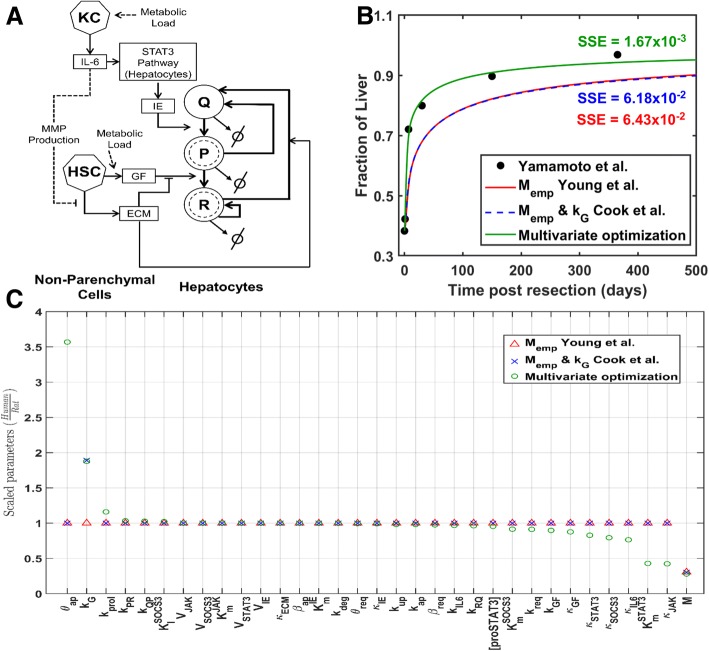
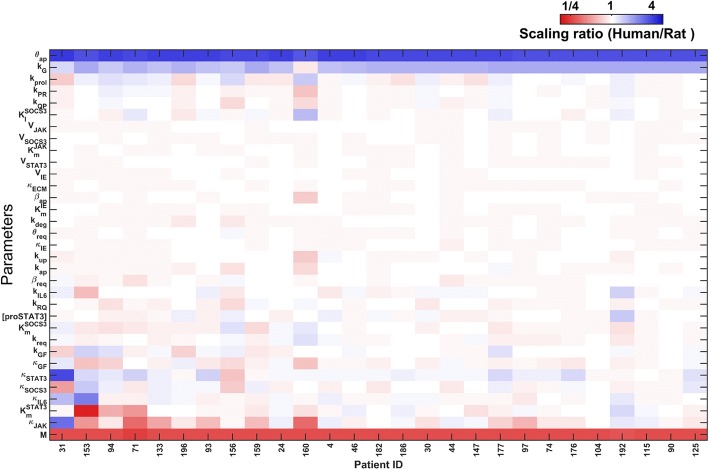
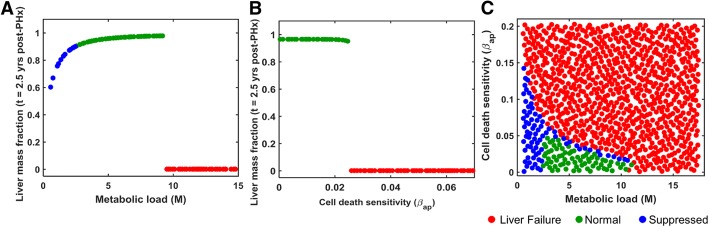
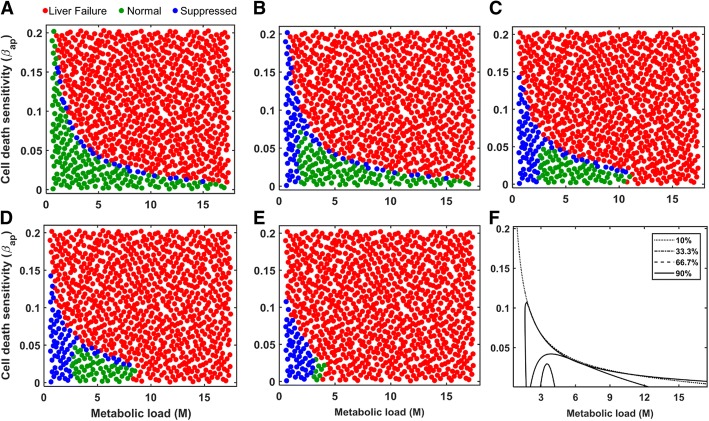
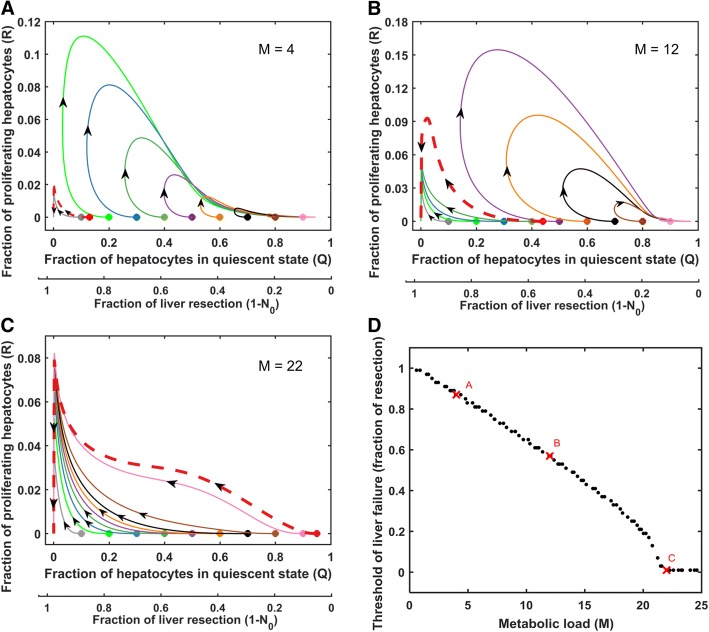
We utilized a mathematical model that integrates signaling mechanisms and cellular functional state transitions. We tuned the model parameters to match the time scale of human liver regeneration using an elastic net based regularization approach for identifying optimal parameter values. We initially examined the effect of each parameter individually on the response mode (normal, suppressed, failure) and extent of recovery to identify critical parameters. We employed phase plane analysis to compute the threshold of resection. We mapped the distribution of the response modes and threshold of resection in a virtual patient cohort generated in silico via simultaneous variations in two most critical parameters.
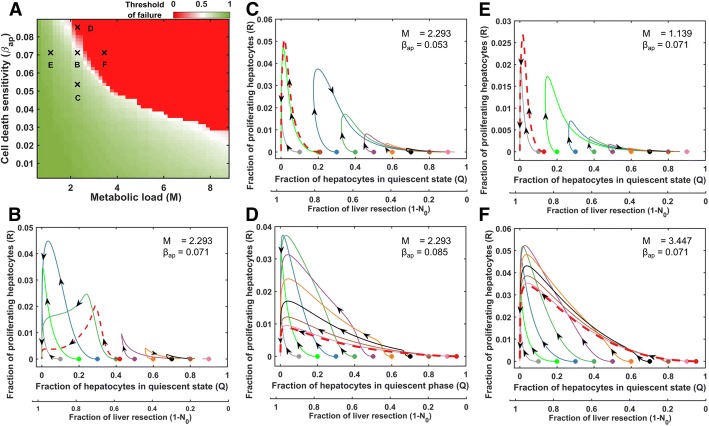
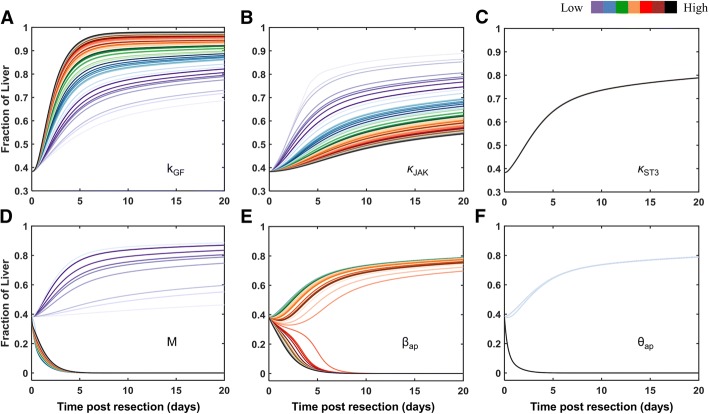
Analysis of the responses to resection with individual parameter variations showed that the response mode and extent of recovery following resection were most sensitive to variations in two perioperative factors, metabolic load and cell death post partial hepatectomy. Phase plane analysis identified two steady states corresponding to recovery and failure, with a threshold of resection separating the two basins of attraction. The size of the basin of attraction for the recovery mode varied as a function of metabolic load and cell death sensitivity, leading to a change in the multiplicity of the system in response to changes in these two parameters.
Our results suggest that the response mode and threshold of failure are critically dependent on the metabolic load and cell death sensitivity parameters that are likely to be patient-specific. Interventions that modulate these critical perioperative factors may be helpful to drive the liver regenerative response process towards a complete recovery mode.
肝脏具有损伤后再生的独特能力,个体间再生反应存在广泛的变异性。现有的肝脏再生计算模型很大程度上是根据啮齿动物数据进行调整的,因此尚不清楚这些模型对人类肝脏再生动态的捕捉程度如何。近期人类肝脏体积测量时间序列数据的可得性为在与人类相关的时间尺度上调整计算模型以及预测可显著改变肝切除术后肝脏再生动态的因素提供了新机会。
我们使用了一个整合信号传导机制和细胞功能状态转变的数学模型。我们采用基于弹性网络的正则化方法来确定最佳参数值,从而调整模型参数以匹配人类肝脏再生的时间尺度。我们首先单独研究每个参数对反应模式(正常、抑制、失败)和恢复程度的影响,以确定关键参数。我们采用相平面分析来计算切除阈值。我们通过同时改变两个最关键的参数,在计算机模拟生成的虚拟患者队列中绘制反应模式分布和切除阈值。
对单个参数变化的切除反应分析表明,切除后的反应模式和恢复程度对两个围手术期因素的变化最为敏感,即代谢负荷和部分肝切除术后的细胞死亡。相平面分析确定了对应于恢复和失败的两个稳态,切除阈值将两个吸引域分开。恢复模式吸引域的大小随代谢负荷和细胞死亡敏感性而变化,导致系统的多重性随这两个参数的变化而改变。
我们的结果表明,反应模式和失败阈值关键取决于可能因患者而异的代谢负荷和细胞死亡敏感性参数。调节这些关键围手术期因素的干预措施可能有助于推动肝脏再生反应过程走向完全恢复模式。