Australian Research Council Centre of Excellence for Mathematical and Statistical Frontiers, School of Mathematical Sciences, Queensland University of Technology, Brisbane, Queensland, Australia.
Basque Center for Applied Mathematics, Bilbao, Spain.
Sci Adv. 2018 Jan 10;4(1):e1701676. doi: 10.1126/sciadv.1701676. eCollection 2018 Jan.
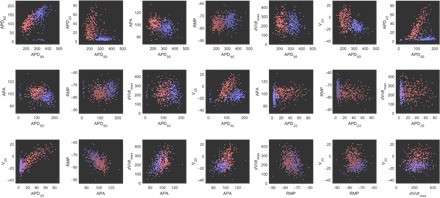
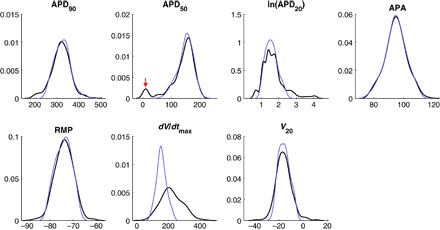
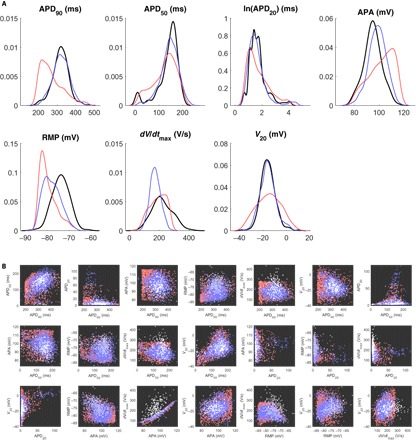
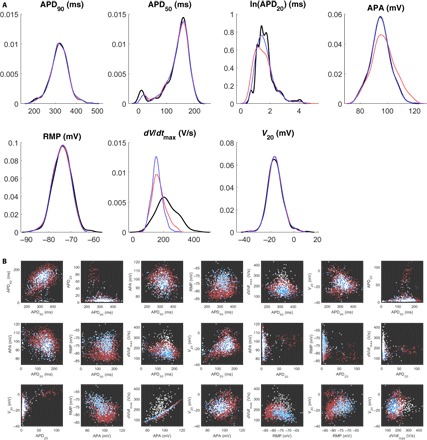
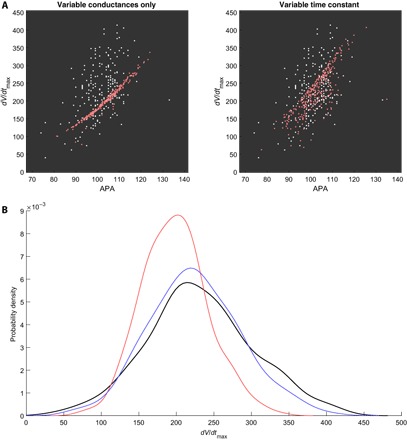
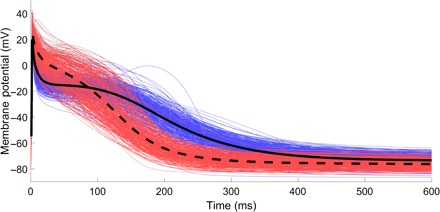
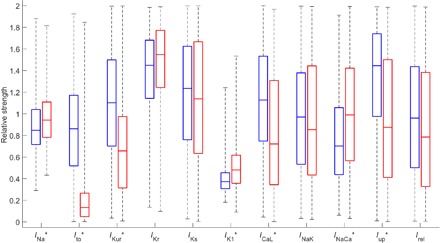
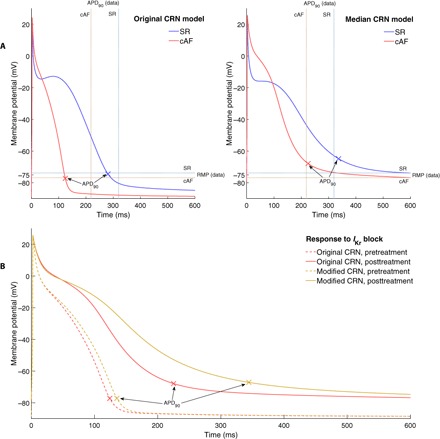
The understanding of complex physical or biological systems nearly always requires a characterization of the variability that underpins these processes. In addition, the data used to calibrate these models may also often exhibit considerable variability. A recent approach to deal with these issues has been to calibrate populations of models (POMs), multiple copies of a single mathematical model but with different parameter values, in response to experimental data. To date, this calibration has been largely limited to selecting models that produce outputs that fall within the ranges of the data set, ignoring any trends that might be present in the data. We present here a novel and general methodology for calibrating POMs to the distributions of a set of measured values in a data set. We demonstrate our technique using a data set from a cardiac electrophysiology study based on the differences in atrial action potential readings between patients exhibiting sinus rhythm (SR) or chronic atrial fibrillation (cAF) and the Courtemanche-Ramirez-Nattel model for human atrial action potentials. Not only does our approach accurately capture the variability inherent in the experimental population, but we also demonstrate how the POMs that it produces may be used to extract additional information from the data used for calibration, including improved identification of the differences underlying stratified data. We also show how our approach allows different hypotheses regarding the variability in complex systems to be quantitatively compared.
对复杂物理或生物系统的理解几乎总是需要对这些过程的基础变异性进行描述。此外,用于校准这些模型的数据也可能经常表现出相当大的可变性。最近一种处理这些问题的方法是针对实验数据,对模型种群(POM)进行校准,即对单个数学模型的多个副本进行校准,但参数值不同。迄今为止,这种校准在很大程度上仅限于选择能够产生输出值落在数据集范围内的模型,而忽略了数据中可能存在的任何趋势。我们在这里提出了一种新颖而通用的方法,用于根据数据集内一组测量值的分布来校准 POM。我们使用基于窦性节律 (SR) 或慢性心房颤动 (cAF) 患者心房动作电位读数差异的数据集和人类心房动作电位的 Courtemanche-Ramirez-Nattel 模型,演示了我们的技术。我们的方法不仅准确地捕捉了实验群体中固有的变异性,还展示了它生成的 POM 如何从用于校准的数据中提取额外信息,包括改进对分层数据基础差异的识别。我们还展示了我们的方法如何允许对复杂系统中变异性的不同假设进行定量比较。