Balsara Dinshaw S
Physics and ACMS Departments, University of Notre Dame, Notre Dame, IN USA.
Living Rev Comput Astrophys. 2017;3(1):2. doi: 10.1007/s41115-017-0002-8. Epub 2017 Dec 11.
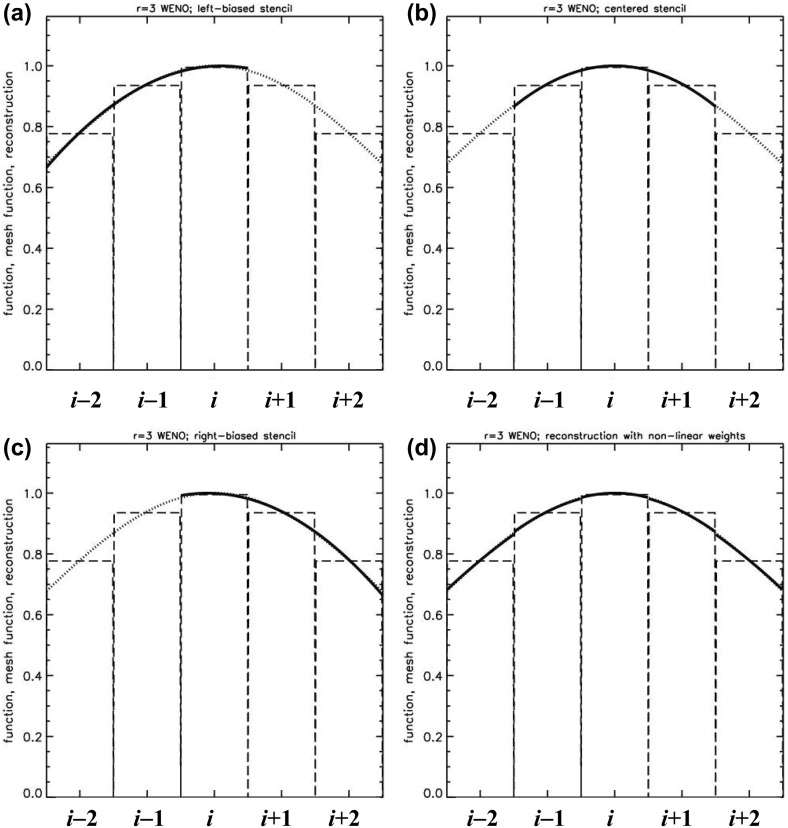
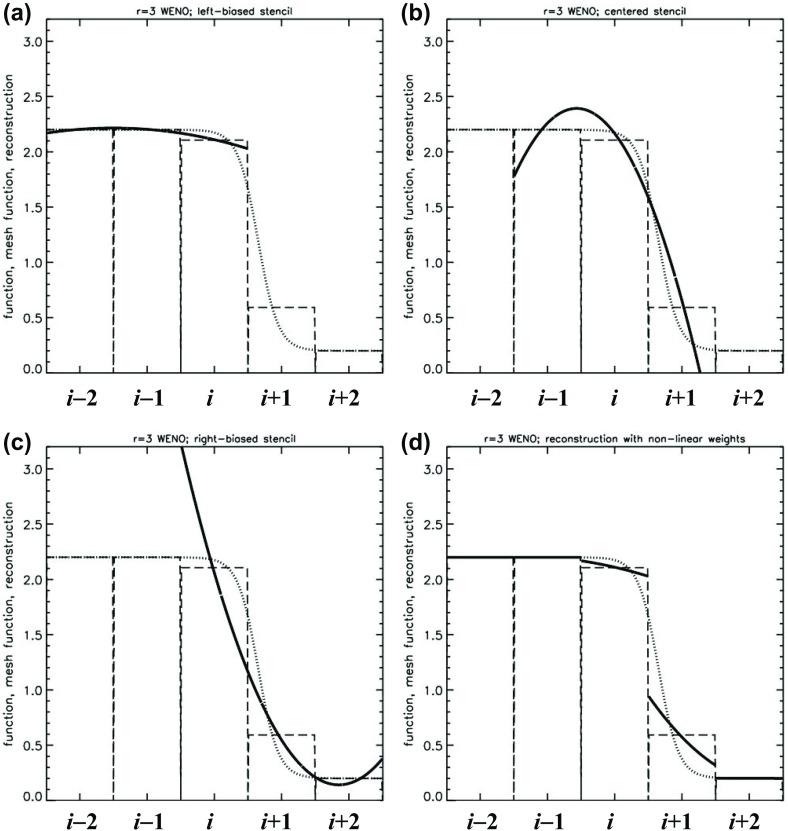
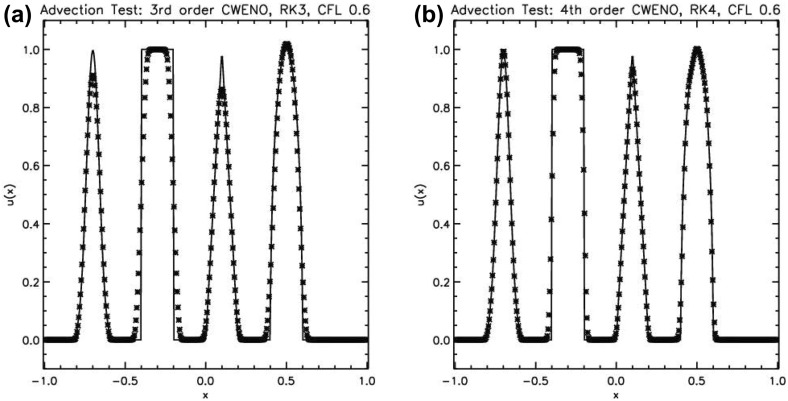
As computational astrophysics comes under pressure to become a precision science, there is an increasing need to move to high accuracy schemes for computational astrophysics. The algorithmic needs of computational astrophysics are indeed very special. The methods need to be robust and preserve the positivity of density and pressure. Relativistic flows should remain sub-luminal. These requirements place additional pressures on a computational astrophysics code, which are usually not felt by a traditional fluid dynamics code. Hence the need for a specialized review. The focus here is on weighted essentially non-oscillatory (WENO) schemes, discontinuous Galerkin (DG) schemes and PNPM schemes. WENO schemes are higher order extensions of traditional second order finite volume schemes. At third order, they are most similar to piecewise parabolic method schemes, which are also included. DG schemes evolve all the moments of the solution, with the result that they are more accurate than WENO schemes. PNPM schemes occupy a compromise position between WENO and DG schemes. They evolve an Nth order spatial polynomial, while reconstructing higher order terms up to Mth order. As a result, the timestep can be larger. Time-dependent astrophysical codes need to be accurate in space and time with the result that the spatial and temporal accuracies must be matched. This is realized with the help of strong stability preserving Runge-Kutta schemes and ADER (Arbitrary DERivative in space and time) schemes, both of which are also described. The emphasis of this review is on computer-implementable ideas, not necessarily on the underlying theory.
随着计算天体物理学面临着成为一门精确科学的压力,对于计算天体物理学而言,转向高精度格式的需求日益增加。计算天体物理学的算法需求确实非常特殊。这些方法需要稳健且保持密度和压力的正值性。相对论性流应保持亚光速。这些要求给计算天体物理学代码带来了额外的压力,而传统流体动力学代码通常不会感受到这些压力。因此需要进行专门的综述。这里重点关注加权本质无振荡(WENO)格式、间断伽辽金(DG)格式和PNPM格式。WENO格式是传统二阶有限体积格式的高阶扩展。在三阶时,它们与也包含在内的分段抛物线方法格式最为相似。DG格式演化解的所有矩,结果是它们比WENO格式更精确。PNPM格式在WENO格式和DG格式之间占据折衷位置。它们演化一个N阶空间多项式,同时重构高达M阶的高阶项。结果,时间步长可以更大。与时间相关的天体物理代码需要在空间和时间上都精确,结果是空间和时间精度必须匹配。这借助于强稳定性保持龙格 - 库塔格式和ADER(时空任意导数)格式来实现,这两种格式也会进行描述。本综述的重点是计算机可实现的思想,不一定是基础理论。