Lee Boram, Leem Jungtae, Kim Hyunho, Jo Hee-Geun, Yoon Sang-Hoon, Shin Aesook, Sul Jae-Uk, Choi Ye-Yong, Yun Younghee, Kwon Chan-Young
Department of Korean Medicine, Kyung Hee University Korean Medicine Hospital at Gangdong, Seoul.
Chung-Yeon Medical Institute, Gwangju.
Medicine (Baltimore). 2019 Jan;98(3):e14145. doi: 10.1097/MD.0000000000014145.
This systematic review protocol describes the methods that will be used to evaluate the efficacy and safety of herbal medicine in treating traumatic brain injury.
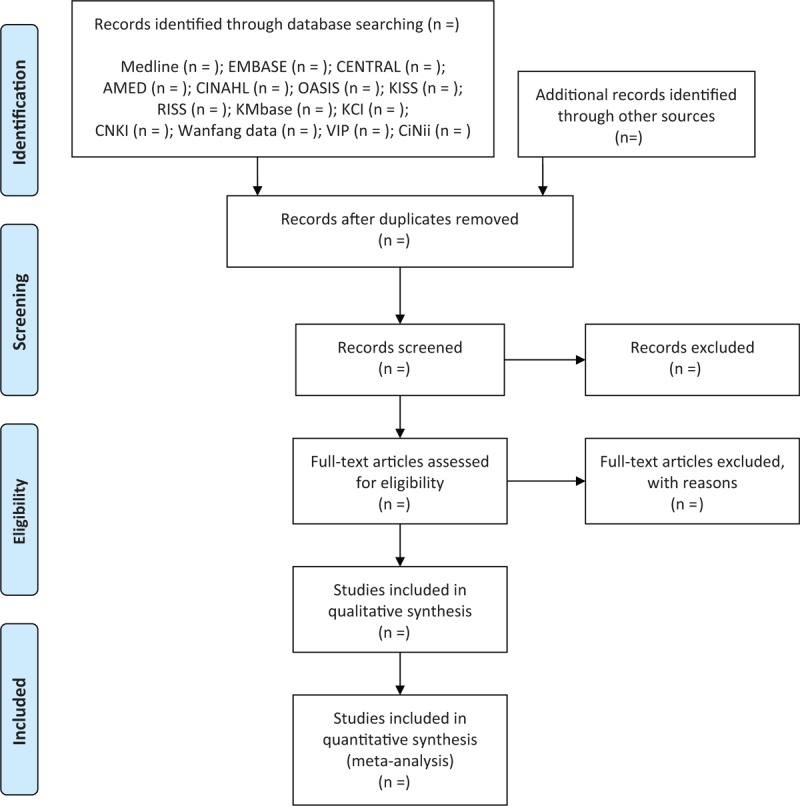
The following electronic databases will be searched up to December 2018 without language or publication status restrictions: Medline, EMBASE, the Cochrane Central Register of Controlled Trials, Allied and Complementary Medicine Database, and Cumulative Index to Nursing and Allied Health Literature. We will also search Korean, Chinese, and Japanese databases. Any randomized controlled trials related to herbal medicine for traumatic brain injury will be included. The functional outcome, consciousness state, morbidity, and mortality will be assessed as primary outcomes. The quality of life, adverse events, and total effective rate will be evaluated as secondary outcomes. Two researchers will independently perform the study selection, data extraction, assessment of study quality, and evaluation of the quality of evidence for the main findings. Data synthesis and analysis will be performed using RevMan version 5.3. The results will be expressed as a risk ratio for the binary outcome and as the mean difference or standardized mean difference for a continuous outcome. We will synthesize the data by either fixed effects or random effects model according to a heterogeneity test or the number of studies included in the meta-analysis. The methodological quality of the included studies will be evaluated using the Cochrane Collaboration's risk of bias tool. The quality of evidence for each main outcome will be evaluated using the Grading of Recommendations Assessment, Development, and Evaluation approach.
Ethical approval is not required because individual patient data are not included. The findings of this systematic review will be disseminated through a peer-reviewed publication or conference presentations.
CRD42018116559.
本系统评价方案描述了用于评估草药治疗创伤性脑损伤的疗效和安全性的方法。
将检索以下电子数据库至2018年12月,不受语言或出版状态限制:医学索引数据库(Medline)、荷兰医学文摘数据库(EMBASE)、考克兰对照试验中心注册库、联合与补充医学数据库以及护理学与健康相关文献累积索引。我们还将检索韩语、中文和日语数据库。将纳入任何与草药治疗创伤性脑损伤相关的随机对照试验。将功能结局、意识状态、发病率和死亡率作为主要结局进行评估。将生活质量、不良事件和总有效率作为次要结局进行评估。两名研究人员将独立进行研究选择、数据提取、研究质量评估以及主要研究结果的证据质量评估。将使用RevMan 5.3版进行数据合成和分析。结果将以二分类结局的风险比以及连续结局的均值差或标准化均值差表示。我们将根据异质性检验或荟萃分析中纳入的研究数量,采用固定效应或随机效应模型对数据进行合成。将使用考克兰协作网的偏倚风险工具评估纳入研究的方法学质量。将使用推荐分级的评估、制定与评价方法评估每个主要结局的证据质量。
由于不纳入个体患者数据,因此无需伦理批准。本系统评价的结果将通过同行评审出版物或会议报告进行传播。
国际前瞻性系统评价注册平台(PROSPERO)注册号:CRD42018116559。